
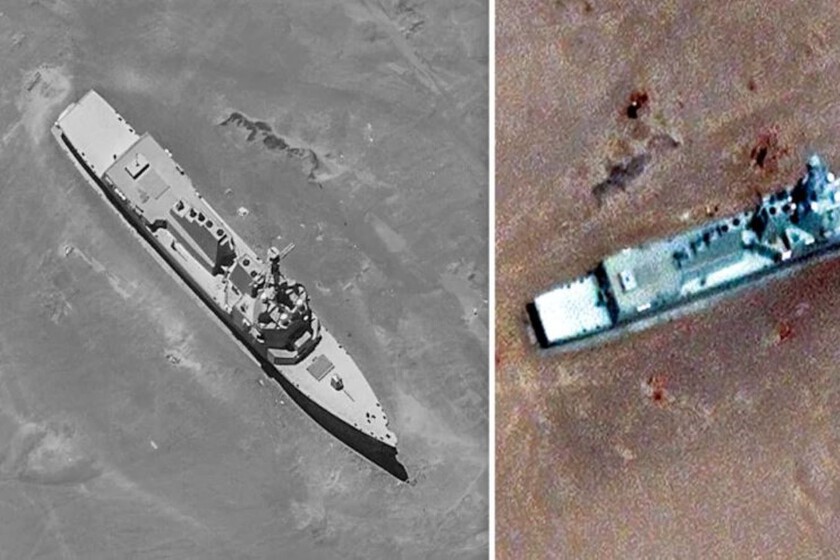
China has built a 155-meter replica of an American destroyer of the Arleigh Burke class for the Navy in one of the most unlikely places: the desert. The vessel was spotted last June by a satellite at a remote Chinese missile-testing facility and is not designed to sail.
Specifically, the structure sits at the Ruoqiang test range in Xinjiang (about 2,700 km from the nearest ocean) and faithfully recreates much of the features of a real destroyer, including the bridge, the mast, the armament, and the flight deck.
It isn’t the first time China has undertaken a project like this, but this time there is a significant difference: the level of detail in the replica marks a leap forward compared to the targets already built there.
The desert has become a laboratory for targeting American ships
The Arleigh Burke-class destroyers are among the U.S. Navy’s premier surface combatants and are equipped with the advanced Aegis combat system, which integrates radars, sensors, and weapons to detect and respond to threats with maximum precision. Their presence takes on particular significance in the Pacific due to the tensions between China and Taiwan: an island Beijing regards as part of its territory, around which it maintains increasing pressure.
In the event of an escalation, the US could deploy forces to the region and these destroyers could be part of them. Therefore, having embedded a replica of one of these ships allows the Chinese military to practice a very specific part of the problem: detecting, identifying, tracking, and attacking a moving American naval target. And also being able to maintain the tracking as it changes position.
Analysts cited by CNN specifically connect the new replica to China’s efforts to improve the accuracy of its hypersonic missiles. And China has been preparing for that scenario for a long time: the Ruoqiang facility had already been used to build targets related to anti-ship ballistic missile tests, including the ones known as the DF-21D or “carrier killers.”
In 2021, in addition to ship replicas, images also showed a target about 75 meters long mounted on rails six meters wide. These targets could be used to conduct detection and tracking tests, since a ship does not stay still waiting for a missile: the rails allow moving large targets and reproduce, at least partially, the maneuvering of a ship at sea.

And that is precisely one of the reasons these facilities are far more interesting than a mere target for missile launches. Now, with this new three-dimensional replica, the target can more faithfully reproduce the geometry and signature of a specific vessel, although CNN’s images alone do not reveal exactly what tests are being conducted.
And the destroyer isn’t alone…
The Taklamakan Desert has become a colossal catalog of military targets in recent years, as well as replicas of American aircraft carriers and destroyers. Satellite imagery shows reproductions of military installations, Taiwanese government buildings, fighter jets, and other structures related to potential adversaries.
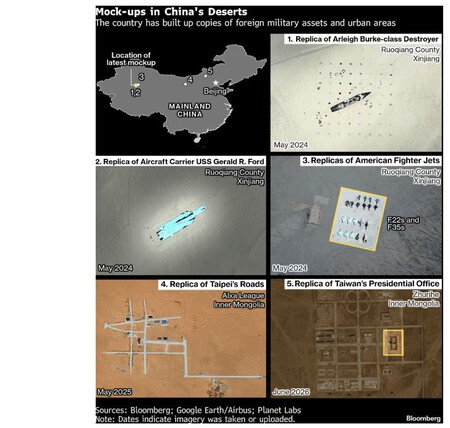
All of this aligns with China’s area-denial strategy (A2/AD), whose aim is to complicate the ability of an American force to operate close to its shores. It also explains why there may be value in dedicating so much effort to reproducing a destroyer, rather than focusing solely on an aircraft carrier: before reaching the fleet’s most valuable asset, you must overcome the ships that escort and protect it.
Images | CNN, Bloomberg, Planet Labs, USNI