With electric cars, and more broadly the growing mass of vehicles we must compensate for, we’ve developed a bad habit: seeing high torque and horsepower figures on spec sheets and not batting an eye. But turning up the big horsepower isn’t without consequences, and this inflation feeds price increases. There’s no secret: settling for less lightens the bill. The catch is whether the “less” is enough!
Volkswagen T-Roc 1.5 eTSI 116 hp DSG7 Life: 116 hp and 200 Nm of torque
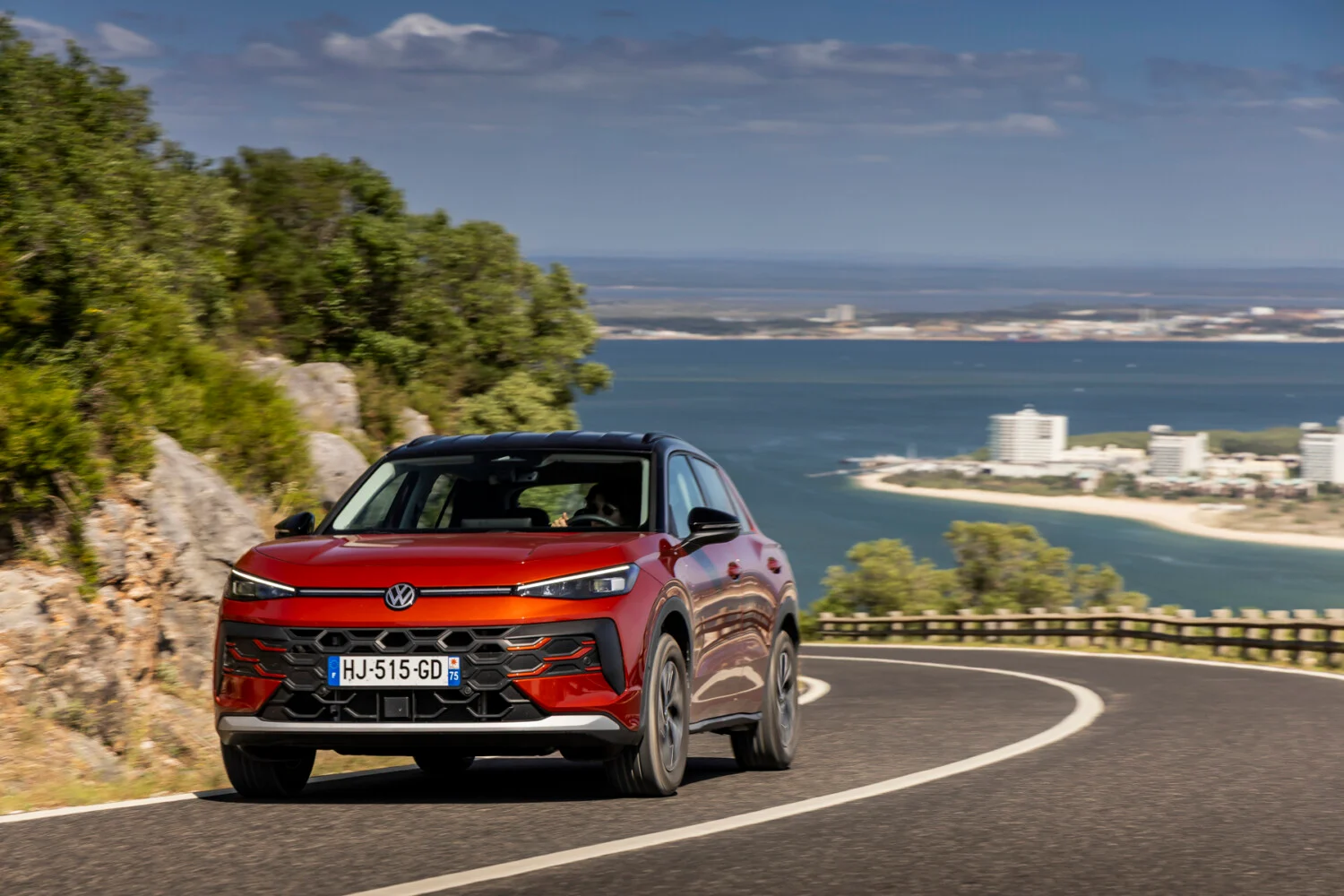
116 hp and 200 Nm of torque, even before the aforementioned weight rolling in, this pedigree already seemed modest. It’s all the more so when it’s paired with a curb weight over 3,000 pounds and a noticeably larger footprint. At 4.38 m (about 172 in) long, the T-Roc stays under 4.40 m on most occasions, a length that’s often treated as the line separating the B and C segments, but it’s unquestionably a “big small” SUV. The extra length comes because it now rides on the same platform as its bigger brother, the Tiguan.
Given that, the natural reflex is to think the best bet is the “big” engine, namely the same 1.5 eTSI Hybrid with 150 hp. With identical trims, the difference isn’t “just” €2,500 — a sum that can be manageable (especially when spread over a lease or loan) to avoid what many presume is a penalty.
But when it comes to the available trims, the minimum required price effectively jumps from €29,990 (entry 116 hp eTSI Hybrid) to… €41,000, the starting price for a 150 hp T-Roc eTSI Hybrid: it’s a different story now. I’ll try to reassure some readers… or perhaps not!
Volkswagen T-Roc 1.5 eTSI 116 ch DSG7 Life: never the feeling of being underpowered
On the long, straight roads slicing through southern Spain, we never felt the T-Roc was in distress. And especially not in the Sierra de Aracena y Picos de Aroche natural park. To be precise: I’m not saying the 116 hp T-Roc eTSI is a lively little animal and that 34 hp more or less wouldn’t change things. The stopwatch tells a different story. The less powerful version is 2.2 seconds slower to 0–60 mph, and the gap stretches to more than 3 seconds in the 1,000-meter standing-start sprint — that’s not trivial. But since the T-Roc doesn’t have a track-ready personality to begin with, the real difference in feel behind the wheel isn’t dramatic. It’s only when you want to pull a fairly spirited overtake that it’s noticeably lacking. Add to that the 1.5’s faithful companion, the DSG7 transmission — famed for its smoothness and lack of jolts — which isn’t exactly the most reactive dual-clutch. Its gearing is tuned more for lowering consumption than chasing performance. The Sport mode is a touch more responsive, but it mostly raises the decibel meter more than the actual sportiness on offer.
Volkswagen T-Roc 1.5 eTSI 116 ch DSG7 Life: mechanical smoothness
In short, the T-Roc won’t pin you to the seat, but it has other strengths. Namely, the smoothness of its mechanical drivetrain, comfort, and welcoming ambiance. Opting for the more modest engine doesn’t force you to compromise. On the contrary. With simple 16-inch wheels—plus a stout 60-series sidewall—the little VW doesn’t pretend to be nimble or athletic, but it’s certainly comfortable. And that with no gimmicks, since the Life trim can’t be equipped with adaptive suspension. With slightly more refined insulation, we’d be fully satisfied. Using a smaller engine doesn’t prevent it from looking good, even in its understated Life trim. Don’t expect flash or drama, but the progress in material choices won’t escape the eyes of today’s first-generation owners. Following the current trend, the effect is achieved with fabric-look finishings that aren’t entirely sure how they’ll stand up over time, but for now it’s a success. The enormous 12.9-inch central touchscreen, now standard from Life (versus 10.3 inches on the base), also enhances the interior vibe. It provides intuitive access to all on-board functions, including the climate control. And note that the climate controls remain accessible, almost like true physical buttons.
Volkswagen T-Roc 1.5 eTSI 116 ch DSG7 Life: not a paragon of virtue
Practicality-wise, there’s no sliding rear bench (a Tiguan feature) to slightly boost cargo volume in certain situations. As it stands, the boot is already among the largest in its class (470 liters). The front-passenger seat folds down, and the cargo floor is adjustable, helping in some cases. Moreover, the extra exterior space translates to more room inside for passengers — for example, it has more interior space than a Peugeot 3008, to name one rival — and gives the T-Roc real family-friendly appeal. On the other hand, even in this version the T-Roc isn’t a paragon of virtue. Yes, it sits at a lower price than its more powerful twin, which is welcome. And as noted above, it’s offered in trims that aren’t available on the 150 hp model. But at €33,500 in Life trim, which addresses some of the equipment gaps of the entry price, it remains in the upper tier of the urban-SUV segment. It’s a touch less true if you widen the lens to include compact SUVs, where its size and comfort bring it closer to that class’s standards — a convenient way to swallow the pill.
Volkswagen T-Roc 1.5 eTSI 116 ch DSG7 Life: a bit profligate in daily use
Unfortunately, it remains a touch thirsty in daily use. Still less so than its 150 hp sibling, but in 2026 an average over 6.4 L/100 km (roughly 37 mpg US) is no longer something to brag about, even if that’s around 0.4 L/100 km better than the 150 hp version. Noting that highway driving proves the most reasonable scenario — provided you keep your right foot light, which says a lot about the engine’s tuning and the transmission’s gearing. The 48-volt mild-hybrid system helps lessen the sting, but the 48V alternator-starter is somewhat dated by today’s standards and isn’t enough to bring consumption down to the levels achieved by non-rechargeable hybrids that many rivals offer. In fact, the T-Roc, along with the Golf, is set to be VW’s first to showcase the new non-rechargeable hybrid setup. The best move might be to wait a few more weeks before placing an order; the best T-Roc may still be ahead of us.
Volkswagen T-Roc 1.5 eTSI 116 ch DSG7 Life: its upsides?
- Intuitive ergonomics
- Interior space and comfort
- Soft, easy-to-use controls
Volkswagen T-Roc 1.5 eTSI 116 ch DSG7 Life: its downsides?
- Fuel consumption
- Placidity of handling
- Performance
Auto-Journal verdict: 3.5/5
As we await the upcoming all-hybrid powertrain, this T-Roc eTSI 116 hp is probably the most pragmatic choice in the lineup. It isn’t a hunter-killer, but it delivers enough power without compromising its core strengths: comfort and interior space.
Find our road-trip test of the Volkswagen T-Roc 1.5 eTSI 116 hp DSG7 Life in Auto-Journal issue no. 1212, dated June 25, 2026.