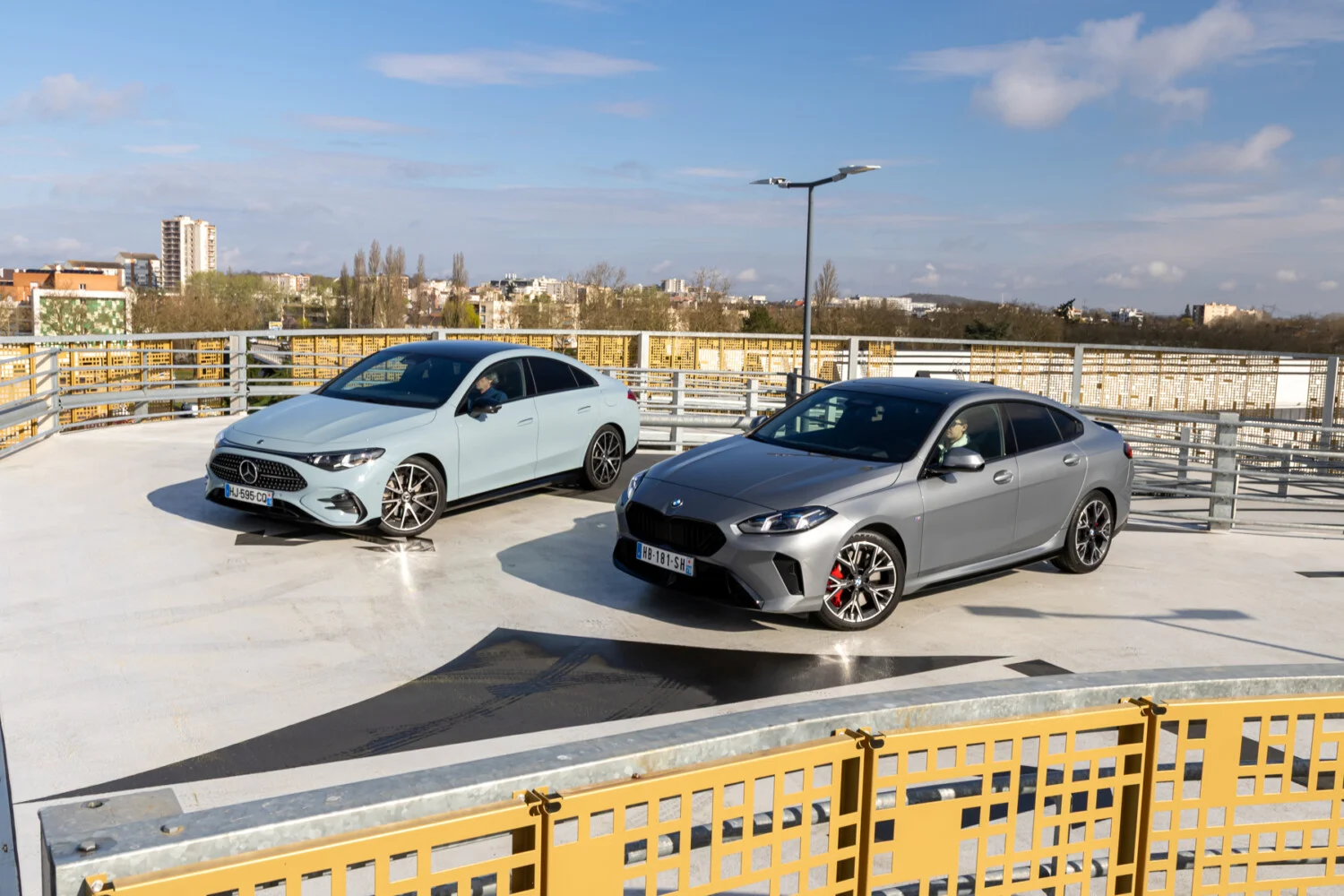
Originally launched as an electric model, the third generation of the Mercedes CLA broadened its lineup with hybrid versions to reach a wider audience. From the start, the CLA has played the “four-door coupé” card, a body style that Mercedes had kicked off a few years earlier with the CLS. Yet while the first two CLA generations relied on the same platform as their contemporaries in the A-Class range, the third generation benefits from a dedicated undercarriage capable of accommodating either 100% electric or internal-combustion versions like the one we tested. Its direct rival in the four-door coupé category, the BMW 2 Series Gran Coupé, shares its platform with the 1 Series and does not come in a 100% electric version.
Its powertrain is electrified with a 48 V mild-hybrid system, the 2 Series 220 using a turbocharged 3-cylinder petrol engine also found in X1, 1 Series, or Mini Countryman. In contrast, the CLA is grounded in a four-cylinder setup, which should, on paper at least, deliver smoother operation.
Mercedes CLA vs BMW 2 Series Gran Coupé: What’s it like inside?
But before confirming engine smoothness, let’s take a seat. The two cars share frameless windows on all four doors, a clear nod to their coupe-citizenship.
In the CLA, the massive digital cockpit in front of the driver immediately catches the eye: a 10.25‑inch instrument cluster followed by two 14‑inch screens, one of which is reserved for the passenger. Spectacular!
The CLA also showcases backlit, aesthetically pleasing vents for night driving, but there are only two of them, versus four in the A-Class and as many as five in the C-Class. When getting inside, there is one notable ergonomic misstep that spoils the mood: in our test car with power-adjustable seats whose controls sit on the inner door panel, you must reach to the central screen to adjust the lumbar support. Two separate places to adjust the seat—there must be a simpler way!
In the same vein, Mercedes has fallen into the trap of copying the three-button-for-four-windows scheme first seen on the VW ID.3: two buttons to operate the windows on the right and left, and one switch to toggle between the front and rear windows. Copying mediocre concepts is a mistake!
With the driving position found, all that remains is to start, and to do so you simply press the brake and shift the “gear lever” to Drive. It’s as straightforward as in a Tesla or other electric models—except here there’s an internal combustion engine under the hood.
On the other hand, when you stop, put the car in P and exit—the car will shut off. Practical! The instrument cluster also earns points, offering several truly different displays, from full-screen GPS to retro-style gauges, whereas BMW’s variations are comparatively muted.
Speaking of the screen, the center display is responsive, the menus are reasonably well organized (lombard adjustment aside…), and it takes no more than two actions to dismiss the speed alert. At the rear, the legroom is a pleasant surprise: there’s plenty of space lengthwise. However, don’t plan on seating a passenger on the center rear seat, unless you want to punish them.
As for the trunk, it’s a traditional boot rather than a hatch, which limits access, but the volume is respectable at 425 liters. It’s a pity that, with 17 cm more length than the 2 Series Gran Coupé, the CLA’s trunk isn’t noticeably larger than its rival’s—it’s only 5 liters more!
Where the size difference is most evident is in the rear seats: the CLA offers about 5 cm more knee room than the BMW. However, the BMW’s front seats are well-contoured, leaving enough legroom. Headroom behind is tighter, with about 3 cm less in the Munich car: at 1.80 m (roughly 5’11”), you’ll feel it. That’s not the case in the Mercedes. Moving to the BMW’s front cabin, you’ll find only two screens—the center display is smaller (10.7 inches) than the CLA’s 14 inches.
No “wow” factor here, so the overall impression feels less modern than in the CLA (even though the car is barely a year old), but the ergonomics are better in everyday use, with easier-to-find controls and a more traditional layout. There are four window controls, the electric seat controls are grouped in one place, and there’s a single action required to start and stop the car… And yes, two taps are enough to disable the speed alert. But despite BMW’s superior ergonomics, the Mercedes comes out ahead in this “Inside Life” category thanks to more generous rear passenger space.
Mercedes CLA vs BMW 2 Series Gran Coupé: On the road?
Behind the wheel, the two cars remain distinctly different. Here’s the bad news for the CLA: despite its apparently smoother four-cylinder, it turned out to be the less refined in daily use, to put it bluntly. In fact, the management of hybridization proved capricious at low speeds, with jolts, sudden bursts of torque, and difficulty maintaining a steady pace in stop-and-go traffic. Surprising! And more disappointing is that once you’re past the low gears, the powertrain tends to deliver seamless transitions between fully electric and combustion modes.
That’s a key difference between the two cars: the Mercedes can run in zero-emission mode, albeit briefly, while the BMW always employs its three-cylinder for acceleration. The three-cylinder is well isolated from vibration and acoustic intrusion, dispelling concerns about its architecture. In terms of performance, both feel evenly matched in accelerations, overtaking, and highway speeds. The sensation of having a little extra power on tap is pleasant in either car. This holds up at high speeds as well, with quick revivals.
Where the Mercedes presents a very linear four-cylinder with little character, the BMW’s three-cylinder feels more progressive and lively. It’s not claiming any performance supremacy, but the driving experience feels more rewarding to the driver. The chassis dynamics reflect this too: the CLA is more comfortable but lacks real dynamism, while the 2 Series is firmer—especially at low speeds—and far more responsive. It’s evident at the first corner: the BMW’s front end feels more eager, requiring less steering input. The CLA, by contrast, feels a bit inert yet offers more suppleness. One caveat: over large potholes, the CLA can hit its stops more easily, resulting in harsher thumps. Comfort versus dynamism—this section could have ended in a tie, but Mercedes’ awkward low-speed hybrid behavior gives BMW the edge here.
Mercedes CLA vs BMW 2 Series Gran Coupé: Budget?
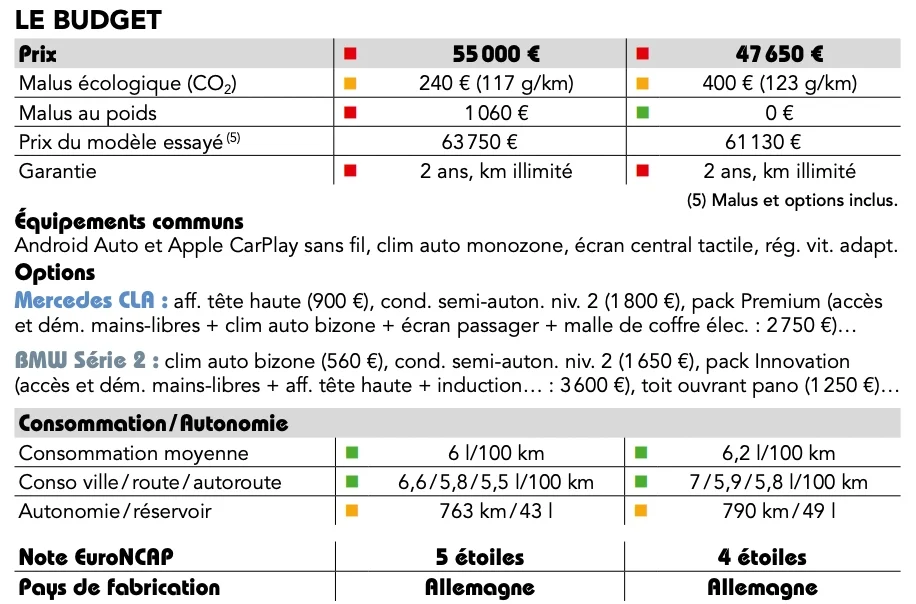
Last criterion to separate the rivals: price. Let’s not drag this out: with more than €7,000 in starting price difference in BMW’s favor, the Bavarian wins this round. Although it starts with a somewhat less equipped baseline, it remains cheaper on the whole once you add the options needed to catch up. So yes, you can get a cheaper CLA by stripping it down and loading the 2 Series with every option imaginable, but at parity of equipment, the Bavarian is the more “reasonable” choice—even if it pushes past the €50,000 mark.
Note, by the way, that the star-badged sedan adds more than €1,000 in weight-based penalties (it’s about 158 kg heavier on our scales), penalties the rival avoids. Even if the Mercedes drinks a little less fuel, it isn’t enough to reverse the trend: the average gap sits around 0.2 L/100 km, which is surprisingly small. Between a “full hybrid” capable of running mostly on electricity in city driving and a micro-hybrid that can’t, the difference in efficiency could have been larger. So it’s either BMW did a better job, or Mercedes misstepped—your call.
Finally, note that the CLA’s fuel tank holds 43 liters, enabling an estimated average range of about 763 km, compared with 790 km for the 2 Series, which does consume slightly more but can carry a 49 L tank of SP95/E10. Bon voyage potential for long-distance travelers!
Mercedes CLA 200 8G-eDCT 183 hp AMG Line: its pros
- Comfortable
- “Wow” factor inside
- Spaciousness
Mercedes CLA 200 8G-eDCT 183 hp AMG Line: its cons
- Hybrid management at low speed
- Ergonomic missteps
- Lack of dynamism
BMW 2 Series Gran Coupé 170 hp M Sport: its pros
- Driving pleasure
- Impeccable ergonomics
- More reasonable pricing
BMW 2 Series Gran Coupé 170 hp M Sport: its cons
- Outdated presentation?
- Low-speed ride comfort
- Limited rear headroom
Mercedes CLA vs BMW 2 Series Gran Coupé: verdicts?
- On the road: BMW 2 Series Gran Coupé 170 hp M Sport
- Inside Life: Mercedes CLA 200 8G-eDCT 183 hp AMG Line
- Budget: BMW 2 Series Gran Coupé 170 hp M Sport
The Auto-Journal’s pick: BMW 2 Series Gran Coupé 170 hp M Sport
The CLA’s standout interior presentation and solid comfort, underscored by generous rear space, are undeniable. Yet it stumbles with some awkward low-speed jolts and ergonomic missteps. In contrast, the BMW offers a more cohesive package and, for many, a more engaging drive—closer to what fans expect from the brand, in a sense.
Mercedes CLA 200 8G-eDCT 183 hp AMG Line vs BMW 2 Series Gran Coupé 170 hp M Sport: in measurements
Find our comparative test between the Mercedes CLA 200 8G-eDCT 183 hp AMG Line and the BMW 2 Series Gran Coupé 170 hp M Sport in Auto-Journal issue 1210 from May 28, 2026.