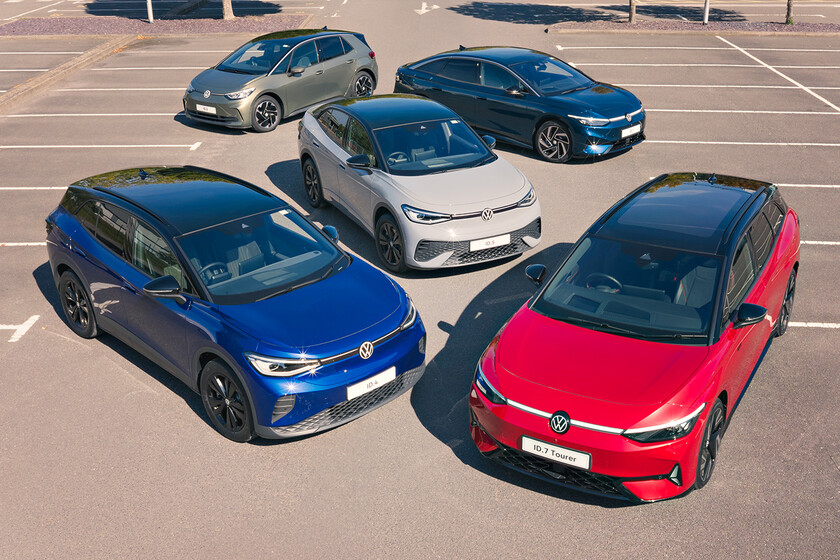
There were fears of massive layoffs of around 100,000 employees, but in the end, the blood did not flow. For now. The Volkswagen Group has officially unveiled its major relaunch plan for 2030 aimed at reducing losses. The German giant foresees factory closures, but above all the reduction of nearly half of the car models it offers worldwide (only the Volkswagen brand alone proposes 17 models with countless versions and finishes), with broadly simplified ranges.
The goal is to reduce production capacity and to sell only the models that perform best or generate the most margin.
There Aren’t Buyers for That Many Cars
Ultimately, Volkswagen has not announced mass layoffs, but rather a roadmap that anticipates further sacrifices. After a highly anticipated supervisory board meeting, the German group presented late Thursday the “next phase of its transformation,” which includes new cuts in production capacity and a thorough pruning of the lineup across all its brands, including Audi, Porsche, and Skoda, as well as the sale of prestige brands such as Ducati and Lamborghini.
The aim is to bring production to around 9 million units per year, in line with current sales. Before the pandemic, the group had an installed capacity of about 12 million vehicles per year. Since the end of 2024, it had already been implementing an adjustment aimed at reducing production by 2 million units.

“By 2030, we will transform the Volkswagen Group into the most attractive automotive company in the world.” This is the ambition that Oliver Blume, the group’s president, outlined yesterday, presenting one of the most ambitious and radical plans in Volkswagen’s history. Radical because it seeks to compensate for a black year for the manufacturer, which faces both Chinese competition in its home market, a country where the Volkswagen group has 35 factories, and the advance of those same brands in Europe.
This is complemented by a persistently declining demand since 2019 and a North American market that has tightened since Donald Trump decided to raise tariffs on European car imports. In short, the Volkswagen Group has no choice but to restructure quickly, as the profitability of some brands, such as Porsche, which barely turns a profit, has fallen to alarming levels. The main objective will be to gain agility at all levels: fewer factories, fewer employees, and fewer models.
“The range will be progressively rationalized by up to 50% and will focus on the most profitable segments. The complexity of the offering, especially the number of equipment options, will be reduced by up to 75%. This will allow concentrating investments in products and technologies that deliver the greatest added value to customers and the strongest contribution to the group,” the press release explains.
However, if fewer units are manufactured, fewer assembly lines and fewer factories are needed. Half of Europe’s car factories are operating at 50% capacity, and few brands can boast activity above 80% of capacity in their plants. Therefore, there is no alternative: Volkswagen will have to close plants.
The official statement’s silence contrasts with the leaks from Manager Magazin and Spiegel, which talk of up to 100,000 jobs affected worldwide and the closure of four plants (Hannover, Emden, and Zwickau of Volkswagen, and Neckarsulm of Audi), with internal schedules pointing to 2031, 2032, and 2034 respectively.
Underlying tensions are about corporate governance, between the state of Lower Saxony and the workers’ representatives on the supervisory board, and the Porsche-Piëch family, holding 32% of the capital through Porsche SE, pressing for deeper cuts — the same dynamic that in December 2024 halted plant closures in exchange for 35,000 layoffs agreed with IG Metall.
The union has responded with strikes at all German plants, defending co-determination as the mechanism that has so far prevented the most drastic closures, something that also affects the group’s 670,000 employees worldwide, including those at Seat and Cupra in Martorell and Landaben.
Thus, although the leaders do not address the social aspect in the meeting’s communiqué, it demonstrates the scale of the crisis facing the world’s second-largest automaker.
Images | Volkswagen