
Formula 1 has always been at the forefront of innovation, and it could hardly be otherwise when it comes to the implementation of artificial intelligence. In the new technical regulations, AI is not merely a support tool but directly carries technical responsibilities within a team. One of them, managing the deployment of the battery’s energy. It’s turning into a fiasco.
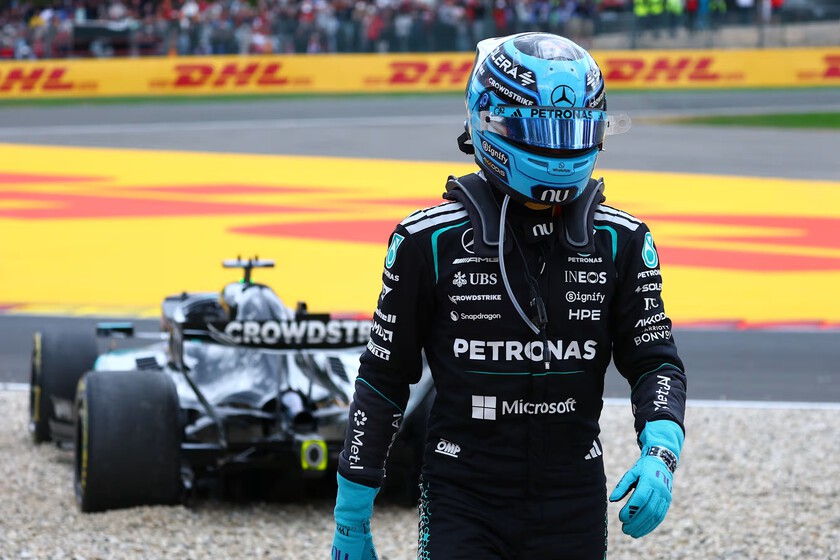
Last weekend at Spa, one of the title contenders, George Russell, had to retire due to a failure of the AI that manages his battery. It’s not the first time this has happened this season, and the drivers’ conclusion is universal: they are hostages to an algorithm that is starting to drive, and to err, for them.
An AI error took Russell out of the race at Spa
The 2026 season has one word as the main protagonist in Formula 1: battery. The deployment of energy is emerging as the key to the races, but there is a factor not everyone knows: who decides when that energy is deployed is not the driver, but an artificial intelligence that maps the circuit to use the battery in the most efficient possible way.
A measure that not only goes against the technical regulation, which clearly states that “the driver must drive the car himself”, but that is making the races noticeably worse. The AI learns during the weekend, and that is why in races, especially in the final laps, already all the cars deploy energy at practically the same points and overtaking becomes impossible.
But it is not the only problem the system is causing. There is something even worse than all the AIs from all teams doing the same: that an AI makes a mistake. That’s what happened to Russell at Spa, and it has cost him almost all the World Championship options he still had. The drivers complain that they are hostages to an algorithm.

After the start, Russell’s battery was completely drained in just a few metres, which left the Mercedes stranded on the immense Kemmel Straight, on which many cars overtook him. In the end, the action culminated in a touch with Lewis Hamilton and Russell’s retirement from the race, which he yelled so loudly on the radio that FOM censored it.
According to Russell, the self-learning system of his AI works worse than that of his teammate, Kimi Antonelli, and that is causing him to systematically lose two to three tenths on the straights with no way for him to solve it. He is not the only one affected. Oscar Piastri is in a similar situation at McLaren.
“The qualifying is decided by computers”, Piastri lamented in Spa. The lineup of drivers unhappy with the new Formula 1 already has hardly any flaws, and the fans don’t seem to be convinced by this bet on electricity and technologies that distance Formula 1 from what it is supposed to be: a competitive sport.
Images | Formula 1