
The South China Sea is one of the globe’s most geopolitically tense flashpoints. Located between China, the island of Taiwan and other territories such as the Philippines, Vietnam, or Malaysia, it is an area of great strategic value: a key maritime corridor for world trade. Its sovereignty has decades of ongoing dispute: China claims the vast majority of these waters under the so-called ‘nine-dash line’, while its neighbors reject it.
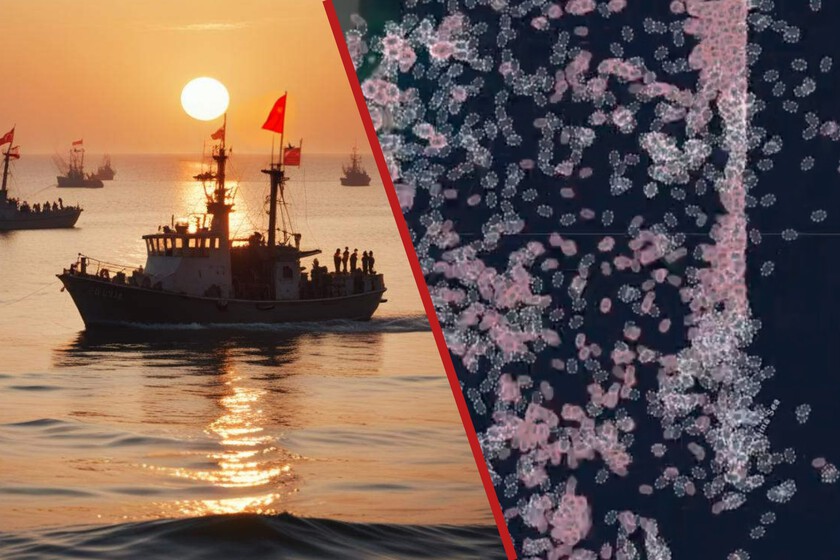
China maintains a constant presence there, with military maneuvers or routinely sending patrols from its Coast Guard. The most recent one in early July, tightening the line. But its pressure is not limited to military ships: it has also resorted to unusual practices, such as mobilizing thousands of fishing boats to form a ‘Great Wall’. Although military analysts suspect they could be more than mere fishing fleets.
Thousands of fishing vessels blocking the “grey zone”
This tension actually extends to all the seas in the area, both the South China Sea and the East China Sea, waters that separate the Chinese mainland from Taiwan and Japan. It has been in the latter where China has carried out suspicious deployments of fishing boats in recent months, in an unprecedented volume.
The most striking case was December 25, Christmas Day. More than 2,000 fishing vessels gathered forming two parallel inverted L-shapes, each about 400 km long extending toward the Japanese coasts. Each vessel was about 500 m from another in perfect formation. The movement drew attention: they maintained the formation for about 30 hours, enduring nearly hurricane-strength winds, before dispersing suddenly.
The second deployment with civilian ships arrived on January 11, 2026. According to The New York Times, about 1,400 Chinese fishing boats regrouped again, in total coordination, also in the East China Sea. On this occasion, the improvised ‘Great Fishing Wall’ stretched for about 300 km, forcing transport ships to dodge them or take a detour. The movement of these ships was captured by satellite imagery.
A kind of barrier mysteriously appeared at the entrance to Scarborough Reef, one of the hot spots in the South China Sea. Satellite images depicted this strange floating structure about 10 m in size between May 27 and 30. By June 1 it had disappeared. From Taiwan they pointed out that it was a new move by China.
Fishermen Who Are They Really Covert Military?
Maritime security experts say that behind these movements could lie the Chinese Maritime Militia: a supposed clandestine fleet run by the government of the People’s Republic to impose its control in these disputed waters without provoking a direct confrontation. China has denied its existence, and these activities, on several occasions.

According to Business Insider, the Pentagon concluded in a recent assessment of China’s military capabilities that “Beijing subsidizes various local and provincial commercial organizations to operate as ships of the Chinese Maritime Militia and carry out ‘official’ missions from time to time, apart from their usual civilian commercial activities“. They explain that they add workers from the maritime sector, usually fishermen, to bolster the People’s Liberation Army Navy (PLAN) and the China Coast Guard. Although their tasks center on fishing, they train them to mobilize when required.
The fact is that the strict, military-style training raises suspicions that they are not simple fishermen: “The scale, the geometry, the coordination, and the rapid assembly and dispersal of these formations are simply irreconcilable with normal fishing behavior,” explains Andrew S. Erickson, professor at the U.S. Naval War College and an expert on the Chinese Maritime Militia.
While China also carries out other openly announced operations to pressure the region. In early July, it announced the deployment of several of its Coast Guard ships east of Taiwan, once again escalating tensions with the island. According to Kuan Bi-ling, director of Taiwan’s Ocean Affairs Council, these movements are part of a strategy to control the “grey zone.” She also warned that with these actions China runs the risk of “triggering an international crisis.” “When several actions accumulate, a completely new status quo can be created,” she noted.
Images | EuroHub4sino, Business Insider on YouTube