
In brief
The 1994 Bugatti EB110 GT prototype, chassis C13, sold at auction for a record $3.8 million, underscoring a growing fascination with 1990s hypercars. This ultra-rare factory model, virtually unridden and impeccably preserved, stands out for its unique provenance and remarkable technical specifications. Its prototype status, low mileage, and meticulous configuration appeal to demanding collectors. The sale marks a turning point for the value of “modern classics,” drawing attention to Bugatti’s heritage before the Veyron era.
A 1990s supercar crossing the three-million mark was still the preserve of a few Ferraris or the McLaren F1. And yet a 1994 Bugatti EB110 GT has just shattered those benchmarks by selling for 3.8 million dollars at auction, more than about €3.5 million. The sum vaults it to the top tier of the hypercar market of that era and confirms that some pre‑Veyron icons have staged a serious comeback.
Behind this impressive figure lies not just any EB110, but a rare factory prototype, nearly untouched, which spent more than thirty years being shown rather than truly driven. This example, identified by its chassis number 39012 and nicknamed “C13”, weathered Bugatti’s bankruptcy, was revived by Dauer Racing, and spent a life as a show car under the spotlight, before becoming today one of the most valuable Bugatti EB110 GTs ever sold. A reason to take a closer look at what makes this C13 so special.
A 1994 Bugatti EB110 GT at 3.8 Million Dollars
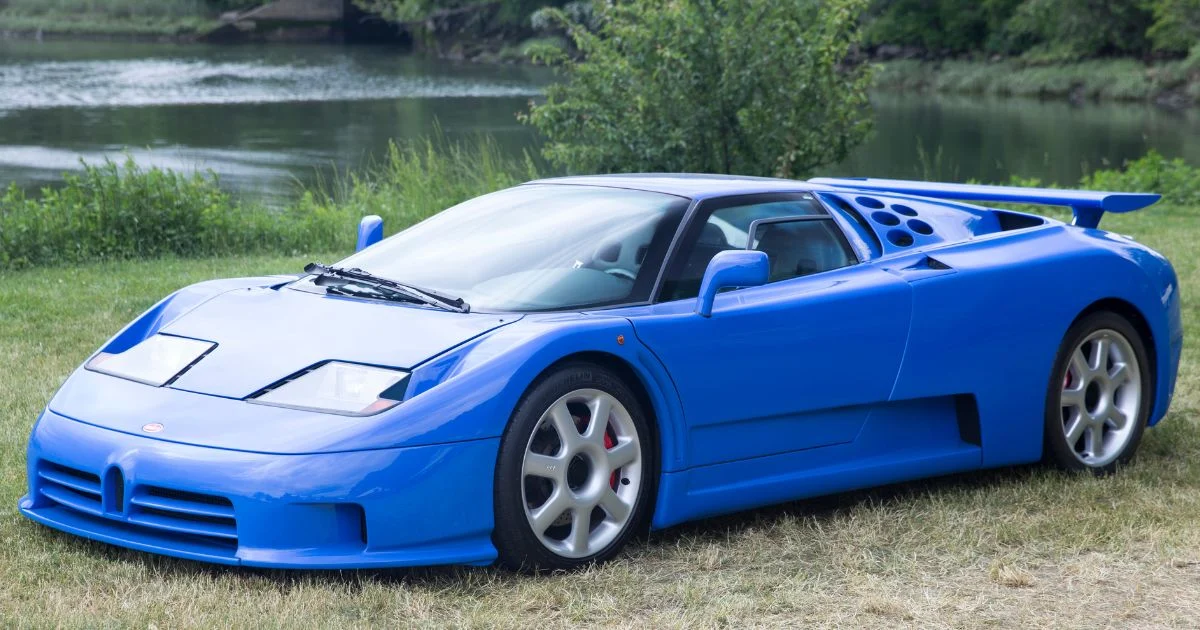
The car that just soared to 3.8 million dollars on dupontregistry.com is a 1994 Bugatti EB110 GT, carrying chassis number 39012. This second‑generation prototype, known by code “C13”, sits on a carbon‑fiber chassis developed with Aerospatiale, as is typical for the EB110 lineage. It belongs to a run of only 15 factory prototypes built, placing it in a very exclusive club. C13 was used as a display car and notably appeared at the Bologna Motor Show in 1992, a showcase of Bugatti’s renaissance in the early 1990s.
Following the manufacturer’s bankruptcy, the car was acquired by Jochen Dauer’s team, via Dauer Racing, which bought a portion of EB110 stock. The example was originally painted Verde Scuro, a dark green, before being completely redone in Bugatti Blu, the marque’s iconic blue shade. The interior features light gray leather, 18‑inch magnesium wheels, and several Dauer‑specific elements. Used mainly as a show car rather than a test mule, this EB110 GT carries only 712 miles, about 1,146 km, on the odometer after just over three decades, a figure that weighs heavily with collectors.
Prototype C13: Technical Sheet and a Symbol of Modern Classics
Behind its quintessential 1990s silhouette lies a technical spec that remains impressive to this day. The Bugatti EB110 GT is powered by a 3.5‑liter V12, boosted by four turbochargers, producing 550 horsepower and 451 lb‑ft of torque (about 611 Nm). Power is sent to all four wheels via a six‑speed manual transmission and permanent all‑wheel drive, a combination that already placed the EB110 in the rarefied club of hypercars of its era. The figures of the time projected a 0-100 km/h time around 3.4 seconds and a top speed beyond 340 km/h (over 210 mph), performance that left a lasting impression.
The EB110’s production remained extremely limited, with 96 GTs and 32 Super Sports, in addition to these famed factory prototypes like C13. This example blends several attributes that immediately resonate with collectors: prototype status, showroom‑car role, clear history, near‑symbolic mileage, and a carefully curated configuration blending Bugatti Blu with gray leather. In a climate where 1990s and early 2000s “modern classics” are attracting more enthusiasts, this sale places the EB110 in the same conversation as other icons, and one has even seen Formula 1 world champions like Fernando Alonso behind the wheel of a Bordeaux EB110 in Monaco—a sign that this particular Bugatti still has a long road ahead in the collector supercar market.
Comparison Table
| Model | Year | Chassis | Sale Price | Mileage | Engine | Power | Torque | 0-60 mph | Top speed |
|---|---|---|---|---|---|---|---|---|---|
| Bugatti EB110 GT “C13” (prototype) | 1994 | 39012 | 3.8 million USD (~€3.5M) | 712 miles (1,146 km) | V12 3.5L quad‑turbo | 550 hp | 451 lb‑ft (611 Nm) | ~3.4 s | >340 km/h (~210 mph) |
Key takeaways
- The 1994 Bugatti EB110 GT prototype C13 sold for 3.8 million dollars at a US auction.
- It’s one of only 15 factory prototypes, barely driven with just 1,146 km on the odometer.
- It features a unique setup: carbon‑fiber chassis, 3.5L quad‑turbo V12, and exceptional provenance.
- This model was primarily used as a show car, enhancing its appeal to collectors.
- The sale redefines the value trajectory for 1990s hypercars among enthusiasts and investors.
FAQ
Why is the Bugatti EB110 GT “C13” so expensive?
Its status as a rare factory prototype, its low mileage, and its unique history contribute to its record auction value.
How many Bugatti EB110 GTs were produced?
There were 96 EB110 GTs, 32 Super Sports, and only 15 factory prototypes like C13.
What are the performance figures of the Bugatti EB110 GT?
It posts roughly 0-60 mph in about 3.4 seconds and a top speed beyond 340 km/h (over 210 mph).
What engine powers the EB110 GT prototype?
A 3.5-liter V12 with four turbochargers producing 550 hp and 611 Nm of torque.
What makes the C13 chassis special?
The C13 chassis served as a showroom prototype, was shown at a trade show, and remained barely used for over thirty years.