On March 13, 2004, fifteen vehicles launched into the Mojave Desert with a goal that at the time seemed straight out of science fiction: to travel 228 km without a driver. The Pentagon’s tech arm, the Defense Advanced Research Projects Agency (DARPA), had put up a million dollars for whoever could achieve it… and no one did.
Yet what appeared to be a failure became the modern era’s ‘Big Bang’ of autonomous driving: it spurred the development of LiDAR, computer vision, and machine learning, and brought together many of the engineers who a few years later would lead projects like Waymo and much of the autonomous car revolution.
The race the Pentagon organized to save lives on the front
The origin of this curious competition goes back to the year 2000, when the US Congress passed a law setting an ambitious objective: by 2015, one third of military ground vehicles should be unmanned.
Experience in conflicts such as Iraq and Afghanistan had shown that logistics convoys were the most vulnerable targets to ambushes and improvised explosive devices (IEDs)… so automating those vehicles would dramatically reduce the risk for soldiers.
But the Pentagon saw that the defense industry was moving too slowly and chose an unprecedented solution: organize an open competition for universities, companies, and independent engineers. The challenge was to cover 228 km between Barstow (California) and Primm (Nevada) without human intervention and in under ten hours. The exact route was only given to the teams two hours before the start to prevent memorization or any cheating.
Among the participants were even military giants such as TerraMax, a 16-ton Oshkosh tactical truck designed to show that the real goal was never to build cars that could park themselves, but to create complete supply convoys able to cross war zones without exposing their drivers.

That day ended in a genuine technological humiliation for the participants. Among the most notable examples were a self-driving motorcycle that couldn’t even stay upright at startup, or a Toyota Tundra equipped with stereoscopic cameras that mistook the shadow of a hillside for an obstacle and stopped forever. Others got stuck in ditches or were unable to overcome simple slopes.
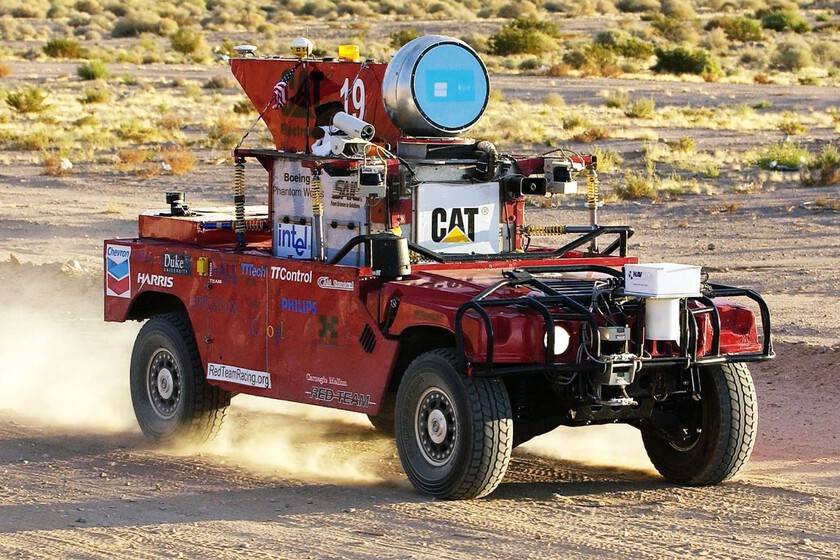
The farthest that day went was ‘Sandstorm,’ a Humvee M998 prepared by Carnegie Mellon University, which only covered 11.9 km (a little over 5% of the route), before veering off course and ending with its tires burning from the friction. That image perfectly summarized how little the technology had advanced in 2004 and, yet, it also showed that the problem was not unsolvable.
From desert failure to Waymo and today’s ADAS systems
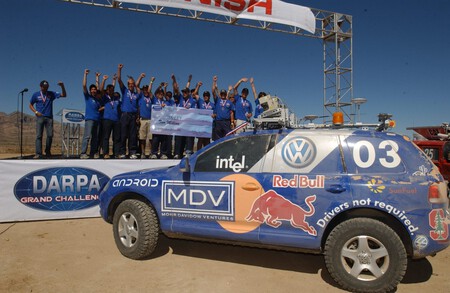
Rather than cancel the project, DARPA did the exact opposite: it launched a new edition just 18 months later and doubled the prize to two million dollars. The spectacular result: five teams completed the route, with the winner ‘Stanley,’ a Volkswagen Touareg developed by Stanford University.
The project, led by Sebastian Thrun, finished the trial in 6 hours and 53 minutes thanks to a combination of software, cameras, and an innovative three-dimensional LiDAR sensor developed by David Hall, founder of Velodyne.
After other editions, in 2009, Google recruited Sebastian Thrun and Chris Urmson (another of the key figures from the DARPA Grand Challenge) to launch their secret autonomous driving project, the seed of today’s Waymo. Other participants would go on to lead companies such as Aurora Innovation, Argo AI, or Uber ATG, in addition to developing technologies that many manufacturers now use in their advanced driver-assistance systems.
Today, fully autonomous driving still faces enormous technical and regulatory challenges; however, much of the technologies that allow a car to stay in its lane, detect pedestrians, brake autonomously, or interpret its surroundings began to take shape on that March 13, 2004.
Images | Fast Wars Facts