
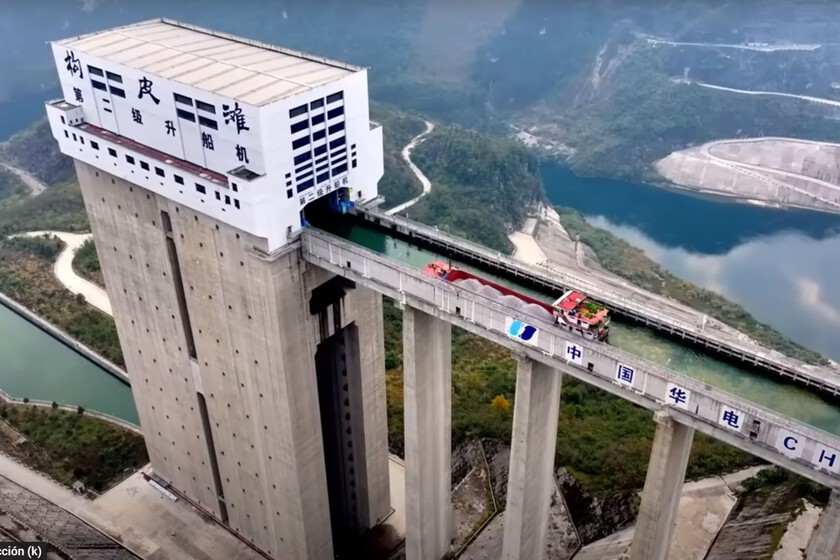
When a titan-scale dam such as China’s Three Gorges is built, challenges go beyond mere water containment. One of the biggest issues that arise is the disruption of river traffic: how can ships the size of skyscrapers continue to navigate when a concrete wall over a hundred meters tall blocks their path?
To solve this dilemma, Chinese engineers designed one of the most impressive structures in modern history: a colossal ship lift that defies gravity and redefines river navigation.
A ship lift that defies gravity
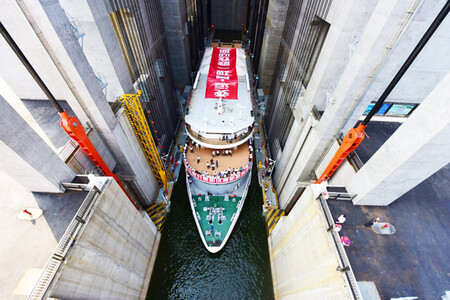
Unlike traditional locks, which require multiple chambers and hours of operation, the Three Gorges Dam lift enables vessels of up to 3,000 tonnes to be raised or lowered 113 m in just 40 minutes.
This system has revolutionized the efficiency of transportation on the Yangtze River, reducing passage time by more than 75% compared to five-stage locks, which can take between three and four hours to complete.
The operation of the lift is an engineering marvel. The lifting chamber, akin to a gigantic floating tub, measures 120 m in length, 18 m in width, and 3.5 m in depth. Ships enter this platform, which is raised or lowered by a system of 256 steel cables connected to 128 double-sheave pulleys.
These cables are balanced with counterweights, reducing the mechanical effort required to move the structure. The stability of the system is ensured by four reinforced concrete towers standing 169 m tall, acting as supporting columns. Inside, advanced control mechanisms allow a smooth and safe maneuver, minimizing vibrations and ensuring precision in every lift.
This level of sophistication has turned the lift into a global benchmark for innovation and energy efficiency. Since its inauguration in 2016, the lift has carried more than 25,800 vessels and 15.49 million tonnes of cargo, reducing logistical costs by 25%.
Beyond its economic impact, it has improved navigation safety in a historically intricate stretch of the Yangtze, where strong currents and abrupt gradient posed a considerable risk. Yet its impact goes beyond the functional scope.
The structure has also become a premier tourist attraction, offering visitors the chance to experience firsthand what it means to “navigate through the air.” Specialized cruises allow observers to study the process in detail, providing a unique perspective on this masterpiece of modern engineering.
A system that goes beyond the Three Gorges Dam

While the Three Gorges ship lift is the best-known of its kind, China has advanced this technology further with the Goupitan ship lift, the largest in the world in terms of vertical lift.
With the capacity to raise ships up to 199 meters high, it towers above the height of many skyscrapers. Its design includes a network of elevated aqueducts and tunnels that connect its three lifts, stretching over 2.3 km. Yet these structures, or similar ones, can also be found beyond China.
Notable examples include the Krasnoyarsk Dam lift in Russia, the Strépy-Thieu lift in Belgium, and the Falkirk Wheel in Scotland, the world’s only rotating ship lift. All stand as a testament to humanity’s incredible ability to adapt navigation to the challenges posed by terrain.
The creation of these ship lifts has redefined river transport, allowing rivers once split in two to become routes of commerce and connection between travelers.
In the case of China, these structures have propelled the Yangtze economy, facilitating the transport of goods and improving the safety of vessels crossing the region.
Far from being merely a technical curiosity, the Three Gorges Dam lift and its counterparts around the world stand as proof of how engineering can overcome limits imposed by nature. Now, ships not only sail rivers, but can also “climb mountains”.
Curiously, ten years after its inauguration, the lift has already outgrown its original scale. In 2025 the Yangtze recorded 173 million tonnes of cargo traffic, surpassing the initial design of 100 million.
In June 2026, approval was granted for a new project worth 11.4 billion dollars that aims to double capacity to 336 million tonnes annually.