
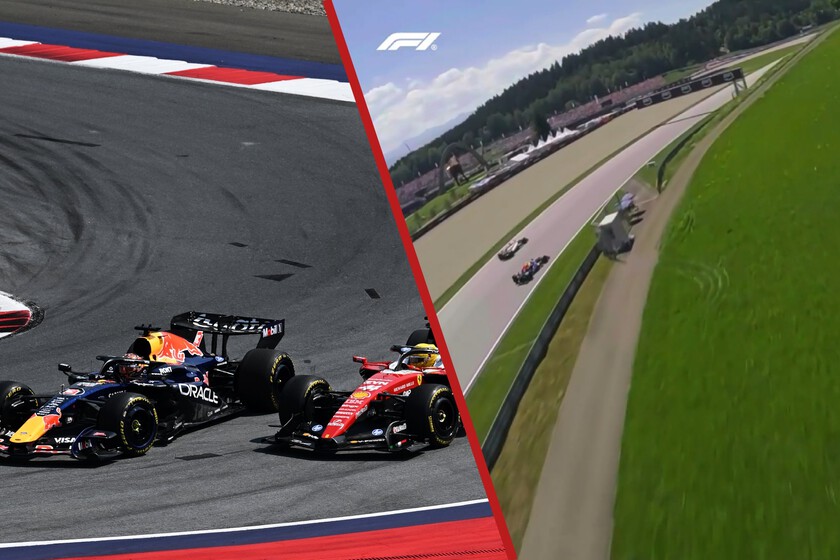
For years now, Formula 1 has been tinkering with new ways to convey the thrill of the races. One of them is an FPV drone capable of reaching 350 km/h to chase the single-seaters. It is very similar to the one developed by Red Bull, and during the Austrian Grand Prix we could see its first live steps.
The problem is that it seems the production team hasn’t yet learned to use it. Although, logically, on social media they have only shared some footage from free practice that looked good, when it came to chasing duels between several cars in a race the result was an avalanche of memes and a lot to improve.
The Formula 1 drone goes from 0 to 300 km/h in four seconds
The Austrian Grand Prix wasn’t particularly memorable on the sporting side, but it could go down in history for a technological innovation: the debut of FPV drones in Formula 1. For the first time, we saw a drone capable of reaching 350 km/h to follow the cars and record the race, although the experience left a lot to be desired.
The Formula 1 drone weighs less than a kilogram, is built from carbon fiber, fiberglass and 3D-printed polymers and goes from 0 to 300 km/h in four seconds, reaching 350 km/h and accelerations of 6G. A model very similar to Red Bull’s, but they still have not dared to put it on track in competition. And now we understand why.
The Formula 1 drone showed promising results in free practice, offering controlled shots of good quality. But the trouble came in the race, when nobody knows what will happen and improvisation is necessary. There, the drone, or rather the operators, became a source of memes for social networks.

Because rarely did the drone manage to frame a shot well during the race, almost always with the cars scrapping on the track in a corner of the image, almost out of frame, while in the middle you could see the vast nothingness. The high point came when we almost lost the exciting duel between Lewis Hamilton and Max Verstappen live due to wanting to use the drone.
And perhaps in Formula 1 they didn’t take into account something that Red Bull does know: by its architecture, these drones can only chase the cars from behind, since from the front they wouldn’t be able to film them. The problem is that when several Formula 1 cars are running together, they generate a curtain of air expelled upward that makes the drone uncontrollable.
Flying fast over the Red Bull Ring, as seen from the drone-eye view! 🤩💨#F1 #AustrianGP pic.twitter.com/cZbQhNfFwB
— Formula 1 (@F1) June 26, 2026
Not to mention the risk it poses to the public, and that makes it impossible to use these drones on circuits that aren’t as open as the Red Bull Ring. A promising technology, but many details to be polished.
Images | Red Bull, Formula 1