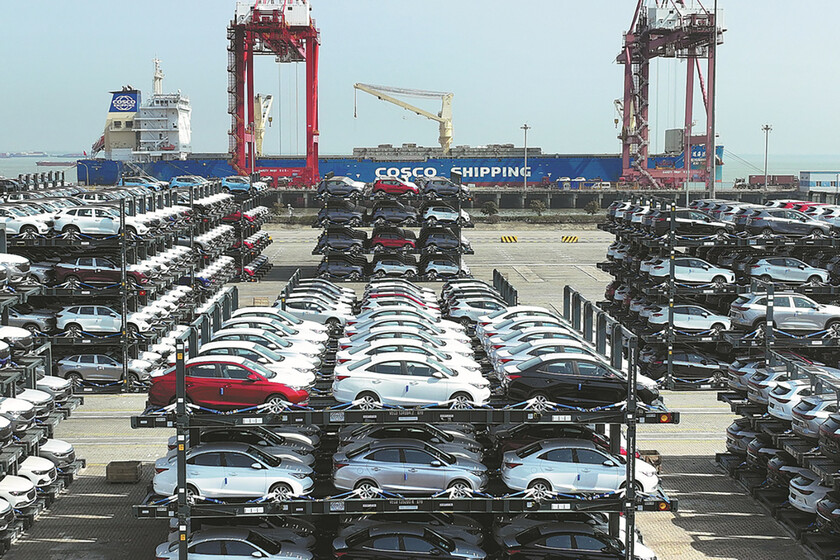
Car sales in China have been slipping for months, and 2026 is proving to be the year when that trend hardens into a structural crisis. The Chinese market has already logged eight consecutive months of declines, and the May data are the poorest of the year. And that can only mean one thing: Chinese brands want to export to Europe by any means to survive.
New car registrations fell 22.3% in May in China, dropping to 1.5 million cars, and the five-month year-to-date total shows a 20% decline. The China Passenger Car Association (CPCA), which at the start of the year anticipated a 1% drop, has revised its forecast to -11%.
Exports are the lifeline for Chinese brands
The most immediate explanation points to higher oil prices due to geopolitical tensions in the Middle East, which have throttled combustion-engine car sales. But Cui Dongshu, the CPCA’s secretary-general, acknowledges that there is something deeper: Chinese household demand for major purchases remains weak, public subsidies have been trimmed, and the market has reached a maturity that makes it impossible to replicate the growth rates of the last few decades.
China is no longer an emerging market in expansion, but a mature market comparable to Europe or the United States. And it is shrinking as well. In fact, the most striking aspect is that even electric vehicles and plug-in hybrids are not immune to the trend. Despite steadily increasing their market share, they now account for 62.2% of the market and posted a 7.5% drop in May, their fifth consecutive negative month.

The structural problem is evident. There are too many brands, too many models, massive overcapacity, and a product homogeneity — they’re all the same — that has tired the consumer.
The issue was openly acknowledged by Avita’s own CEO. “Price wars are a trap, and the proliferation of cars with nearly identical configurations and very similar price ranges has dulled consumer interest.” Some industry analysts estimate that, out of the current hundred brands, this inevitable consolidation will leave only about 5 to 10 Chinese manufacturers standing.
For European brands, the outlook is doubly challenging. Volkswagen, BMW, and Mercedes were already losing ground in the gasoline-car segment and now face the electric segment as well against local manufacturers.
The logical consequence is that Chinese manufacturers with excess capacity and urgent sales needs will look outward. In fact, in May, exports of electric vehicles and PHEVs surged by 112.6%, compared with a 74.7% rise in total Chinese automotive exports.
With the American market doors shut tight, Europe becomes the natural destination. Its combined market share on the continent remains low, but pressure will intensify as the domestic market contracts.
Find your ideal electric car
If you’ve been considering buying an electric car, this will catch your interest. We’ve created the Personalized Electric Car Recommender, where besides seeing models that fit your needs you’ll also get answers to the questions that worry you most, such as price, range, or nearby charging points.

Looking for your next electric car and feeling overwhelmed by the sheer number of options? It’s normal.
More than 45,000 readers have already tried it. What about you?
Advice offered by the brand