
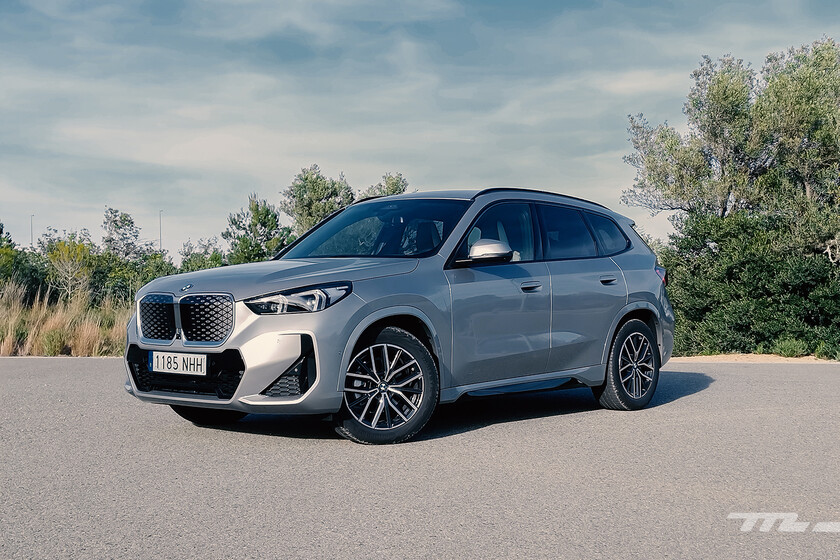
The X1 is BMW’s smallest SUV, though the descriptor no longer does it justice. Like nearly every BMW, the car has grown with each generation, and the X1 is now approaching the dimensions of BMW’s first X3. Alongside that growth, the BMW X1 now offers a 100% electric version, which is also the brand’s cheapest electric model.
Named BMW iX1, it faces rivals such as the Audi Q4, the Mercedes EQA, and the Tesla Model Y. We test today the most affordable version of the range and the one that theoretically offers the best range, the iX1 eDrive20.
BMW iX1: a BMW more comfortable than dynamic
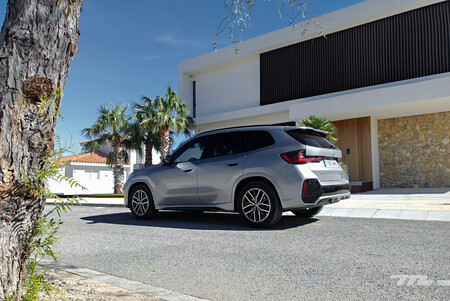
With its large vertical grille, the optional 20-inch wheels, and dimensions clearly larger than those of the previous generation (+5.3 cm in length, +4.4 cm in height), the new BMW X1 seems to have inherited the look and the space on the market from the X3.
However, in this case the increase has been positive. The first generation suffered from awkward proportions that did not suit the brand’s style. The second generation improved, but this third one has finally achieved an attractive silhouette.

What is it like to drive? The iX1 eDrive20 is the entry point to BMW’s electric lineup: a single motor mounted on the front axle, 204 HP and front-wheel drive. WLTP range up to 516 km, usable battery capacity of 65.2 kWh and DC fast charging up to 130 kW. From 0 to 100 km/h, BMW claims 8.6 seconds.
It is not the fastest BMW in the lineup, of course. But that doesn’t mean it’s dull. It is as easy to drive as it is to enjoy, with precise steering, albeit somewhat light for my taste.
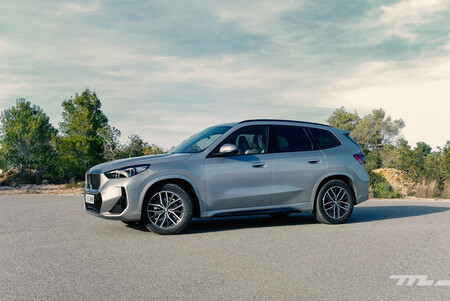
The suspension is reasonably firm, filtering out imperfections well without becoming uncomfortable: potholes hardly transmit vibrations to the cabin, and the M Sport versions, like this test unit, include adaptive suspension to soften the ride even more.
In corners, body roll is minimized, and with a low center of gravity, the way through bends feels composed, more than you would expect from an SUV. BMW has also given it six driving modes to suit different preferences. The first three are fairly obvious: Personal, Sport and Efficient. The other three are the new ‘My Modes’ that BMW calls ‘Expressive’, ‘Relaxed’ and ‘Digital Art’. Okay.
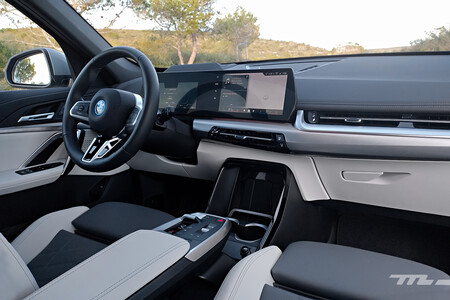
These modes project unusual graphics on the screens and alter the ‘engine sound’ with compositions by Hans Zimmer, the two-time Oscar winner. It sounds nice on paper, but in practice you end up returning to modes without any soundscape. Why do BMW and all brands insist on adding spaceship-like sounds to a B-movie?
To top it all, the iX1 is genuinely quiet, with excellent isolation from road noise and aerodynamic wind, even at highway speeds, something not true of all EVs, even the priciest ones.
In daily use, the iX1 defaults to the adaptive regenerative braking mode, which uses the navigation and sensors to adjust the regeneration intensity every time you ease off the accelerator. In practice, we found it very effective, but you can switch to the normal regeneration mode from the central touchscreen, although we would have preferred to adjust it with steering-wheel paddles.
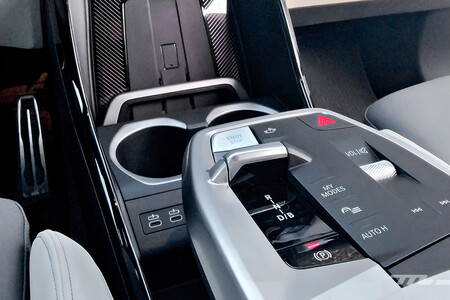
Additionally, there is a one-pedal braking mode. The rest of the driver aids, such as lane-keeping, are very well calibrated and do not interfere with driving unless you are truly about to make an error.
A barely adequate consumption. Electric propulsion suits the X1, though it brings its own drawbacks. Its battery is small for its segment and offers an official range of between 460 and 516 km. In real life, this translates to around 390 km of range thanks to an average consumption of 16.7 kWh/100 km. On highways, however, consumption rises to 19.9 kWh/100 km at legal speeds in Spain, leaving the maximum range at 316 km, or 225 to 250 km between charges up to 80%.
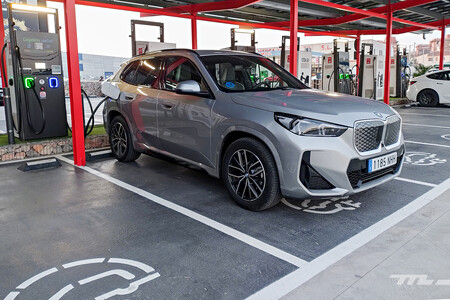
Nevertheless, the iX1’s rapid-charging capability is not outstanding. Its peak of 130 kW is on par with the Audi Q4 E-tron, but below the Volvo C40 Recharge and the Tesla Model Y. Moreover, in our fast charging test from 20% to 80%, the iX1 did not exceed 60 kW of power, although it stayed steady beyond 70% before gradually tapering. In any case, it does not compensate for the lack of truly fast charging, as it took 40 minutes, and the range is somewhat limited.
An immense and refined interior
All X1s come equipped with BMW’s Curved Display. A 10.25-inch digital instrument cluster paired with a 10.7-inch touchscreen infotainment system. The removal of the iDrive rotary controller is the main drawback. Without it, almost any function requires diving into touch menus.
The result is a real inconvenience even for the most basic operations. The interface has configurable shortcuts and works with a decent flow, but the experience is inferior to the previous generation of iDrive.
Your on-board space is the X1’s strongest argument in this generation. The material quality is on par with BMW’s more expensive cars, with a solidity that Mercedes’ sedans and small SUVs have not fully matched yet.
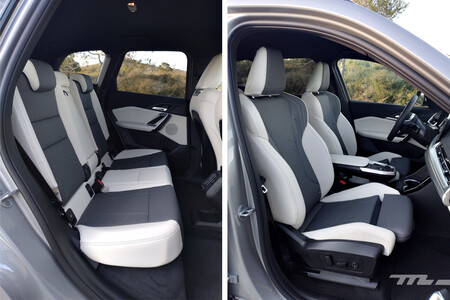
Rear-seat space is notable. Passengers in the back enjoy a cabin typical of a higher-segment SUV. However, in the iX1 the battery raises the floor of the cabin and the seat loses the 13 cm slide function that the gasoline or diesel versions have. This slightly reduces rear passenger comfort and legroom compared with the petrol X1.
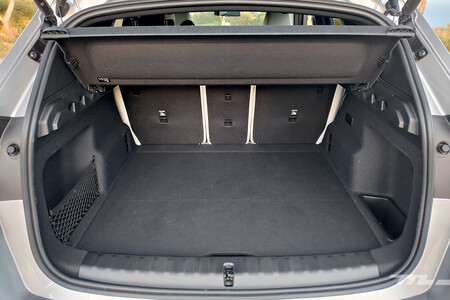
Space and boot. The boot measures 490 liters in the iX1, 50 liters less than the petrol X1, though the difference lies in the double floor rather than the visible space. Still, there is a gap beneath the boot floor to store charging cables. All X1s come with an electric tailgate as standard.
And what about the price?
The iX1 eDrive20 starts in Spain from 50,300 euros in its entry version. However, as is typical with BMW, it’s easy to get carried away with options and end up, as with this test unit, with a car worth 66,000 euros.
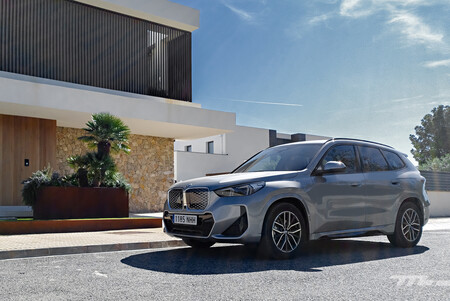
The M Pro package, with its body kit, adaptive suspension, M brakes, and more, already adds a 9,000-euro premium, plus around three thousand euros in comfort packs (electric seats, premium car audio) and technology (head-up display, adaptive headlights, wireless phone charger, keyless access, etc.). Among the cheaper options, the two-tone leather-and-fabric interior costs only 455 euros.
Compared with its direct rivals, the iX1 sits in the same price range as the Volvo EX40 Extended Range (51,000 euros) and the Audi Q4 e-tron with 204 HP and a single motor, which costs around 51,000 euros but with a 59 kWh battery and therefore less range. By contrast, it is noticeably cheaper than the Mercedes EQA 250+ (from 56,000 euros).
However, the underlying issue hasn’t changed: it competes with the Tesla Model Y, which offers more real-world range, more cargo space, more power, and, in its rear-wheel-drive version, a significantly lower starting price: from 40,990 euros. This rises to 50,990 euros in its Premium version with 360 HP and 609 km WLTP range.
BMW iX1 eDrive20: our assessment
7.6
8
8
7.0
8
8
7.0
8
7.0
8
7
Pros
- Space inside
- Ride comfort
Cons
- Too many essential driving controls restricted to the touchscreen
- Range
- Charging power is somewhat modest
The BMW iX1 is a highly capable electric SUV overall. It’s an excellent family car, very comfortable, quiet, reasonably quick, and packed with technology, though much of it is optional. The problem is that its rivals have improved over the three years it’s been on the market. This is especially evident in its range, which is decent to good, as well as in its charging power — which could compensate for the range — but falls short of its rivals. It’s also true that its price is more competitive than most of its premium rivals, but the Tesla Model Y remains far cheaper, with greater range and faster charging.
|
|
|
|
Motor |
An electric motor on the front axle. |
|
Battery |
Lithium-ion, 65.2 kWh usable capacity |
|
Maximum power |
150 kW (204 HP) |
|
Maximum torque |
250 Nm |
|
Drivetrain |
Front-wheel drive. One speed. |
|
Dimensions (L x W x H) |
4,500 x 1,845 x 1,616 mm |
|
Wheelbase |
2,692 mm |
|
Boot space |
490 liters |
|
Weight |
1,940 kg |
|
80–120 km/h |
5 s |
|
0–100 km/h |
8.6 s |
|
Top speed |
170 km/h |
|
WLTP combined consumption |
14.2 kWh/100 km |
|
Average test consumption |
16.7 kWh/100 km (19.9 kWh/100 km on the highway) |
|
Maximum WLTP range |
516 km |
|
Real-world range in test |
390 km |
|
PRICE (PRICE OF TESTED UNIT) |
from 50,300 euros (65,936 euros) |
Find your ideal electric car
If you’ve considered buying an electric car, this will interest you. We have created the Personalized Electric Car Recommender, where, in addition to seeing models that fit your needs, you’ll also get answers to the questions that worry you most, such as price, range, or nearby charging points.
|
The car for this test was loaned by BMW. For more information, consult our guide to corporate relationships. |

Looking for your next electric car and overwhelmed by so many options? It’s normal.
More than 45,000 readers have already tested it. And you?
Advice offered by the brand