
In Brief
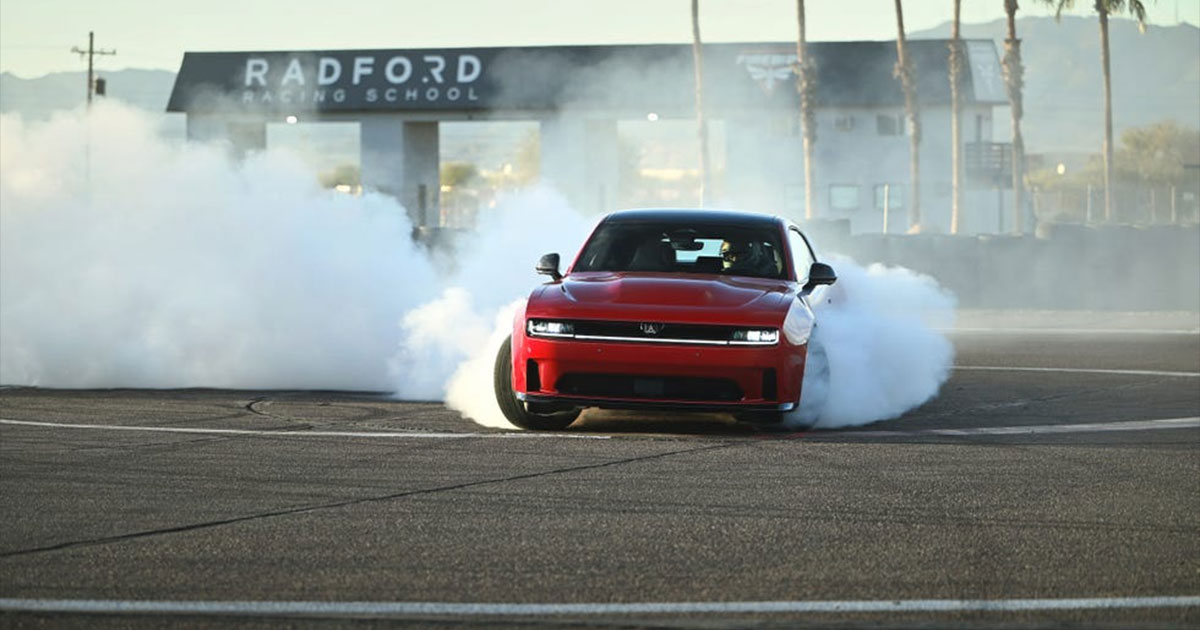
The Dodge Charger, the quintessential American muscle car, will for the first time be officially sold in Europe under Stellantis’ banners. To suit the European market and its strict environmental rules, the Charger arrives in electric and six‑cylinder gasoline versions, abandoning the traditional V8. This move signals Dodge’s intent to lift sales as demand declines in its core markets, by targeting a Europe that’s increasingly receptive to electrified vehicles. The launch also brings a notable technical adaptation: all-wheel drive is now standard across the lineup.
Among the muscle cars sold in Europe, Ford Mustang still makes the cut on our shores despite ever-tighter environmental standards. Chevrolet Camaro has been a memory here as well. Yet the Dodge Charger, the third iconic member of the American muscle trio, has never officially touched European soil. Stellantis, which now owns Dodge, plans to make up for lost time by bringing Charger to Europe in the near future.
An Unexpected European Arrival
The European market has rarely had the chance to embrace these muscle cars. Indeed, American automakers have almost never exported these emblematic machines, despite a passionate fan base in Europe.
The Mustang has enjoyed notable success in Europe, but its sales today are constrained by strict eco regulations. In France, for example, a malus of 80,000 euros applies if a Mustang’s price exceeds 59,300 euros.
Against this backdrop, Dodge announces the Charger’s first European launch. What might feel surprising at first glance—given the global shift away from internal-combustion sports cars deemed too polluting—makes more sense when you consider the Charger’s relative suitability for European constraints.
Two Powertrains
The latest Charger generation was initially offered only as an electric model, with a Daytona R/T version delivering 536 horsepower and 548 Nm of torque and a Scat Pack version at 670 horsepower and 850 Nm. They use a 100.5 kWh battery, yielding EPA ranges of 418–510 km (about 260–317 miles) and WLTP ranges of roughly 540–640 km (about 335–397 miles). The higher-performance variant can sprint from 0 to 100 km/h in 3.3 seconds.
But enthusiasts should rejoice, because Dodge also confirms the arrival of combustion-powered variants in Europe. A concession had to be made: there is no V8 on offer, but a turbocharged inline-six engine. The 3.0-liter twin-turbo gasoline engine produces 420–550 horsepower depending on the variant, with the most potent setup capable of a 0–100 km/h time of 3.9 seconds.
Furthermore, all versions come with standard all-wheel drive, enhancing traction and driving confidence. This marks a first for the Charger, and indeed for the electric version as well. The muscle car becomes distinctly European in character and could square off against electrified performance sedans such as the Hyundai Ioniq 5 N, the Porsche Taycan, and the Mercedes-AMG GT 4-Door Electric. It will be offered as both a two‑door coupe and a four‑door sedan.
Could Europe Save Its Career?
The European arrival of the Dodge Charger appears to be a strategy aimed at lifting overall sales volumes. Charger sales have fallen short of expectations: just 7,421 units in 2025, with a slide to 346 in the last quarter. The situation is even tighter in early 2026, with only 240 units sold in the first quarter. It’s not much better in Canada, where only 648 units were distributed last year.
Launching in Europe—an area more receptive to electric propulsion—seems to be Dodge’s attempt to boost volumes and keep production runs running closer to their optimal capacity. The move mirrors strategies seen in some Chinese automakers, which have pursued European sales to offset softer domestic demand.
Comparative Table
| Model | Powertrain | Power (hp) | Torque (Nm) | Battery (kWh) | Range (km, WLTP) | 0-100 km/h (s) |
|---|---|---|---|---|---|---|
| Dodge Charger Daytona R/T | Electric | 536 | 548 | 100.5 | 540 – 640 | – |
| Dodge Charger Scat Pack | Electric | 670 | 850 | 100.5 | 540 – 640 | 3.3 |
| Dodge Charger 3.0L Biturbo | Gasoline 6-cyl | 420 – 550 | – | – | – | 3.9 (550 hp) |
| Ford Mustang France (for malus comparison) | Gasoline | – | – | – | – | – |
Key Takeaways
- The Dodge Charger will be officially marketed in Europe for the first time by Stellantis.
- Two powertrains are offered: electric (up to 670 hp) and a turbocharged six-cylinder gasoline engine (up to 550 hp).
- The electric versions offer a WLTP-estimated range of 540–640 km (and an EPA range of roughly 260–317 miles).
- All variants come with standard all-wheel drive.
- This launch aims to boost sales in the face of waning demand in Dodge Charger’s traditional markets.
- The model is tailored to European standards, dropping the V8 in favor of options better aligned with environmental regulations.
FAQ
When will the Dodge Charger be available in Europe?
Dodge has announced an upcoming rollout in Europe, but the article does not specify an exact date.
What powertrains will be offered in Europe?
The Charger will be available with a 100% electric powertrain and a turbocharged 3.0-liter inline-six gasoline option, ranging from 420 to 550 hp.
What is the range of the electric Charger variants?
The range is listed between 540 and 640 km according to WLTP for the electric models.
Do the new Dodge Charger models come with all-wheel drive?
Yes, all versions, electric and gasoline, come standard with all-wheel drive.
Why is Dodge launching the Charger in Europe?
This launch aims to boost sales and offset declines in Dodge Charger’s American and Canadian markets.