
In brief
The Renault Twingo E-Tech 2026 marks a turning point by adopting a 100% electric powertrain while preserving its urban, practical spirit. More spacious, better equipped, and endowed with genuine modular innovations, it promises real enjoyment in the city and everyday ease of use. Its range remains modest but coherent with urban use, while its price, positioned well under 20,000 euros with the incentive, makes it particularly accessible. The compromises on certain finish aspects do not detract from livability, connectivity, or the fun of driving in the city.
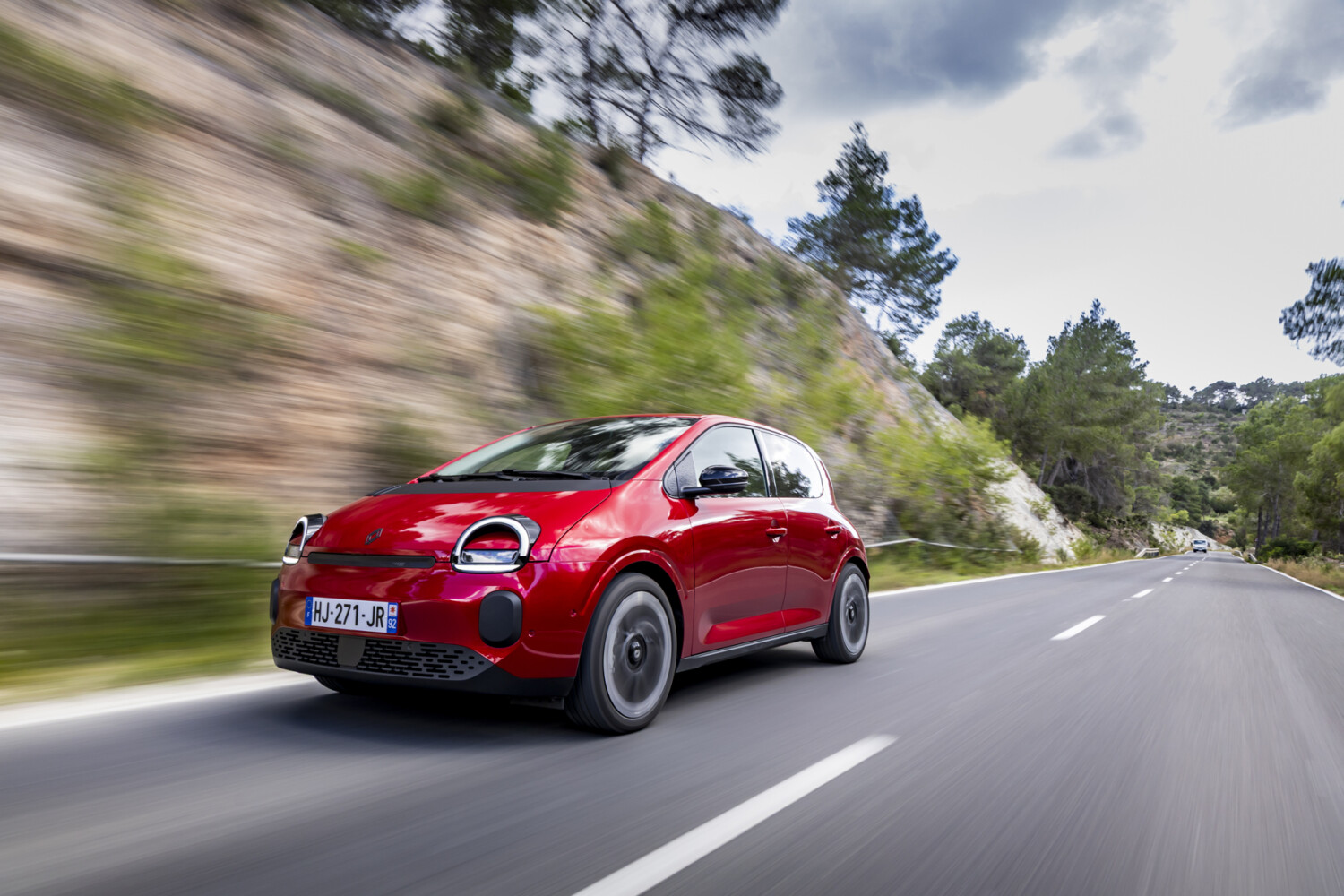
Aside from its chunky, globular headlights, its legendary smile, and a few styling details, the 2026 Twingo has nothing in common with its illustrious 1992 predecessor, which was full of flaws but had enough charm for each of us to have a personal anecdote about it. The new model invokes the spirit and memory of the one that was sold in 1,100,000 units.
But it grows by more than 30 cm in length. It is also wider and rides on chunky 16- or 18-inch wheels, compared with 13 inches on the old model. More importantly, it gains two extra doors and is now exclusively electric.
Renault Twingo E-Tech (82 hp / 27.5 kWh) Techno: Inside, Four Real Seats
Access to the cabin is via traditional door handles. Inside, four real seats. At the rear, the two independent seats slide 17 cm, fold, and tumble to free up 205 dm³ (305 dm³ with the seats moved forward) under the luggage cover and 966 dm³ of cargo space up to the headrests. The front-seat backrest also folds to permit loading of long items, highlighting the advanced modularity of the small Renault.
As for cables, they find their place under a clever double-opening false floor. Up front, the dashboard sits high, a consequence of the monocoque body style and of needing to house a 27.5 kWh LFP battery under the floor. Despite a few color reminders, a playful graphic, and a cheeky emergency-flash button, it doesn’t manage to offer the same simplicity as the original Twingo I, designed, admittedly, more than thirty years ago, with fewer screens and fewer regulatory constraints.
The steering wheel is adjustable in both height and reach, and the pedals are better placed than in its predecessor, allowing precise driver positioning. A spare key fob in the driver’s pocket, Drive mode engaged, and the planner started via an effective voice command, and the “frog” takes off smoothly.
Despite the modest torque (175 Nm) and power (82 hp) of its permanent-magnet motor, it accelerates sufficiently to merge into traffic without difficulty, rarely giving the impression that it’s running out of energy.
Renault Twingo E-Tech (82 hp / 27.5 kWh) Techno: In the City, It’s a Delight!
In city driving, despite a peripheral visibility that is noticeably less generous than that of the original Twingo, it’s a joy to drive. The steering wheel paddles (available only on Techno trim) let you choose your level of regeneration, and a One-Pedal mode makes most pedal braking unnecessary. Under these conditions, average energy consumption should not exceed about 12 kWh/100 km.
This translates to a usable range of roughly 263 km as advertised before recharging. Of course, on highway and especially on freeway, the top speed limited to 130 km/h curtails ambitions for the little Renault. Even though we haven’t measured the car on a long test yet, long-distance consumption (across different routes) would likely approach about 14 kWh/100 km.
On the highway, you should expect to stop more often and take breaks roughly every 150 km. If you’ve opted for the Advanced Charge pack (which includes an 11 kW bidirectional charger and 50 kW DC fast charging capability), moving from 15% to 80% on a fast charger takes about half an hour.
Renault Twingo E-Tech (82 hp / 27.5 kWh) Techno: It Has Clearly Matured
In city driving, with a minimum 11 kW charger, a full recharge can be achieved in about 2 hours 35 minutes. At home, on a 7.4 kW wallbox, figure about 4 hours. Without specific equipment, using a standard household outlet, it’s best to let the car charge overnight. Note that, like a Renault 5 or 4, V2L and V2G functions allow powering various electrical devices or feeding electricity back into the grid via Mobilize services and can help cut your electricity bill.
In terms of handling, compared with the first Twingo, the new model has clearly matured. Its stability and comfort make daily driving feel secure. The rear torsion beam can react a bit harshly to rough road imperfections, sometimes bouncing along a series of deformations rather than absorbing them, but the suspension effectively filters the minor bumps. This means the car rides with a bit more roll than the Renault 5, and its more heavily damped steering, paired with low-rolling-resistance tires, reduces agility somewhat.
Renault Twingo E-Tech (82 hp / 27.5 kWh) Techno: Priced Under 20,000 euros
Well-equipped, reasonably pleasant to drive, comfortable and easy to live with on a daily basis, the new Twingo manages to keep its price under 20,000 euros. Its base price starts at €19,490, and even in Techno form with the indispensable Advanced Charge pack and a few options as in our test car, it comes in at €19,970 after applying the minimum ecological incentives of €3,620. A real sign that the “frog” still has a secret weapon.
Admittedly, there are a few compromises. They show up in the quality of plastics, seat support, sound insulation, the absence of rear power windows, visible mounting screws, or the fit of certain components. But overall, quality doesn’t seem to have been the primary metric, as evidenced by hidden windshield trim details.
According to Renault, the strength of the Twingo lies in the Leap 100 project, which allowed the car to be conceived in only 21 months by leveraging processes from China that were previously unfamiliar to us. While the design was finalized in France, at the Technocentre, the model’s conception was carried out by ACDC, Renault’s Chinese subsidiary, using a process that saved time, parts, and thus money.
Renault Twingo E-Tech (82 hp / 27.5 kWh) Techno: Its Pros?
- Regenerative braking
- Interior space / modularity
- Connectivity
Renault Twingo E-Tech (82 hp / 27.5 kWh) Techno: Its Cons?
- Limited range
- Overly amplified steering
- Road noise starting at 90 mph
The Auto Journal verdict: 4/5
Difficult not to fall under its spell. Beyond its evocative styling, it keeps prices tight, doesn’t skimp on features, prioritizes livability and interior space, and delivers genuine city-driving pleasure. It’s a pity the range is so limited.
Renault Twingo E-Tech (82 hp / 27.5 kWh) Techno: At a glance

Find our first test of the Renault Twingo E-Tech (82 hp / 27.5 kWh) Techno in Auto Journal issue #1206, dated 04/02/2026.
Comparative table
| Feature | Value |
|---|---|
| Power | 82 hp |
| Battery | 27.5 kWh |
| Official range | 263 km |
| City consumption | 12 kWh/100 km |
| Highway/long-distance consumption | 14 kWh/100 km |
| Top speed | 130 km/h |
| Base price (with incentive) | €19,490 |
| Techno version (with Advanced Charge pack, with incentives) | €19,970 |
| Minimal ecological incentives | €3,620 |
| 11 kW charging time | 2 h 35 |
| Wallbox 7.4 kW charging time | 4 h |
| Fast charging (15–80% on 50 kW) | ~30 min |
| Trunk volume (seats forward) | 305 dm³ |
| Trunk volume (seats folded to head restraints) | 966 dm³ |
The essentials to remember
- The Renault Twingo E-Tech 2026 is a 100% electric city car designed for urban life.
- It offers an advertised range of 263 km and 82 hp.
- Interior practicality and modularity are standout strengths.
- Prices, after incentives, start at €19,490, making it accessible.
- Charging times range from 30 minutes to 4 hours depending on setup.
- Among its drawbacks: highway-range, steering feel, and some finish quality concerns.
FAQ
What is the real range of the Twingo E-Tech 2026?
The advertised range is 263 km, but it drops on the highway, requiring stops roughly every 150 km.
How long does it take to recharge the Twingo E-Tech?
On an 11 kW charger, a full charge takes about 2 h 35; on a fast charger (15–80%), around 30 minutes.
Is the Twingo E-Tech suitable for city life?
Yes, it is perfectly suited thanks to its size, agility, One-Pedal mode, and interior modularity.
What is the price of the Twingo E-Tech with the ecological incentive?
The base price, after the incentive, starts at €19,490; the Techno version equipped is listed at €19,970 with the minimal ecological incentives of €3,620.
What are its main strengths and weaknesses?
Strengths include regenerative braking, habitable interior, modularity, and connectivity; weaknesses are limited highway range, over-boosted steering, and road noise from 90 km/h upward.