
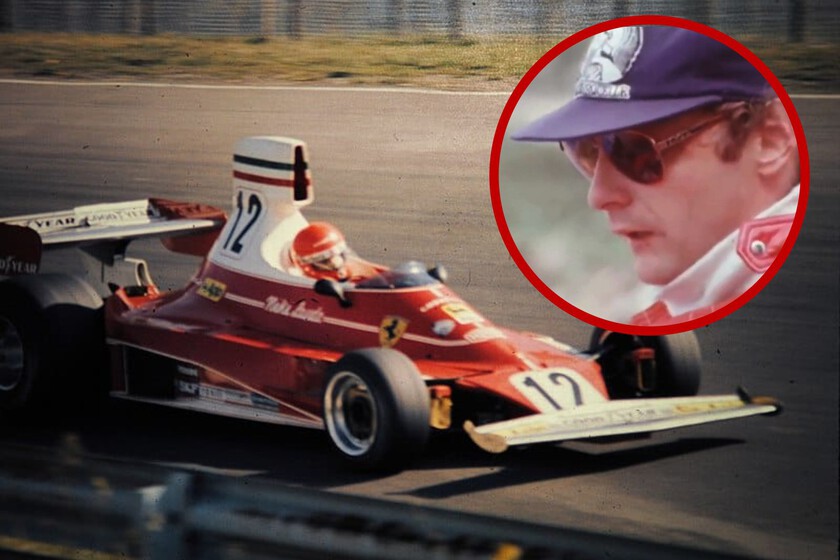
Niki Lauda was a pragmatic driver who evaluated the risks he took in every race. That is why the terrible crash that would change his life forever at the Nürburgring, on August 1, 1976, remains a bitter paradox that nearly claimed the life of the driver who would be reborn after being pronounced dead in the wake of that dramatic fire.
This 2026 marks the 50th anniversary of that terrible moment. It was the seventh race of the 1976 Formula 1 season. Niki Lauda held the title of 1975 World Champion and defended it fiercely, having secured four victories in the six races run so far. His position in the standings gave him confidence.
The Green Hell, a track with no minimum safety standards

Jackie Stewart, the driver who christened Nürburgring as ‘The Green Hell’.
On August 1, 1976, Niki Lauda should not have raced at Nürburgring. The Austrian supported the safety ideas campaigned by British three-time Formula 1 champion Jackie Stewart, who coined the name The Green Hell to refer to Nürburgring’s dangerous layout.
A week earlier, Lauda attempted to boycott the race. He gathered the rest of the Formula 1 drivers to alert them to the problem: Nürburgring lacked the basic resources to guarantee safety. There were not enough marshals, firefighters, or fire trucks to cover the length of the 22.7-kilometer road.
He failed in his bid. Lauda believed that, as championship leader and holder of the lap record on that German circuit at the time, he would be the best spokesman for the drivers. But his rivals did not back him: some mocked his excessive zeal, calling him a “chicken,” and others did not even get along with him.
Thus, the race went ahead.
The morning had rained, but that did not dampen the enthusiasm of the roughly 300,000 spectators at the German Grand Prix. The sun had returned, though a shower fell just before the start, delaying the race.
And here began the problems for the drivers.
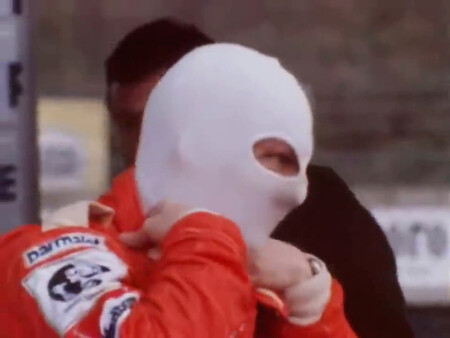
Niki Lauda wore his shirt and balaclava, and zipped up his fireproof suit, and headed to his Ferrari 312T2. He had rain tires mounted, like all the drivers except the German Jochen Mass of McLaren-Ford.
On taking the first lap around that nearly 23-kilometer circuit, the asphalt was dry, with some short damp stretches. And then 14 of the 28 drivers chose to pit to swap rain tires for dry rubber. Among them was Niki Lauda.
And suddenly, on the second lap, something happened.
It is said that the Ferrari 312T2’s rear suspension failed, perhaps the car struck a damp patch, or Lauda simply entered the corner too fast. The Austrian driver could never explain what happened. As he explained in 2016 to the Frankfurter Allgemeine Zeitung, his memories were erased forever:
The morning before the race, a fan came to me and asked for an autograph, with the date written on it. “It could be the last one, Mr. Lauda,” he said. At that moment I thought: “Who is this idiot?”; but of course I was polite and wrote it. At some point after the start, as the track dried more and more, I had to switch from rain tires to dry. After that, I no longer know anything. If that kid hadn’t filmed that movie with his Super 8 camera, I would never have known what happened.
That is how Brett Lunger, one of the drivers who saved Lauda, lived it:
There was a very fast right-hand bend followed by a blind left, taken at full throttle even with the wet surface. As I was turning at around 240 km/h I saw dust in the air, but I didn’t know what it was. It was Niki going off the track. I don’t think anything broke on him; he was coming in really fast.
Niki Lauda lost control of his Ferrari 312T2, crashed into a berm that bordered the track, the car’s tanks ruptured and began leaking fuel while the Ferrari rebounded, ending up on fire in the middle of the track as Guy Edwards’ car, following, narrowly avoided it after brushing it slightly.
And at that moment he was struck by the Surtees-Ford of Brett Lunger:
When I saw it, he was stopped on the track, in flames. I was approaching the bend and tried to slow down, but there was no way to avoid him. When I hit him, the extinguisher in my car discharged, and perhaps that helped quell the flames somewhat.
As Paco Costas recounted in El País, based on the testimony gathered immediately from a frightened Arturo Merzario, Wolf-Williams-Ford driver, Nürburgring’s characteristics proved decisive:
On the second lap, fourteen participants pitted, including Lauda, switching to dry tires, with no one losing a lap. Lauda rejoined the race and blended with the tail end of the group, which was already stretched; he pushed the pace to recover the lost time and thus reached the end of a very fast section that ended with a tremendous jump.
When he landed, he unexpectedly encountered one of this dangerous circuit’s dreaded traps: water. His car spun, hitting the barriers on one side and coming to rest in the middle of the track. Guy Edwards managed to pass, according to his words after the race, without knowing how, but Brett Lunger, who couldn’t see the Austrian’s car in the jump, hit him and was hurled against the barrier on the opposite side.
The Austrian Harald Ertl, who was just behind, also failed to brake and struck Lunger’s car. The three cars, badly damaged, blocked the way, but Lauda’s Ferrari was completely wrecked and hung on the barrier, catching fire at the same time.
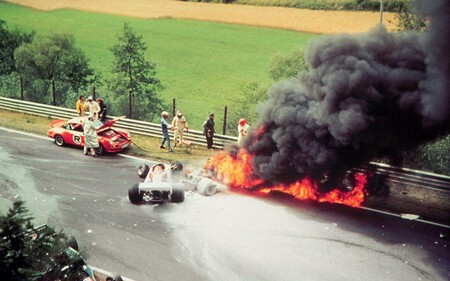
Niki Lauda could not get out of the car on his own. The drivers Brett Lunger, Arturo Merzario, Guy Edwards, and Harald Ertl immediately helped their rival. Merzario, who had driven for Ferrari, managed to release the car’s anchors, which differed from those used on British cars. Harald Ertl emptied a fire extinguisher over the Ferrari and Brett Lunger pulled Lauda from that deadly trap.
By then, the Austrian driver had already suffered severe burns. The helmet came off in the first impact, and the white balaclava was already black from the intense heat of the blaze. In total, there were 45 unbearable seconds during which Niki Lauda inhaled toxic gases from the burning fuel and the surrounding components. In the nearby Adenau hospital they could do nothing for him.
Niki Lauda was airlifted to Ludwigshafen Hospital, 145 kilometers from Nürburgring. There he was diagnosed with second and third-degree burns on the face and hands, a crushed cheekbone, and three broken ribs, though the most severe damage was not visible: his lungs were severely affected.
For that reason, he was transferred to Mannheim University Hospital, the nearest center capable of treating such severe pulmonary poisoning.
In Mannheim, Niki Lauda was pronounced dead. Ferrari’s sporting director Daniele Audetto called Enzo Ferrari to tell him that Lauda would die imminently, according to the doctors. At that moment, Il Commendatore ordered Audetto to hire the Brazilian driver Emerson Fittipaldi as Lauda’s replacement.
Lauda came close to dying, but refused to give up. As is well known, he returned to competition after six weeks, having only missed the Austrian Grand Prix and the Dutch Grand Prix, and at the Italian Grand Prix in Monza on September 12, 1976, Niki Lauda left everyone stunned.
But what happened at Nürburgring would haunt Lauda for the rest of his days.
Niki Lauda: “I have a reason to be ugly, most people don’t”
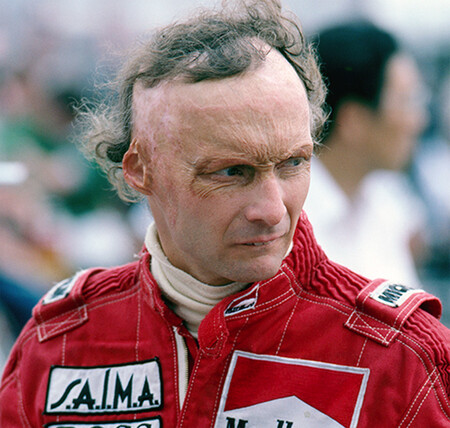
The same Lauda recounted to the press how he underwent successive skin grafts on the forehead, the right cheek, and much of the parietal region, and how the public’s morbid curiosity bothered him:
They kept asking me [about the damage to my right ear]: “Why didn’t you have it operated on?” I told that woman: “Where the hell do you think I would find an ear?” That’s just how it is—what more can I do?
Many of the injuries Lauda sustained at Nürburgring were plainly visible, so he decided to wear a cap to avoid people’s stares.
Nevertheless, Lauda never shirked or regretted having raced that day. In fact, in his statements to the Frankfurter Allgemeine Zeitung he explained that August 1 was, for him, just another day:
For me it’s a day like any other. I don’t stand in front of the mirror and tell myself: “Hooray, I’m alive!”. Racing was an extreme risk at that moment, and I was always aware of that. After the accident, I had to decide whether I wanted to take that risk again. I did want to.
Forty-two days later I returned to Monza and finished fourth. Later I won again, even becoming world champion again, I became the old Niki again. The accident was no longer a problem at any moment. But if there are people more anxious than I am—and there are many—these people will suffer a lifelong accident.
Niki Lauda achieved with his mind what his body could never overcome. However, his brutal Nürburgring experience helped spark changes in Formula 1. At that time, as Lauda himself recalled, one or two drivers were killed each season.
Circuits and single-seaters have changed radically. All tracks now require a permanent Medical Center, drivers undertake on-track rescue courses, and the cars are safer. They also possess hyper-resilient survival cells.
What happened on August 1, 1976 at Nürburgring changed the life of Niki Lauda forever, and it also changed the way Formula 1 was lived.