
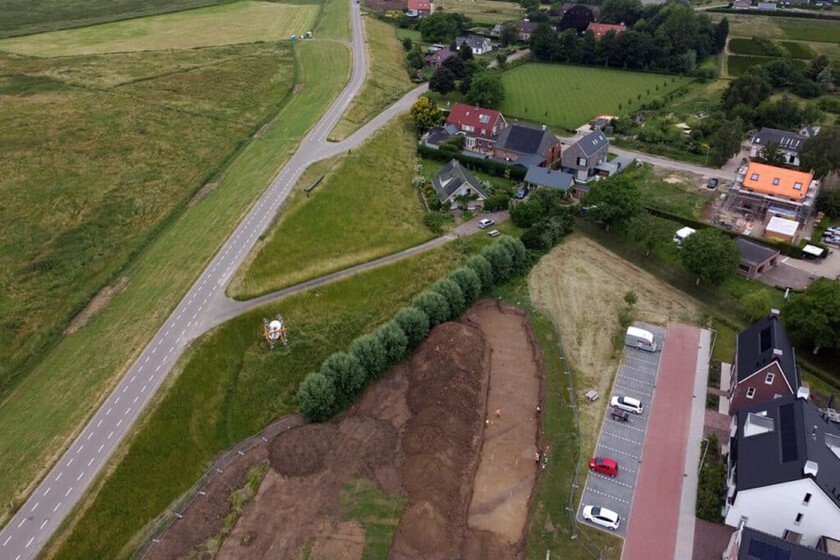
During routine excavations to reinforce the Wolferen-Sprok dike in the eastern Netherlands, archaeologists came across something no one expected to find: an ancient Roman road and a canal dating from about 2,000 years ago, remarkably well preserved beside the Waal River, one of the Rhine’s major arms. The discovery, documented in 2021 by RAAP experts, forever changed the map of the Roman logistical network in this part of Europe.
The two-lane gravel Roman road functioned almost like an ancient military highway: a land route running parallel to a navigable canal about 10 meters wide to move soldiers, food, construction materials, and goods between Nijmegen and the Limes Germanicus, the northern frontier of the Roman Empire.
A Roman road along the Rhine that forced a rethink of the region’s history
To understand the importance of this curious find beneath layers of mud and clay, one must travel back to the 1st century: for almost 450 years, part of today’s Netherlands formed part of the Roman Empire. The Rhine was a strategic frontier and was protected by military forts, camps, and supply routes that allowed troops to be moved quickly across the region.

Archaeologists believe that the canal discovered near Oosterhout connected military vessels with various Roman detachments stationed along the river. Then the RAAP excavation lead Eric Noord explained at the time that the discovery “obliged a review of the known map of Roman infrastructures in the Netherlands.”
Finding a canal of this size next to a road is not something that happens every day, and far from it in such good condition. Moreover, small everyday Roman-era objects were unearthed, such as an oil lamp, an iron spearhead, a bronze hook, or a silver pin.
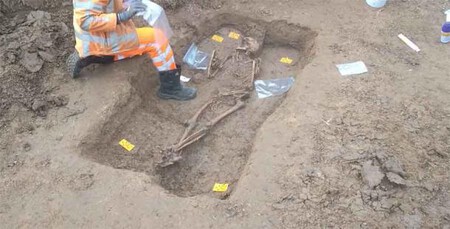
Related to this find, only a few months earlier archaeologists had uncovered an almost intact skeleton in the same area. Tests at the time determined it was about 1,200 years old and belonged to the Early Middle Ages, between the years 500 and 900: placing this person squarely in the era of the Carolingian Empire and Charlemagne (who spent long periods in Nijmegen).
No one knows who the person buried beside the road and the ancient Roman canal was, but the finding links two very different historical moments in the same site: the end of the Roman world and the birth of medieval Europe.
The excavations in the area continued until 2023 as part of the Waal dike reinforcement project, and remains from various eras continued to emerge, from vestiges of the Eighty Years’ War to World War II trenches. Foundations of Herberg de Zwaan, an old 17th-century inn, were also uncovered, eventually buried beneath the dike itself after centuries of enlargements and reconstructions.
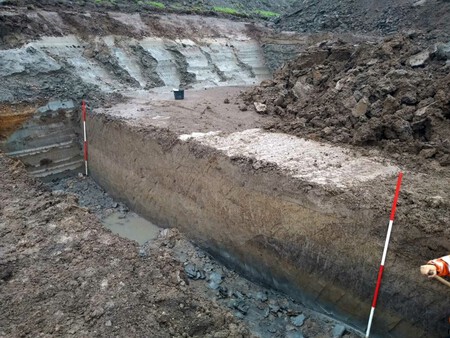
And among all these finds, the old Roman road remained down there, with part of its gravel surface still intact 2,000 years later. Yet another testament to how thoroughly Rome understood the importance of infrastructure and that controlling a territory began with mastering its transport routes, long before modern highways were born.
Images | RAAP