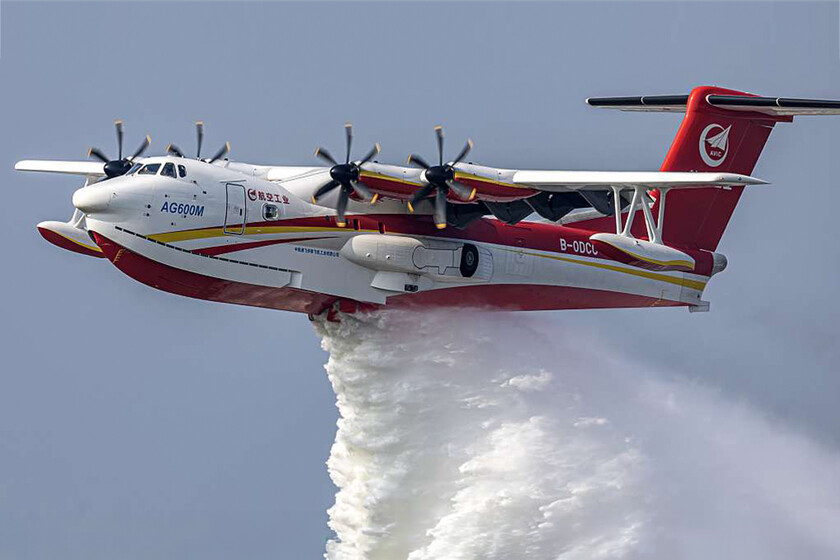
China has never done things by halves. While the world watches in awe at the Persian Gulf’s architectural ambitions, the Asian giant has decades of accumulating its own records, such as the world’s largest dam, capable in theory of altering the Earth’s rotation, or the world’s tallest bridge, from which a cascade of water pours down, because yes. The latest chapter of that story has wings, floats, and is called AG600M ‘Water Dragon’, the world’s largest amphibious aircraft.
How big is it? Not small at all: the size of a Boeing 737. Or, put differently, roughly twice as large as the Canadair CL-415 water bombers of our Air Force.
An AG600M has the operational capacity of two Canadair CL-415s
Manufactured by AVIC (the Aviation Industry Corporation of China), this seaplane has earned the title of the largest amphibious aircraft currently in operation. Its dimensions are impressive: nearly 37 meters long, a wingspan of almost 39 meters, and the capacity to take off carrying more than 53 tons. In size, it rivals a Boeing 737. It can transport up to 50 people, fly for 4,500 kilometers non-stop and reach speeds of 570 km/h thanks to its four turboprop engines.
El proyecto arrancó a finales de la primera década de los 2000. El primer vuelo estaba previsto para 2015, pero los retrasos son inevitables cuando se construye algo sin precedentes, y el Kunlong no levantó el vuelo hasta diciembre de 2017. Desde entonces, ha acumulado más de 3.500 horas de vuelo a lo largo de años de pruebas en condiciones climatológicas de todo tipo, hasta obtener su certificación definitiva.

Its raison d’être is as practical as strategic: maritime search and rescue, coastal patrol, and forest fire suppression. In that last role it is especially striking: it can scoop up to 12 tons of water in a mere 20 seconds, and discharge them at an altitude between 30 and 50 meters while flying at around 230 km/h.
As a water bomber, comparison with the other most well-known amphibian, the Canadair CL-415, is inevitable. While in wingspan the AG600 is about 1.35 times that of a CL-415, and in length 1.86 times, the Chinese aircraft covers around 2.5 times the footprint of a CL-415. In terms of water capacity, the AG600 carries the equivalent of two CL-415s in a single flight (12 tons versus 6.1 tons for the Canadian aircraft).
Pero más allá de sus funciones de emergencias, el AG600M tiene un papel en el tablero geopolítico chino. Con su autonomía de vuelo y su capacidad para operar en mar abierto, podría ser utilizado por China en el marco de sus proyectos en las zonas marítimas disputadas del Mar de China Meridional, que Pekín reclama casi en su totalidad.
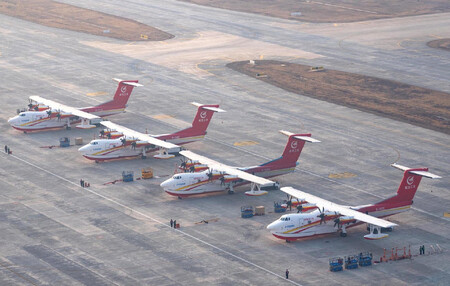
Sin embargo, no son pocos, empezando por EEUU, en estimar que este avión anfibio también podría utilizarse con fines militares. De hecho, el equipamiento a bordo de la aeronave podrá modificarse según los requisitos de una misión específica.
Algunos expertos creen que el Kunlong será una herramienta muy efectiva para mantener líneas de comunicación con sus bases en islas remotas, como las cadenas de las islas Paracelso y Spratly en el mar de China Meridional.
Estas islas son el centro de disputas territoriales con países como Vietnam y Filipinas. Además, este amphibian could deploy anti-submarine mines to protect that archipelago, or simply to close maritime navigation in a given area, such as a strait.
El Kunlong no es el primer avión anfibio enorme que ha existido. El legendario Spruce Goose de Howard Hughes tenía una envergadura que casi triplicaba la suya, y el Martin Mars sirvió como transporte en la Segunda Guerra Mundial. Pero ambos pertenecen a los libros de historia. El Dragón de Agua, en cambio, está listo para volar.
Imágenes | National Civil Aircraft Test Flight, Xinhua