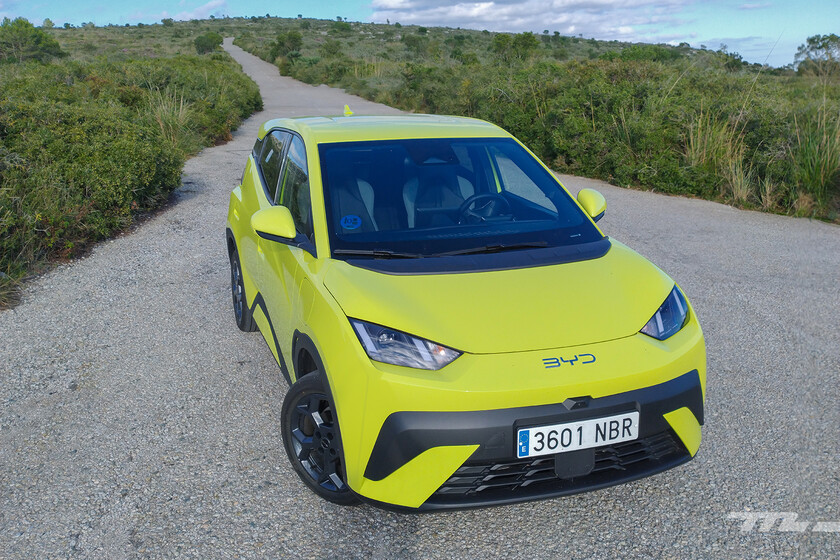
Having burst onto Europe with force and surpassed Tesla as a maker of plug-in cars, although its vehicles are not as accessible, the Shenzhen brand added a genuinely inexpensive model to its lineup, the BYD Dolphin Surf.
In its first year on the market, in 2025, the Dolphin Surf ranked as the fourth best-selling electric car in Spain. Its main argument for imposing itself in our market is a starting price under 20,000 euros. However, with its 88 hp and 220 km of range, it isn’t the most versatile in the lineup. That role falls to the top-of-the-line variant, powered by a 156 hp motor and with a range of 310 km. This Dolphin Surf flagship (from 26,490 euros) is the one we test today before measuring its real range.
BYD Dolphin Surf: bigger than an electric Renault 5
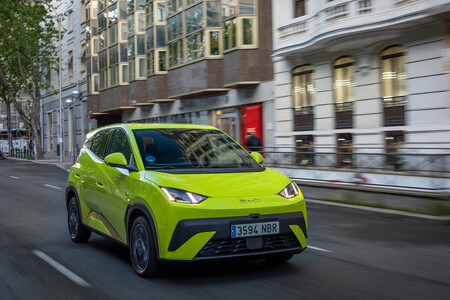
While the 3.99 m length places the Dolphin Surf squarely in the city-car territory, like a Citroën C3, its narrow width (1.72 m) and unusual height (1.58 m) give it a somewhat disconcerting silhouette that makes it seem smaller than it actually is. You might think it’s like a Fiat 500 (3.57 m) and in reality it’s 7 cm larger than a Renault 5 E-Tech, since the French car is 5 cm wider and 8 cm shorter.
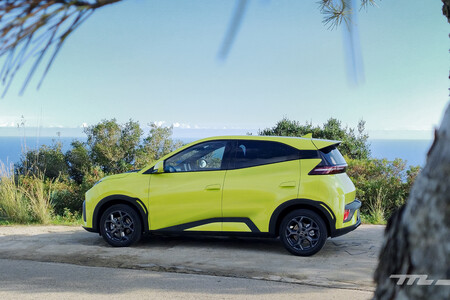
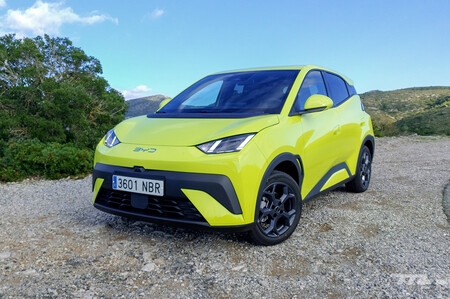
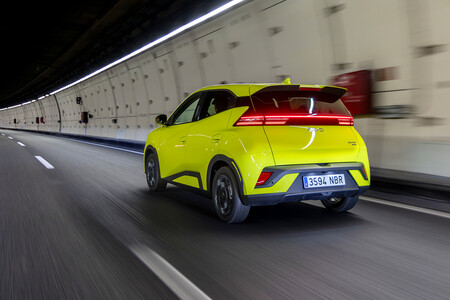
But beware, those generous dimensions are due to redesigned bumpers as the Chinese BYD Seagull became the European BYD Dolphin Surf. And those new bumpers, with a more aggressive design, add 16 cm. In any case, the overall styling remains quite sober, with a design that relies on sharply defined edges. Some details attempt to energize the line, such as the floating roof or the rear stripe that visually widens the tailgate.

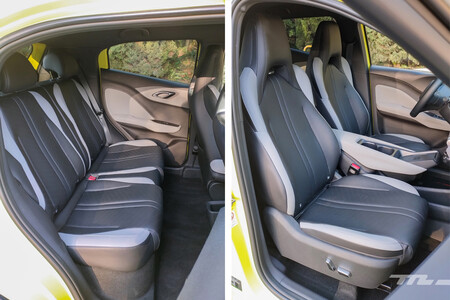
Interior. If the exterior of the Dolphin Surf has a playful touch, the cabin ultimately ends up being more serious. Although the materials are basically hard plastics, they are well assembled and convey a good perceived quality. The seats with integrated headrests and the three-spoke steering wheel covered in faux leather contribute to this atmosphere, as does the famous swiveling central screen.
Storage spaces, however, are less convincing: the wide open tray under the armrest lacks accessibility, while the narrow door pockets reveal the car’s narrow width (1.72 m).
This narrow width also limits rear space to only two seats (compared with the three seats in the R5 and C3), but passengers are comfortable. The abundant headroom, the reclining backrest and the legroom are quite decent. It is in this aspect better than the R5. The boot is more modest, with 308 liters advertised, including space under the floor to store the two charging cables.
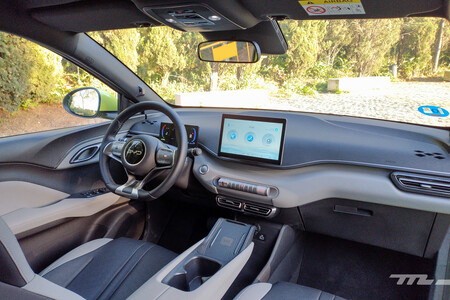
Display and information-entertainment. It is the brand’s hallmark and is present in all BYD models: a horizontal central touchscreen that swivels 90º when you press a button on the steering wheel. While essentially a gadget, it has the merit of letting everyone set it to their liking. Note that when vertical, Android Auto and Apple CarPlay are not available, and if you wear polarized sunglasses you won’t see the screen.
As for the graphics on its screens, the instrument cluster and the touchscreen, they can be disappointing. In the small instrument panel there is too much information spread around without coherence, and in general, the graphics feel dated. But its weak point, without a doubt, is ergonomics.
Although it has some physical buttons, these do not control the air conditioning. Ventilation, heating, and air conditioning are controlled via small icons on the touchscreen. So small that it’s nearly impossible to hit them while driving without taking too long to look away from the road, especially if you don’t have pianist-like fingers.
Fortunately, in an OTA update the brand added a gesture function. Swiping three fingers up or down on the screen allows raising or lowering the temperature, and sliding them left to right and vice versa lets you adjust the temperature, all without needing to look at the screen to find the correct icon.
Otherwise, the scattered settings in different menus, such as the speed warning, the level of regenerative braking, or the steering firmness, and the need to take your eyes off the road, often lead me to abandon using those adjustments. And to top it off, the camera that monitors the driver’s gaze to detect excessive distraction or drowsiness keeps scolding me with vocal alerts.
Behind the wheel of the BYD Dolphin Surf: small, but mighty
Sitting high, the gear shift begins by turning the curious cylindrical selector located above the ventilation grills, as in a BYD Atto 3, for example. The BYD takes off in silence… provided you have turned off the various audible warning alerts. In the city, its compact size and the liveliness of its motor make it a roadrunner that only scooters can keep up with. BYD has, perhaps unintentionally, reinvented the old Smart ForTwo: in the city it is unbeatable. And when parking, it even has a battery of cameras for a 360° view. Parking this car is a breeze.
On the highway and in Sport mode, you must admit the wheels are overwhelmed by the action, they squeal at the slightest provocation. This forces me to approach intersections cautiously. Despite perfectly dry pavement, the 220 Nm of torque already exceed the grip and traction capacity of the front tires.
An exuberant surge due to the excellent performance of the 156 hp electric motor and the limited grip of the standard Hankook Ion tires. In the rain, the traction control becomes almost a co-pilot, but the BYD Dolphin Surf remains safe at all times.
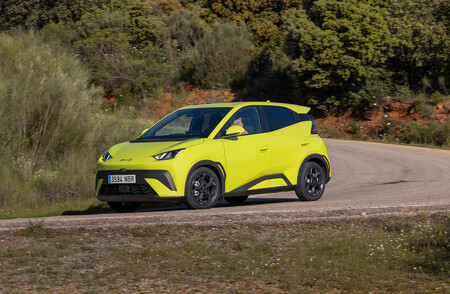
Furthermore, with every roundabout and bend, the car feels almost playful and is by no means slow. On the contrary, despite its small size and modest power—by EV standards—the Dolphin Surf moves along briskly.
At the limit of grip that the tires can bear, the tires squeal in protest and the nose progressively straightens the trajectory while the rear end follows the front axle with reassuring stability, as the car leans in the corners, despite a somewhat firm suspension in the city (undoubtedly due to overly stiff springs).
Moreover, the brake feel is identical to that of a gasoline car, easy to dose and without that initial moment where brakes seem to have no bite as in many EVs and PHEVs. Undoubtedly, the distinctive regenerative braking of this BYD helps that sensation. And while it is very weak in the city, as is typical for BYD, it is surprisingly stronger on the highway, or at speeds above 50 km/h.
Thanks to its direct steering and good straight-line reactivity, which surprises more than a few GTI skeptics in recovery (80 to 120 km/h in 5.5 s). On the highway, the Dolphin Surf reaches 120 km/h with a brief press on the accelerator and activates its semi-autonomous driving system with a touch on the dedicated steering wheel button.

When, a few years ago, people wanted to show off a car, the most common thing was to boast about low consumption, power, or extras. Now, no. Technology has taken center stage. But not always where we imagine it, rather in places far less obvious.
Advice offered by the brand
In short, I’ve been pleasantly surprised by how much more fun to drive this car is than its official specs might initially suggest. Obviously, it isn’t aiming for sporty credentials, but with better tires and improved body-roll control, BYD could offer a sportier variant.
And what about comfort in all this? Somewhere between a Citroën C3 ultra-comfortable and a Renault 5 that’s firmer, the Dolphin Surf convinced me in most irregularities. It absorbs city bumps well and doesn’t pogo on a succession of potholes.
As seen at the start, the smooth BYD has nothing dynamic about it on winding roads, but it doesn’t lull its driver. Here, the steering wheel sways too often to keep the car centered in the lane due to the lane-keeping assist. Yet it’s a feature somewhat unusual for this segment and demonstrates the technological orientation of the little Chinese model.
That said, it’s not a car built for long trips or the highway. Wind and road noise become more noticeable around 120 km/h, while the battery level indicator drops quickly.
Consumption and range
With 310 km certified in the WLTP mixed cycle, the Dolphin Surf with 156 hp approaches the range of the Renault 5 with 120 hp and a small battery (312 km) and the Citroën ë-C3 (326 km). In my usual test route, which mixed secondary roads, fast lanes at 120 km/h and urban driving (where the average was 13 kWh/100 km), the Chinese compact consumed 19 kWh/100 km, equating to 227 km of range. Measured at temperatures around 10–12°C, it’s likely these figures will drop significantly in colder weather, which is normal for a model with an LFP battery and no heat pump.
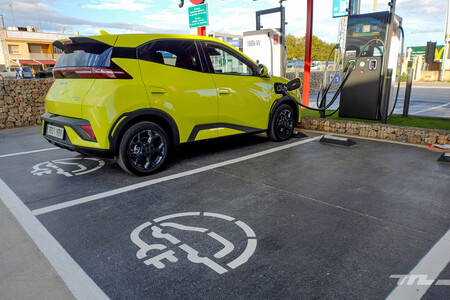
As with other urban utilities, highway range will be more restricted, with consumption around 24 kWh/100 km at 120 km/h, which translates to a maximum range of 180 km. But since it’s rare to stop charging with less than 10% and resume with more than 80%, the useful range then drops to 125 km between two fast-charging stops. In practice, it amounts to leaving Barcelona for Valencia, for example, and stopping to recharge once just after Tarragona.
When it comes to charging, the Dolphin Surf supports up to 85 kW in DC and promises to go from 10% to 80% in 30 minutes. It has achieved a 120 kW charge, and again with BYD, the charging curve stayed high, near 80 kW, throughout the session.
Price and alternatives to the BYD Dolphin Surf
BYD boasts a Dolphin Surf for less than 20,000 euros (from 18,780 euros). It isn’t a lie, but it refers to the entry-level BYD Dolphin Surf Active. It has an 88 hp electric motor and a 30 kWh battery with which it homologates 220 km of range in the WLTP combined cycle.
In general, this is what the competition offers. The Citroën ë-C3 and Fiat Grande Panda duo advertise 320 km WLTP with a 44 kWh battery, and the 20,000-euro version also uses a 30 kWh battery. As for the entry Renault 5, it promises 310 km WLTP with a 40 kWh battery.
It is true that for under 20,000 euros you will have to settle for limited autonomy, but the standard equipment is complete. As standard, it includes connected GPS, air conditioning, rear-view camera, and adaptive cruise control.
The mid version adds a larger battery (43.2 kWh usable), 17-inch wheels, automatic wipers, and an electric driver’s seat, all for 22,780 euros. Finally, the top-of-the-line version offers a 360° camera, wireless phone charger, heated front seats, and automatic headlights in exchange for 25,280 euros.
The Comfort version of 156 hp we tested isn’t exactly the cheap car per se that the brand wants to sell us, as it starts from 26,490 euros (before discounts or offers). Still, it is a cheap model relative to the rest of the market. An equivalent Renault 5 (150 hp and 50 kWh battery) costs almost 30,000 euros.
As for the Dacia Spring, another very affordable urban EV, it feels somewhat limited in its versatility. Even in its entry version, the Dolphin Surf offers more power and equipment, albeit with a similar range.
Only the Citroën eC3 presents as a rival to the Dolphin Surf. Its modern and more mainstream design, along with a similar autonomy across all versions and a price that sits around BYD’s could make us hesitate.
BYD Dolphin Surf Comfort: our rating
7.5
7
7
7
7
8
8
7
8
8
8
Pros
- Price
- Fully featured standard equipment
- Good performance
Cons
- Potentially improvable traction
- Very weak regenerative braking
- Lane-keeping assistant too intrusive
The BYD Dolphin Surf not only stands out for its highly competitive price, but it also shines on its own against its rivals. Its impressive equipment list, its dynamism, and its well-curated presentation make it an almost ideal proposition for those seeking a compact, affordable, and spacious car.
That said, some details can be bothersome, such as a screen that still isn’t ideal to use or the absence of a fifth seat, aspects that could tilt the balance toward more conventional options when buying.
|
|
|
|---|---|
|
Motor |
Electric, front axle. |
|
batería |
Lithium iron phosphate (LFP) 43.2 kWh usable. Maximum charging power: 85 kW (DC) and 11 kW (AC) |
|
potencia máxima |
115 kW (156 hp) |
|
par máximo |
220 Nm |
|
transmisión |
Front-wheel drive. |
|
dimensiones (Largo x ancho x alto) |
3,990 x 1,720 x 1,590 mm |
|
batalla |
2,500 mm |
|
maletero |
308 liters |
|
peso |
1,465 kg |
|
80 a 120 km/h |
5.5 s |
|
0 a 100 km/h |
9.1 s |
|
velocidad máxima |
150 km/h |
|
consumo medio homologado (WLTP) |
16 kWh/100 km |
|
consumo medio en prueba |
19 kWh/100 km (13 kWh/100 km en ciudad) |
|
Autonomía eléctrica media homologada (WLTP) |
310 km |
|
Autonomía eléctrica en prueba |
227 km |
Find your ideal electric car
If you have considered buying an electric car, this will interest you. We have created the Personalized Electric Car Recommender, where besides seeing models that fit your needs you’ll also get answers to the questions that worry you most, such as price, range, or nearby charging points.
|
The car used for this test was provided by BYD. For more information please consult our guide to corporate relationships. |