Founded in 1997, the Chinese group Chery has undergone meteoric growth. For instance, in 2025 it produced nearly 2.8 million vehicles, about 1 million more than Renault and roughly 400,000 more than Stellantis. And the Chinese giant has no intention of stopping there: it aims to accelerate its sales even further, with the European market squarely in its sights. It is in this context that the Omoda and Jaecoo brands enter the scene.
In brief
The Jaecoo 7 SHS-P 279 hp Exclusive marks the striking entry of a new Chinese brand into the European family-SUV market. This plug-in hybrid captivates with its ostentatious design, its rich equipment, and its high-performance hybrid system. While the driving experience impresses with its modernity and its equipment, comfort is a bit short of perfection and the ergonomics of the multimedia system remain the main areas for improvement. With a competitive price and an enticing advertised range, the Jaecoo 7 could well shake up the segment’s benchmarks.
Jaecoo 7 SHS-P 279 hp Exclusive: close to a Citroën C5 Aircross
Launched in 2023, these two brands have shown fairly compelling results in the countries where they are already established, notably in Spain with 23,000 registrations, and even 53,000 units sold in the United Kingdom. While awaiting the arrival of the Omoda models, which aim for a more upscale crossover positioning, Jaecoo kicks things off in France with a compact SUV.
The Jaecoo 7 adds to an already highly competitive segment where the headliners include the Peugeot 3008, Citroën C5 Aircross, Volkswagen Tiguan, and MG EHS. As a novelty, our test underscored that the vehicle does not go unnoticed on the street and raises a number of questions.
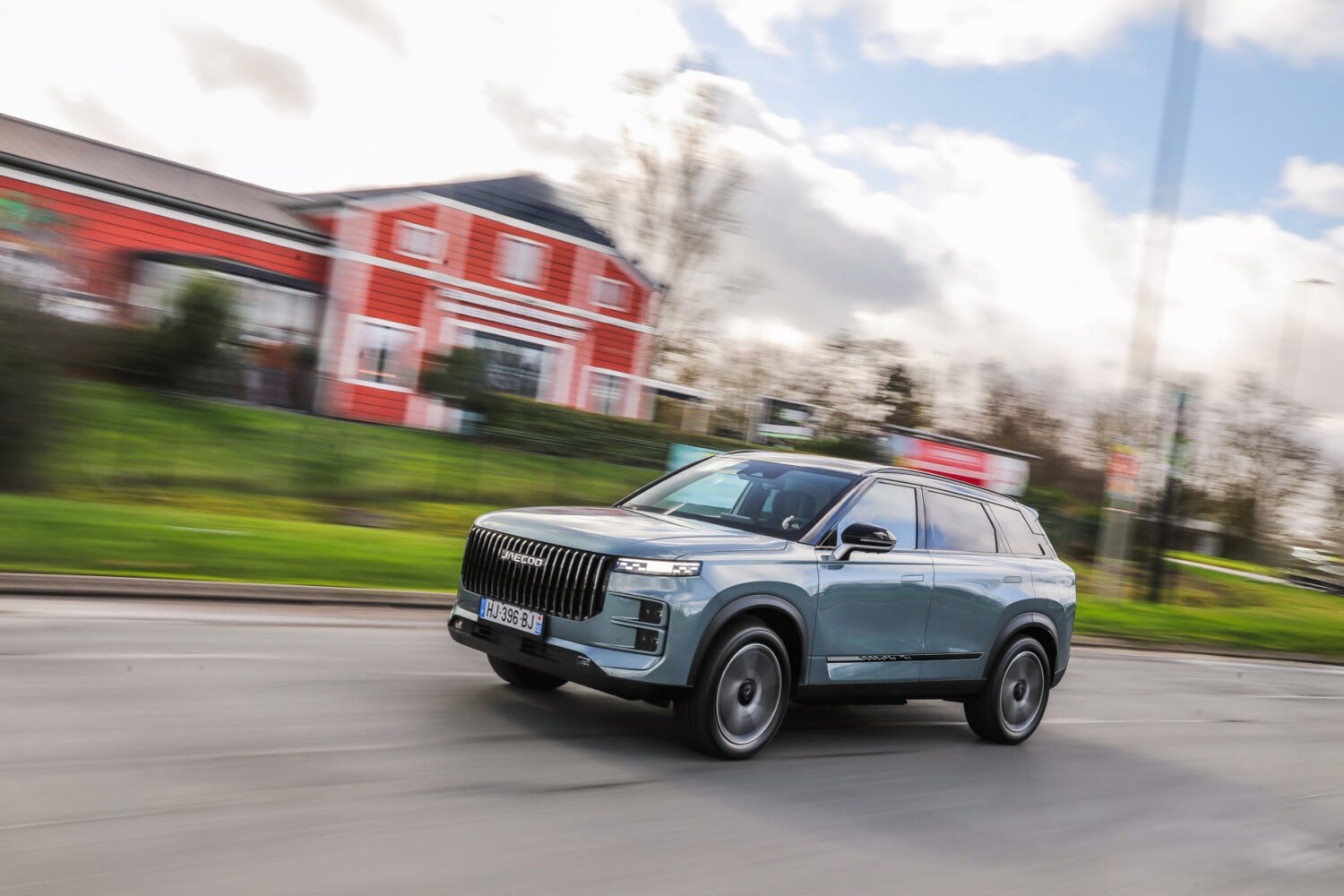
You have to admit that its particularly ostentatious design grabs attention. Readily identifiable, the Chinese SUV is distinguished by a large, boxy grille and double-deck full-LED headlights. The rear is more understated, with styling that evokes a Range Rover. Notably, the spoiler integrates the wiper discreetly and there’s a broad light band. In terms of size, the Jaecoo 7 is close to a Citroën C5 Aircross, for example, at 4.50 m long and 1.86 m wide.
Jaecoo 7 SHS-P 279 hp Exclusive: a level of modernity that surprises
But the Jaecoo makes its strongest impression once you’re inside. Beyond the careful presentation, it’s the level of modernity that stands out, anchored by a prominent vertical 14.8-inch (37 cm) touchscreen, reminiscent of the Tesla universe. Very feature-rich, the interface nonetheless demands a period of adaptation to become familiar with its many menus and submenus. It consequently forces the driver to frequently take eyes off the road, even to access basic functions. This is a point the manufacturer will absolutely need to improve if it wants to rival its competitors on this front. The cockpit also benefits from numerous storage spaces, such as the large central bin. Build quality is generally satisfactory: the upper areas use fairly premium materials, while the lower zones rely on more ordinary plastics, which is more open to critique. Finally, according to our initial observations, the cabin space also appears to be a strong point for the Jaecoo, with dimensions in the mid-range of its class. Only the cargo area (500 liters, per the manufacturer) seemed a bit tight, with a fairly high load lip. For now, the brand offers two powertrains: a full hybrid and the plug-in hybrid version of our test. The latter pairs a 1.5-liter turbocharged gasoline engine producing 143 hp with an electrified drivetrain delivering 204 hp in a single gear and powered by an 18.4 kWh battery. Combined system output: 279 horsepower. According to the manufacturer, this system would permit up to 90 km of range in 100% electric mode. We will verify this in a forthcoming long-term test. Also note that the battery accepts fast charging up to 40 kW — enabling a 30 to 80% energy recovery in 20 minutes, which is handy for reducing average consumption on long journeys.
Jaecoo 7 SHS-P 279 hp Exclusive: comfort that disappoints a bit
All things considered, we were drawn to the smoothness, the running feel, and the overall performance. The power delivery is lively and the transition from petrol to electric is seamless. It is, of course, possible to tailor the electric assistance to the situation, for instance by conserving energy in the battery for a future urban leg. On our roughly 93-mile (150 km) route, blending highways and city traffic, the onboard computer showed an average consumption of 6 L/100 km. That figure should be interpreted with caution, since we didn’t manage to drain the battery completely: the electric motor continuously aided the 1.5 turbo petrol engine. Another plus is the large 55-liter tank, paired with the stated electric range, which would give a total range slightly over 1,000 km according to the manufacturer. A strong argument for long-haul drivers. If the Jaecoo 7 handles well on the open roads, its comfort level was a touch disappointing. The suspension was set too firmly, diminishing passenger comfort, and the vibrations could be noticeable on rural roads. But the main takeaway is the price-to-equipment ratio, where the Chinese SUV punches above its weight. Priced from €35,990, the Jaecoo 7 offers a level of equipment that can make rivals pale—even before you consider the Exclusive trim, which our test model wore, at €37,990. This version includes a panoramic roof, semi-autonomous driving, leather upholstery, heated and ventilated front seats, a power tailgate, a head-up display, and an innovative 540° camera (360° + 3D!). And the list of features doesn’t stop there…
Jaecoo 7 SHS-P 279 hp Exclusive: the positives
- Price
- Rich equipment
- Hybrid system
Jaecoo 7 SHS-P 279 hp Exclusive: the negatives
- Comfort somewhat lacking
- Multimedia system ergonomics
- Brand image still forming
The Auto-Journal’s verdict: 4/5
A bold entry. Until now, no compact plug-in hybrid SUV boasted a price-to-performance ratio as competitive. The Jaecoo 7 is well equipped, spacious, well finished, and powered by a coherent drivetrain. Its drawbacks lie mainly in comfort and the multimedia system’s ergonomics.
Jaecoo 7 SHS-P 279 hp Exclusive: in measurements
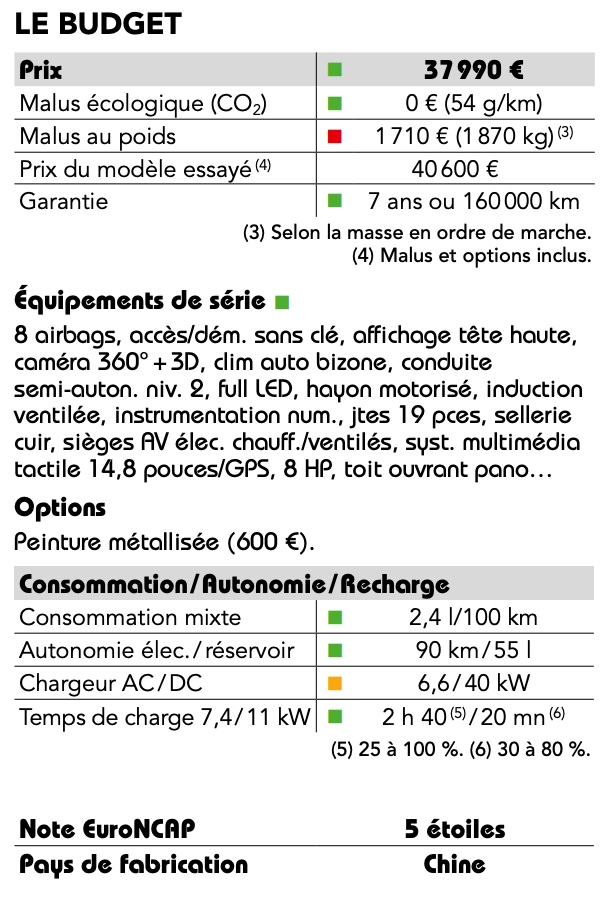
Find our first Jaecoo 7 SHS-P 279 hp Exclusive test in l’Auto-Journal no. 1204, March 5, 2026.
Comparison table
| Criterion | Jaecoo 7 SHS-P 279 hp Exclusive |
|---|---|
| Length | 4.50 m |
| Width | 1.86 m |
| Boot capacity | 500 liters |
| Total power | 279 hp |
| Battery | 18.4 kWh |
| Estimated electric range | 90 km |
| Max charging speed | 40 kW |
| Starting price | €35,990 |
| Exclusive price | €37,990 |
| Measured combined consumption | 6 L/100 km |
| Gasoline tank capacity | 55 liters |
| Total range announced | >1,000 km |
The essentials to remember
- The Jaecoo 7 SHS-P 279 hp Exclusive rises as a new plug-in hybrid family SUV on the European market.
- Its distinctive design and its very comprehensive equipment make it a serious rival in its segment.
- The announced all-electric range is 90 km, with a combined output of 279 hp.
- The Exclusive version is listed at €37,990 and comes with a host of premium features as standard.
- The main drawbacks noted concern the ride comfort and the ergonomics of the multimedia system.
- An attractive price/performance ratio that could lure many buyers.
FAQ
What is the announced electric range of the Jaecoo 7 SHS-P 279 hp Exclusive?
The manufacturer claims up to 90 km of range in 100% electric mode.
What is the price of the Jaecoo 7 Exclusive?
The Jaecoo 7 Exclusive is listed at €37,990.
What are the main standard features on the Jaecoo 7 Exclusive?
A panoramic sunroof, semi-autonomous driving, leather upholstery, heated and ventilated front seats, a power tailgate, a head-up display, and a 540° camera.
What was the measured combined consumption during the test?
The onboard computer showed an average of 6 L/100 km over 150 km.
What were the main drawbacks noted during the test?
Suspension comfort considered improvable and the ergonomics of the multimedia system.