
In the world of large electric sedans, talk is often about range, power, or giant displays. Much less about how you turn the wheel. And yet, it is precisely there that Mercedes-Benz has chosen to shake up expectations with its electric flagship, the Mercedes EQS, by preparing an evolution that goes right to the core of the bond between driver and car.
In Brief
Mercedes-Benz introduces on the refreshed EQS a fully electronic steer-by-wire system, a first for a German automaker. This technology removes the mechanical link between the steering wheel and the wheels, in favor of electronic signals and a refined driving feel. The system promises crisper handling, enhanced comfort, and easier maneuvers, aided by the 10-degree rear steering. Safety is bolstered by electronic redundancies and extensive long-distance testing. For purists, the traditional electro-mechanical steering remains available in the lineup.
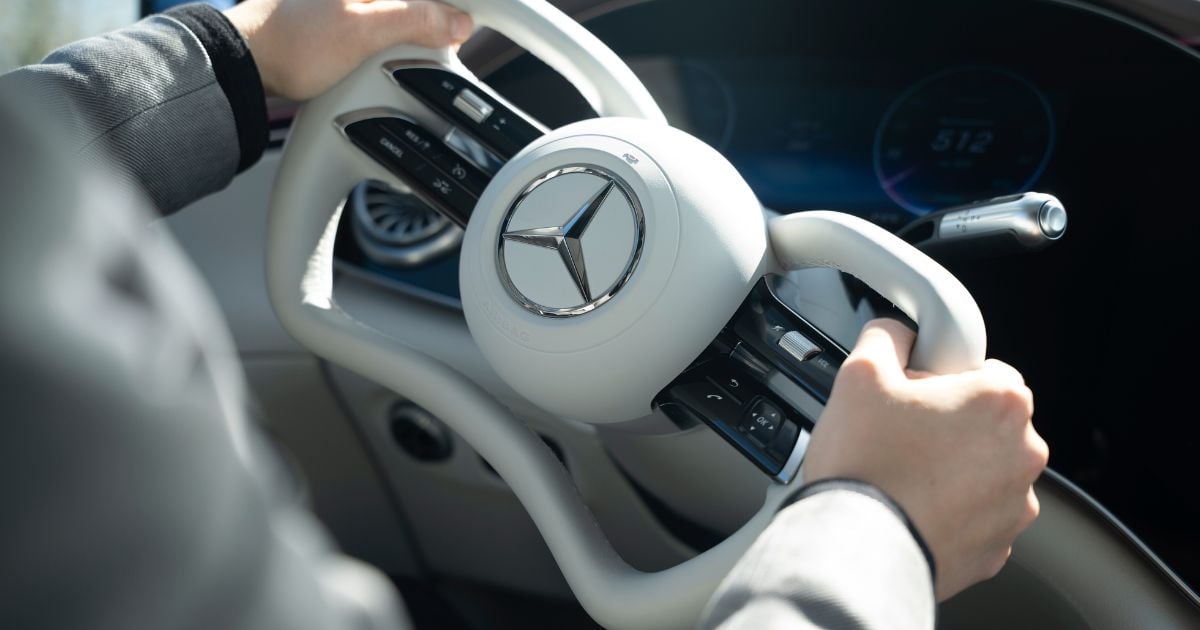
Just a few months after the launch of the new EQS, Stuttgart-based brand is poised to introduce a completely unprecedented steering technology on a production model, featuring a new compact, flattened steering wheel, a driving feel described as finer, and daily comfort boosted. A break with tradition for a company that boasts 140 years of automotive history—and this time promises nothing less than a new way to pilot its flagship electric, to the point of becoming the first German manufacturer to cross this threshold.
Mercedes EQS: A New, Production-Ready Steer-By-Wire System
Mercedes-Benz will indeed offer steer-by-wire technology on the refreshed EQS electric sedan, making it the first German automaker to install it in a production vehicle. In practice, this architecture eliminates the traditional mechanical link between the steering wheel and the front wheels and replaces it with electronic signals. On the EQS, this system will be available with all powertrains and will be paired automatically with the 10-degree rear steering, already known for reducing turning radius and improving stability.
This new steering device was developed to filter out road-born vibrations while preserving a Mercedes-like feel. The tire-road contact forces are reconstructed through modeling calculations to give the driver precise feedback in the wheel. Mercedes-Benz even describes this new generation of steering as “precise, intuitive and effortless — that’s how the new steering feels in the EQS,” the brand explains. The payoff is easier maneuvers, less steering effort, and an even finer balance between sportiness, comfort, and lateral agility, especially thanks to the joint work with the rear-steering system.
Steering Wheel, Safety and Testing: How Mercedes Secures Its Electronic Steering
To accompany this shift to electronic steering, the interior of the EQS steer-by-wire adopts a new flat, more compact steering wheel. The design frees up more space in front of the driver, improves the view of the display, and makes getting in and out easier. Mercedes describes this as a way to reinforce its “Welcome home” ambiance as soon as you sit behind the wheel. This change in form necessitated a complete redesign of the airbag structure: the deployed cushion can no longer rely on a closed hoop, so it is guided by an internal support and folding architecture that controls its shape during deployment, while maintaining occupant retention and safety standards unchanged compared to a traditional wheel.
On the safety front, the company notes that it has logged more than one million miles of testing across benches, tracks and open roads. The electronic architecture rests on two independent signal paths, to guarantee the ability to steer the vehicle even if one channel fails. And in the extremely unlikely event of a complete system outage, lateral control remains possible thanks to the rear steering and wheel-by-wheel braking interventions via the electronic stability program. For customers who prefer a more traditional setup, Mercedes-Benz continues to offer a conventional electro-mechanical steering as an alternative, while the EQS stands as the brand’s technological showcase for driving dynamics and the feel behind the wheel.
Key Takeaways
- The EQS marks the first time a German-production car offers a 100% electronic steer-by-wire system.
- The mechanical link between the steering wheel and the front wheels is replaced by electronic signals for a more precise and intuitive feel.
- The setup includes a new compact, flat steering wheel, 10-degree rear steering, and aims to boost everyday comfort.
- Mercedes developed a safety system with two independent electronic circuits and more than a million miles of testing.
- The manufacturer offers a traditional electro-mechanical steering option for customers wary of electronics.
- The EQS thus reinforces its role as Mercedes-Benz’s technology showcase.
FAQ
What is steer-by-wire steering on the Mercedes EQS?
It is a system where the mechanical linkage between the steering wheel and the wheels disappears in favor of electronic signal management, offering a different driving feel.
Will this system be available on all EQS versions?
Yes, steer-by-wire will be offered with all powertrain options of the new EQS refreshed.
What are the promised benefits of steer-by-wire?
Steer-by-wire promises a more precise and intuitive driving experience, increased comfort, easier maneuvers, and a balance between sportiness and lateral agility thanks to the rear steering.
How is safety ensured with this technology?
Safety rests on two independent electronic circuits and testing over more than a million miles. In the unlikely event of a complete system failure, rear steering and stability-program interventions take over.
Are there alternatives to this system on the EQS?
Yes, Mercedes-Benz continues to offer a conventional electro-mechanical steering as an alternative to steer-by-wire.