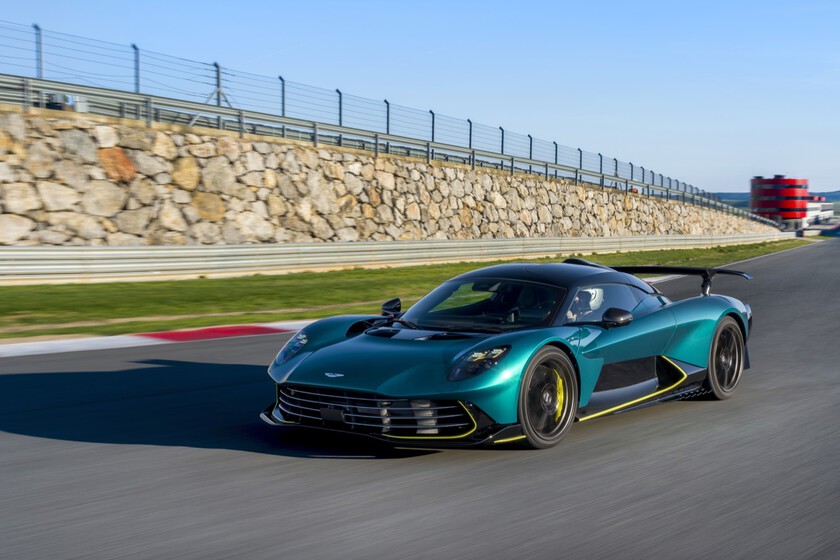
At the now-defunct Geneva Motor Show of 2019, Aston Martin shocked the world by unveiling prototypes of two very special hypercars, the Valkyrie and the Valhalla. Now, seven years later, we’ve had the chance to test the second of them, a car that is especially meaningful for the Gaydon brand in many ways as it marks production in several respects and, in my opinion, the best Aston Martin I have ever driven.
The Valhalla arrives as the first production Aston Martin with a mid-mounted engine, and also as the first production PHEV (plug-in hybrid), since it combines a flat-crank V8 Twin Turbo engine with three electric motors that allow it to do things hitherto unimaginable for Aston Martin. I’ll tell you all about it in detail.
The test of the Valhalla took place at the spectacular Navarra Circuit for the most track-focused driving portion, and it was paired with a road trip along the always beautiful and winding roads surrounding the area. Why test it in two such contrasting environments? Because Aston Martin wanted us to verify for ourselves that this car blends the best of a supercar with a level of on-road usability you might not expect from its exterior appearance.
Hypercar design at a supercar price

The Aston Martin Valhalla is one of those cars that, when you see it up close, makes you dream of having the money to buy it one day. It has an appearance close to the current hypercar look: nothing about it would send a modern McLaren W1, a Ferrari F80, or the former Porsche 918 Spyder, Ferrari LaFerrari, or McLaren P1 running for cover, to name a few.
The front end preserves an element that is present on all Aston Martins and which they might have done without here since the mechanicals are mid-mounted. I’m talking about the wide, low grille that defines the styling of the front, very pointed and sharp.
Above it sits a very short fixed bonnet that houses on the sides the teardrop-shaped headlights, inspired by those of the Valkyrie though considerably larger. The use of opposed Push Rod suspension allows the overall height of the car’s snout to be very low, even lower than the natural height that the wheel arches would require to enclose the 20-inch front tires (the rear wheels are 21 inches).
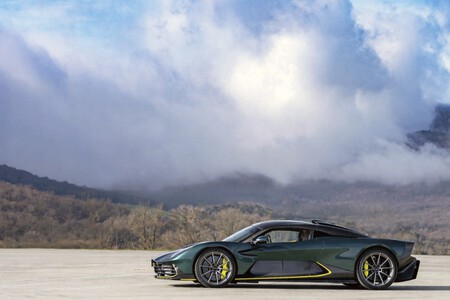
The compact cabin is set very far forward, almost on the front axle. Almost all of the car’s body is made of carbon fiber, and it follows the principle of “form follows function.”
In fact, all the parts that appear in black or visible carbon are active aerodynamic elements, while the rest of the painted bodywork is simply that—design and form of the car.
Highlights include the dihedral doors with forward hinges, which, besides marking their design when they open, also provide a wide entry space into the cockpit and the carbon fiber seats.
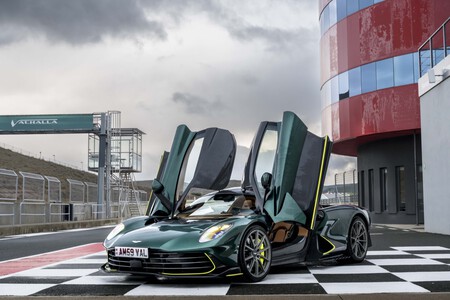
The doors, when opened, free the side pontoon and allow very easy access into the car
That’s because of the large roof section they push aside, and also because when opened they free the entire space of the side pods, making the cockpit, defined by the carbon fiber monocoque chassis, very accessible and easy to climb into.
Not only for that are the doors special in this car. They are also part of the Valhalla’s aerodynamics, as the airflow that exits the front wheel arch is channeled through ducts hidden in the doors toward the engine oil coolers for the V8 and the transmission.
This solution keeps the exterior surface clean and free of visible air intakes, yielding a swept, elegant look at the same time. The exterior mirrors have rounded shapes and are mounted on two arms that protrude well from the side line of the vehicle, making it easy to see surrounding traffic.
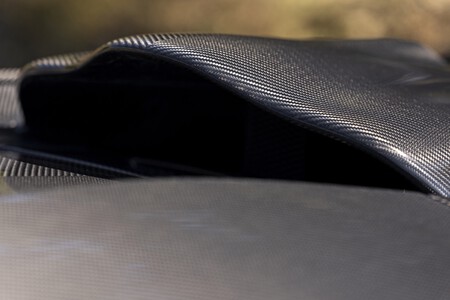
The body is extremely low. Only the roof air intake protrudes slightly, inspired in much of the car’s design by Formula 1, directing air toward the engine’s intake, intercoolers, and a cooling duct for the engine bay.
Continuing toward the rear, we reach the exhausts, placed high above the engine bay. Their sleek, visible design gives that part of the car a very sporty touch. There are also two exhaust outlets lower in the diffuser.
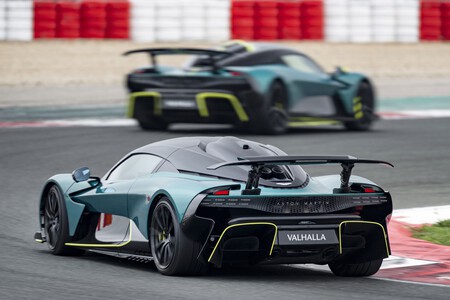
A super-detailed diffuser with two large venturi tunnels that accelerate the air flow under the car and generate downforce. In this regard, special mention goes to the wing, which in its rest position sits flush with the body and does not protrude an inch from the car’s profile.
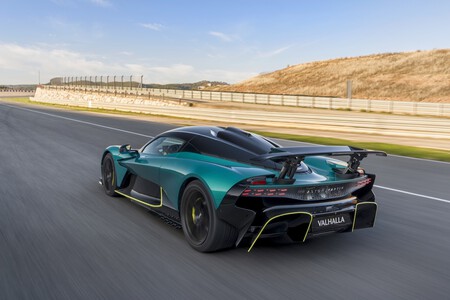
It is an active spoiler that, in Race mode, rises 255 millimeters and begins to move its wing in a T shape to suit the moment’s needs. At 240 km/h maximum downforce of 600 kilograms is achieved and maintained up to 340 km/h.
At the same time, it has a DRS system that reduces aerodynamic drag as the car speeds up, allowing it to reach 350 km/h, at which point the electronic limiter cuts in to prevent going any faster.
The wing’s movement is constant, since it acts in under half a second to adjust its inclination and does so in harmony with two front wings that are integrated into the front splitter. It is clearly visible from the camera projecting the rear image where, on a conventional car, the interior mirror would be. But while we’re at it, let’s see what the interior has in store for us.
Two roomy seats, but no trunk at all
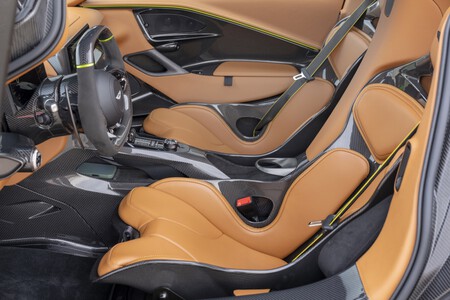
As mentioned earlier, the Valhalla’s doors allow entry into the car with a level of ease never seen in cars of this type. Here you don’t have to contort yourself as you do in its Valkyrie sibling. You simply slide your backside into the seats, which, mind you, are placed very low and have a slim, padded carbon fiber structure.
Once seated in the driver’s chair, what sits before you is a steering wheel with a rather curious shape. Flat at the top and bottom, it is very wide and could be described as more rectangular than round.
We have satellites coming out of the steering column with a clearly Mercedes origin, but their operation is correct. Behind the wheel, a screen acts as the instrument cluster. It lets you access all the car’s information quickly and easily, but it’s true that in cars of this level digital instrumentation doesn’t always align with the luxury experience you expect aboard.
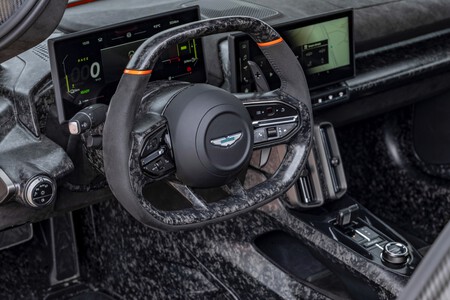
The personalization program allows you to choose, for example, the type of visible carbon fiber for the interior
Marking the center between both seats is a carbon weave running from front to back, and above it the instrument panel floats. It is also this stringer that supports the central air vents, which are arranged vertically.
It features electric adjustment for the steering wheel and steering column in both height and reach, but the seats can only be placed in one of three reclining positions using a key, and they can also slide forward by pulling a strap located between the occupant’s legs.
Exposed carbon, leather covering much of the cabin, and generally the use of high-quality materials make the sensation feel like you are in a very sporty yet somewhat luxurious car at the same time.
We hit the track with 1,079 to enjoy
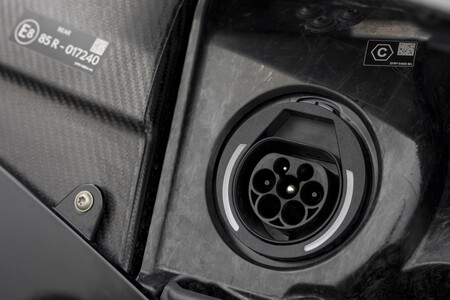
The Valhalla features a central 6.1 kWh battery that can also be charged by the combustion engine or by plugging it in. For this, it has a hidden plug on a panel above the gasoline engine, on the car’s left side. You lift it and you find the plug, which for some will feel like sacrilege.
Thanks to this battery, it can move in electric-only mode for up to 12 kilometers. Purists may gasp, but it makes sense, for example, to start the car in your home garage on Sunday morning before heading out for a drive, avoiding waking the whole neighborhood.
But naturally, being at Navarra Circuit, which has recently been modified and expanded (now owned by British enthusiasts), our main objective wasn’t to test its EV mode.
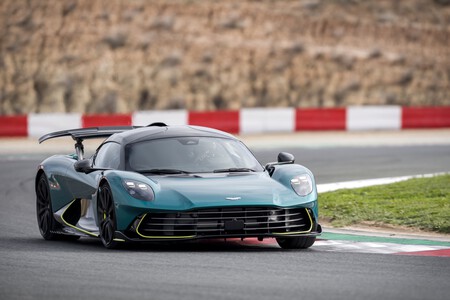
Here we were here to have fun, enjoy the car, and push its limits. So, after a few laps to familiarize myself with Navarra’s layout behind the wheel of the new Aston Martin DBX S, which, by the way, impressed me positively with how fast it allows you to go on track, we were ready to go out onto the circuit with the star of the day.
There would be a total of three 25-minute sessions. In the first, I started in Sport mode. The sound inside the car is significantly more emotive than outside. The V8 4.0 Twin Turbo is AMG-origin, but it isn’t the same one used in, for example, the Vantage or the AMG GT.
It’s a V8 Twin Turbo with a flat crank, the engine AMG developed to try to break the Nürburgring record. It sounds different and feels different from traditional V8s, and Aston Martin assured us that they source it exclusively for this car and you won’t find it in another car.
In the fast corners that follow the finish straight, two very fast right-hand bends, I feel I sit very far forward and with an extremely direct feeling on the front axle. It’s like sitting between both wheels.
You have a very quick and immediate connection with the front wheels, because as soon as you turn the wheel you feel the car dive toward the corner you’ve marked. The carbon-core monocoque weighs only 74.2 kilos and provides an outstanding level of dynamic sensitivity.
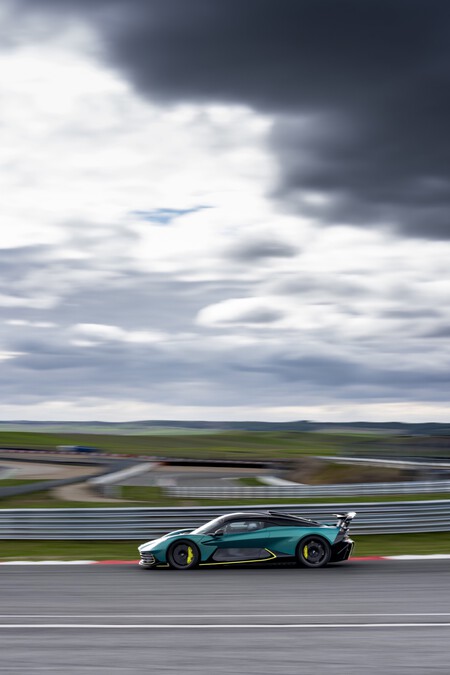
At the exit of the corners, the car is a true rocket. It goes from 0 to 100 km/h in 2.5 seconds, which is an excellent figure, but what’s even more striking is that the 100 to 200 km/h sprint is almost as fast as the previous benchmark.
The push you feel is colossal, which you would expect given the 1,100 Nm of torque listed in the specs. That torque is as commanding as few others, because the V8 4.0 TwinTurbo always runs in concert with the three electric motors.
Two motors are mounted on the front wheels and spin up to 19,000 RPM. The third is integrated into the gearbox, which is eight-speed with a dual-clutch. The instant nature of the electric torque and the constant, strong shove of the V8 make the experience simply overwhelming.
With the paddles behind the wheel you upshift, and you must be quick with your fingers because with so much power the shifts happen every few seconds.
In fast corners the car’s stability is simply magnificent. It’s one of those cars where the faster you push into a bend, the more grip it seemingly plants on the asphalt.
That’s due to the car’s enormous aerodynamic development behind it, even if it doesn’t look that way at first glance. From the interior rearview mirror I can see the wing opening and never stops moving as you drive.
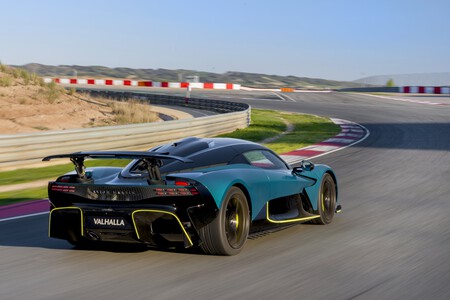
Leaving the slowest corner of the circuit, a right-hand arc of about 30 degrees opens up the longest straight. In first gear I floor it and the car surges forward with unimaginable power. I upshift with the pedal to the floor and in the blink of an eye I’m approaching 240 km/h and closing in on the next right-hand bend.
I push the brake pedal to the floor and the car stops in far fewer meters than I expected. The braking power is very high, but the wing’s aero-brake mode also helps. It can angle up to 51.5 degrees to resist the forward motion and help stop in the fewest meters possible. At maximum load its angle is 45 degrees.
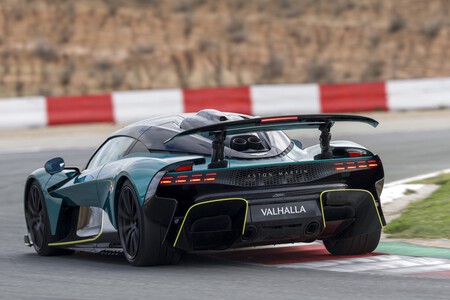
Seeing the airbrake in the rear-view mirror while you keep your head in check and at the same time your eyes don’t wander is quite the experience.
In slow curves the car feels light, and it is. With a total weight of only 1,665 kilograms, the Valhalla is a featherweight by today’s standards, and that is something you notice.
Race mode, an absolute car show
I wrap up the first session truly impressed by the Valhalla’s performance. In the next two 25-minute sessions, I decide to configure it in Race mode, which is the most suitable for getting the most out of the track. Moreover, of the nine traction-control levels, I select 6 to have some electronic assistance at all times.
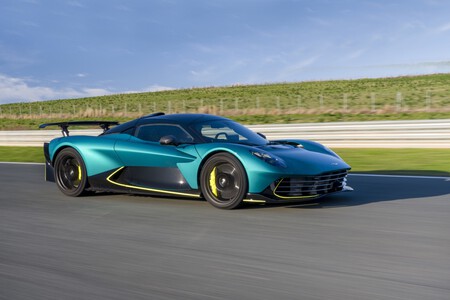
Step onto the track and immediately notice that the car has gained rigidity. It holds a perfectly flat stance in the bends, regardless of how much support you give to the outer tires, and everything happens with immediate clarity.
The acceleration is brutal, to the point that I even slightly feel nauseous in some high-speed sections. No matter what anyone says, the human body isn’t used to these G-forces, and I don’t know many people who could keep their necks pristine like Fernando Alonso could.
The car’s rear Electronic Differential and torque vectoring system make it feasible for many drivers to push it fast
The 1,100 Nm of torque push with unprecedented force and immediate response when you floor it, since the front wheels driven by the electric motors and the V8 combined with the other electric motor in the gearbox make everything happen very quickly.
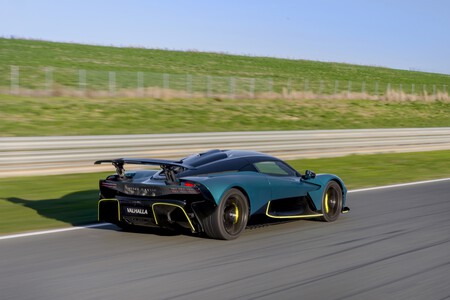
With the paddles behind the wheel you shift up, and you must be fast with your fingers because with so much power the shifts happen every few seconds.
Then weight transfer is immediate, and the car feels more like a lightweight machine such as a Caterham than a 1,000+ horsepower supercar. The car has an excellent weight-to-power ratio, with 620 HP for every 1,000 kilograms. And you can feel it at the wheel. Once I gain confidence, I start pushing the pace further, aware I’m near my limit as a driver.
The braking power is excellent, but the car also remains stable in the path even when braking with the steering wheel turned. Carbon-ceramic brakes with 410 mm discs on the front axle are pinched by six-piston calipers, while the rear discs are 390 mm with four-piston calipers, but beyond the power I like their feel.
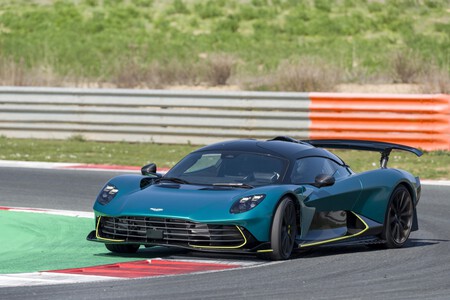
Regardless of when you brake, from the first press of the pedal until you release to let the car proceed into the corner, you have a precise braking feel that prevents overbraking. And don’t forget there’s a back-up parachute—the rear wing when vertical—that also helps bring you to a stop.
The gearbox’s speed is another standout feature. It allows seamless upshifts with immediacy, but it also lowers two gears at a time with a touch of the levers. It enables things like staying in fifth and tapping the lever three times with the plus to drop directly to second gear.
That’s because the engine positioned within the gearbox makes it possible. And that translates into absolute effectiveness on track. But beyond all this, the most notable thing is how easy it is to exploit its mechanics.
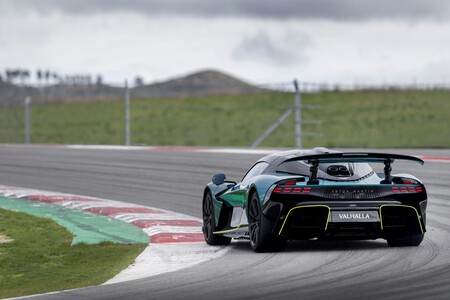
With those power and torque figures, a car could overwhelm you and become undrivable, making the experience unpleasant. That doesn’t happen with the Valhalla, which makes the difficult easy.
It has all-wheel drive, though there’s no physical connection between the front and rear axles. But at the front, the two electric motors allow via the E-TV system to distribute torque individually to each wheel. The front axle also combines with the rear, making a constant torque distribution that greatly helps transfer torque and power to the asphalt.
I think the Valhalla has more than fulfilled what was expected of it. It is an extremely fast car and super effective on track. It’s easy to drive and can post lap times that match the power it offers. But there’s one thing I didn’t expect about it.
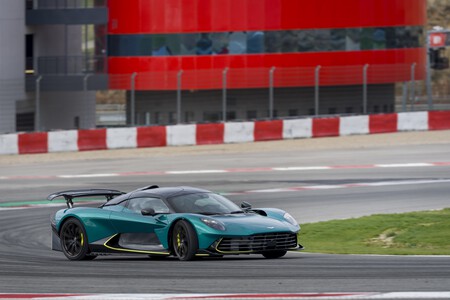
I did not expect it to be a drifting machine as it is. In the ESP-Race mode, the ESP traction control is less intrusive. You can play with the nine levels of electronic intervention to play with some super-addictive drifts that you achieve simply by pressing a bit more accelerator in the bends.
Then the rear tends to step out ahead of you, a maneuver that’s relatively easy to control if you can keep feeding the throttle while power is distributed to all four wheels and the front axle gets more and more to pull it out of the curve and forward.
What’s the result? I never expected to be drifting a nearly-million-euro supercar instead of cruising with precision and elegance like James Bond would on a track day, but… we’ll take it.
On the road, a true GT
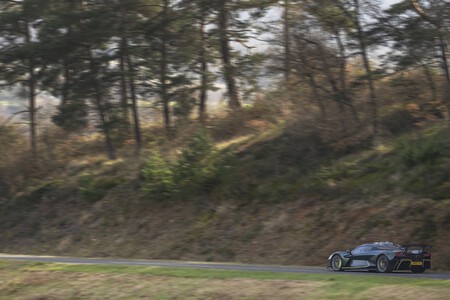
If on track the Valhalla had met expectations, on the road it didn’t. It didn’t because I expected to find a hard, uncomfortable, radical car as many might think from its appearance and setup, and the reality when you drive it on open roads among ordinary mortals is quite different.
We had a little over an hour-long route around the Navarra surroundings, and in these conditions the Valhalla shows its friendlier side. In Comfort mode the car’s character, which we spent the morning on track with, hides away, replaced by a docile and even quiet car, because in the early kilometers with battery load it tended to run in electric mode.
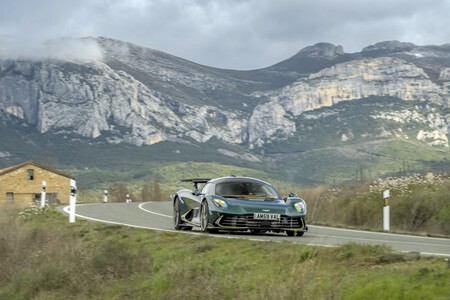
In this mode you can combine the best of the GT world with a high-performance supercar. And they’ve achieved it. They’ve achieved it because the Bilstein suspension damps the road imperfections with notable dignity and doesn’t make the onboard experience uncomfortable. You don’t notice you are in a stiff car at all.
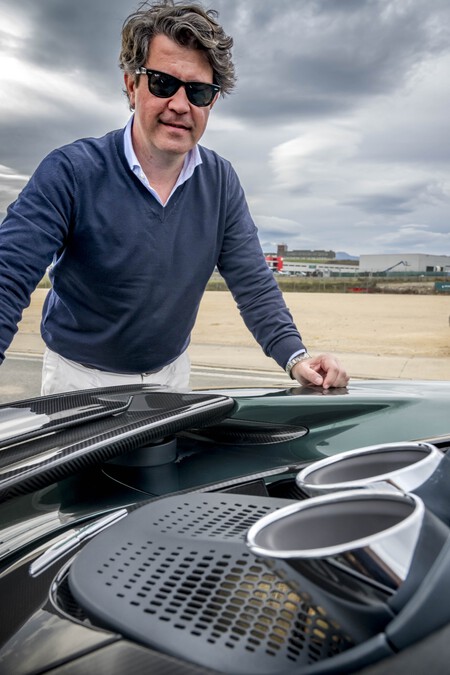
Similarly, the engine sound is mellowed to inaudible levels when you travel in a calm mode. Silence rules the cabin, and that’s welcome because it allows you to converse with your co-pilot as you would in a Vanquish. No shouting.
Although the glass surface around the car is fairly low, front visibility is very good thanks to the design of the nose, which sits notably lower than the windscreen. The rear is always visible via the camera projecting an image where the interior rearview mirror would be, and it does so with absolute clarity and smoothness.
The only downside I find when using it as a GT is that it has no trunk of any kind. Not a single storage space. No storage compartment for luggage or a helmet. You won’t be able to carry a bag behind the seats. And that could be a problem if, for example, you want to take a weekend trip with your partner.
Conclusions and price of the Aston Martin Valhalla
Aston Martin has made a truly special car with the Valhalla, dedicating six years to its development. That’s the time that has passed since the first prototype was shown in 2019 until last year when the first units started being delivered to customers.
I say it’s a special car because it occupies a very interesting position. The base price of the Valhalla is around €850,000, and from there you can start personalizing it to your taste with options and extras, or with everything the Q by Aston Martin program allows.
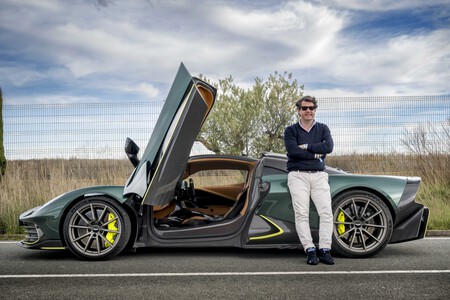
It is a very tight price for a car with design and technology from the hypercar segment, placing it only half a rung above cars like the Lamborghini Revuelto or the Ferrari 249 Testarossa.
In terms of design, I think it’s a car that wins hearts. In terms of track behavior as well, because you can opt to drive it finely and precisely or play with drifts at will with ease. And on the road it offers a level of ride comfort you would expect from an Aston Martin.
Only 999 units will be produced of what could be the best Aston Martin to date. A car that, in a very short time, will become a coveted object for automotive enthusiasts around the world.
So, and even though it may sound cliché whenever we talk about Aston Martin, I think the Valhalla is the car James Bond would choose if one of his hobbies was to go to circuits for track days. Because I believe no other car today offers so much for so little, with such elegance.