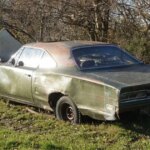
In a rural field along a small creek, an old muscle car stands as a totem to the cows. Instead of the rumble of a V8, you hear only the whisper of leaves—a tree has literally grown through the car, its trunk piercing the hacked sunroof.
This almost surreal scene features a neglected 1969 Dodge Super Bee, a basic pillar-post automatic version, bought in the early 1980s and never pulled from the field since. The YouTuber Ryan, from the Auto Archaeology channel, documented it the first time in 2011, then returned more than a decade later, a bit astonished to find it still there, with its tree… and even a new buyer found via Facebook Marketplace who’s slow to come pick it up.
From Track to Field: How This 1969 Dodge Super Bee Was Put Through Its Paces
Before rust finally chewed it away in the grass, this Super Bee would have been a local race car. Ryan says a previous owner had wrecked it in two stages: a crash with the front-right against a tree, then a slide along a concrete wall on the driver’s side. He recalls: “the owner before this family had hit a tree on the front-right passenger side and rubbed a concrete wall along the driver’s side,” according to Ryan, drawing on stories from friends who already knew the car. Badly damaged, it began a second life: as a donor car for other Mopars.

By 1983, a family of hobbyists bought it solely to strip it for parts, the two brothers each owning a 1969 Super Bee. The engine and the automatic transmission left to feed other projects, some pieces ending up on a black Super Bee. The shell, meanwhile, was left at the edge of the field, beside a stream. When Ryan really found it, he worked at a NAPA parts store and followed a tip from a mailman who loved old cars. No one was home during his first visit, but on the second, a resident opened the door and said, “Sure, go ahead.” He could then photograph and film this already worn Super Bee in detail.
Forty years of abandonment and a tree driving the Super Bee through the roof
On his return, Ryan finds the car even more swallowed by nature. The Super Bee hasn’t moved since the mid-1980s: “it has been there since about 1983, 1984 (…). Now that I’m 42, I was born in 1983, so it’s been there about 42 years and hasn’t moved,” he recalls. The scene hasn’t changed: the body sits in the grass by the creek, which has accelerated chassis rust. Under the car, friends Eric and Ron find almost nothing left: the load-bearing structure has all but vanished.
From above, some original details still endure. The famous white “bumblebee” stripe shows up in ghost form on the rear, and the Super Bee tail emblem remains in place. The chrome “reverse” wheels with old drag-slick-style tires protrude from the grass. But the most striking image is above: an old owner had cut a non-original sunroof, with no vinyl; just bare sheet metal. Through that opening, a tree took root in the cabin and began to push upward. Ryan jokes, somewhat incredulous: “Oh, there’s a tree creeping into the interior. Oh, it’s actually growing upward—see the tree growing through the sunroof?” With the door panel jammed and branches wedged in the metal, the car has become a rusty sculpture, half machine, half plant.
Despite this extreme condition, the Super Bee remains a symbol within the Mopar world. Ryan notes it is a basic three-speed automatic, with an 8.75 rear, a scarcely optioned post car, painted in F8 green with a green interior and a white rear Bumblebee stripe. He explains on YouTube: “It’s a three-speed automatic, an 8.75 rear, a minimally optioned post car. The paint is F8 green, interior F8 green with a white Bumblebee stripe at the back.” Placed for sale on Facebook Marketplace decades after arriving in the field, it drew a buyer on paper, but the new owner still hasn’t come to collect it. Ryan hopes it won’t be chopped for parts again: after serving as an organ bank for Mopars for forty years, this Super Bee, frozen around a tree, already tells an entire chapter of American barn-find history by itself.