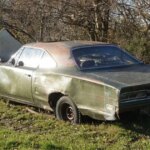
In a farm field by the edge of a small creek, an old muscle car stands as a totem for the cows. Where the roar of a V8 would typically fill the air, you hear only the whispers of leaves: a tree has literally grown up through the car, its trunk piercing the makeshift sunroof.
This almost surreal scene features a deserted 1969 Dodge Super Bee, a basic, pillarless automatic, bought in the early 1980s and never hauled out of that field since. YouTuber Ryan, from the Auto Archaeology channel, first documented it in 2011, then returned more than a decade later, a little astonished to find it still there—with its tree… and even a new buyer found via Facebook Marketplace who still hasn’t come to fetch it.
From the Track to the Field: How This 1969 Dodge Super Bee Gave It All
Before it finally surrendered to rust, this Super Bee would have served as a local racing staple. Ryan recounts that a previous owner wrecked it in two acts: a front-right collision with a tree, followed by a slide along a concrete wall on the driver’s side. He recalls: “the previous owner before this family had hit a tree on the front-right, passenger side, and scraped a concrete wall along the driver’s side,” he explains, drawing on stories from friends who already knew the car. Battered as it was, it began a second life: as a donor car for other Mopar projects.

Around 1983, a family of enthusiasts bought it solely to strip it for parts; two brothers each owned a 1969 Super Bee. The engine and the automatic transmission were removed to feed other projects, with some pieces ending up on a black Super Bee. The shell, meanwhile, was left at the edge of a field near a stream. When Ryan really found it, he was working at a NAPA auto parts store and had followed a tip from a fellow vintage-car aficionado. No one was there on his first visit, but on his return, a woman opened the door and said, “Yes, go ahead,” he recalls. He could then photograph and film this already-worn Super Bee in detail.
Forty Years of Abandonment and a Tree Growing Through the Super Bee’s Roof
Revisiting the site, Ryan finds the car even more engulfed by nature. The Super Bee hasn’t budged since the mid-1980s: “it was there since about 1983, 1984 (…). Now that I’m 42, I was born in 1983, so it’s been there about 42 years and hasn’t moved,” he sums up. The scene hasn’t changed: the shell sits in the grass by the creek, a combination that has accelerated the chassis’s corrosion. Underneath, his friends Eric and Ron find almost nothing left—the structural frame has all but vanished.
From above, a few original details still cling to time. You can still make out the famous white “bumblebee” rear stripe in ghost mode, and the Super Bee badge on the trunk remains in place. The chrome “reverse” wheels, paired with old drag-style slicks, poke through the grass. But the most striking sight is on the roof: a non-original sunroof, cut by a previous owner, vinyl-free, just bare metal. It’s through this opening that a tree took root inside the cabin and began to grow. Ryan humorously notes, a touch incredulous: “Oh, there’s a tree crawling into the interior. Oh, it’s actually growing upward… you see the tree growing through the sunroof?” With the door panel jammed and branches wedged in the sheet metal, the car has become a rusty sculpture—half mechanical, half vegetal.
Despite its extreme state, the Super Bee still holds symbolic value in the modest Mopar world. Ryan reminds us that this is a basic three-speed automatic, with an 8¼ rear end, a minimally optioned pillar car, painted in F8 green with a matching green interior and a white rear Bumble Bee stripe. He spells it out: “It’s a three-speed automatic, an 8¼ rear, a pillar car with few options. The paint is F8 green, interior F8 green with a white Bumble Bee stripe at the rear,” he details on YouTube. Listed for sale on Facebook Marketplace decades after arriving in the field, it looked to have a buyer on paper, but the new owner still hasn’t come to pick it up. Ryan hopes it won’t be stripped down again: after serving as an organ bank for forty years, this Super Bee, perched around a tree, is already telling an entire chapter of American barn-find lore on its own.