The visit of Pope John Paul II to Spain has recently brought the pope’s cars back into the spotlight. Armored Mercedes, purpose-built 4x4s, electric vehicles… And amid this very ceremonial gallery, one story still stands out even after more than forty years: the tale of a small SEAT Panda transformed in a hurry to transport the pope.
Fall 1982 is the moment. From October 31 to November 9, John Paul II makes his first official visit to Spain. Two major Masses are planned at the Santiago Bernabéu and the Camp Nou, with a clear security requirement: the pope must arrive motorized to the center of the pitch. The problem is that the Vatican’s official papamobile doesn’t fit the stadium access. In a matter of days, the Spanish state and SEAT devise a solution that is as simple as it is improbable: adapt a standard Panda into a pontifical vehicle, in barely two weeks, almost in a rush.
When the SEAT Panda improvises the papamobile for Pope John Paul II
It all begins a few weeks before John Paul II’s arrival. A Vatican commission travels to Spain to inspect routes, verify distances, and check access points. That’s when the verdict lands: the papal vehicle planned for Madrid and Barcelona cannot enter the Bernabéu or the Camp Nou. “The Vatican’s official car was a Range Rover on which they had installed a glass urn after the attack in St. Peter’s Square a year earlier,” recalls Isidre López, head of SEAT Históricos, in an interview with Moveo. Too tall, too bulky, impossible to thread through the stadium tunnels.
Yet, the security team insists the pope stay aboard a vehicle until the center of the field, surrounded by the crowd yet always in motion. Since SEAT still belonged to the Instituto Nacional de Industria (INI), the state turns to the brand to find a solution. The Vatican provides very precise access measurements. “According to the measurements supplied by the Vatican, they saw that it matched the base of a Panda, and that’s how, in two weeks, the Papamobile was created,” explains López. The work kicks off at the Zona Franca plant in Barcelona, without consulting the Martorell Technical Center, which was heavily occupied with the forthcoming Ibiza. The timing simply left no room for anything else.
How a simple Panda was transformed into a papamobile
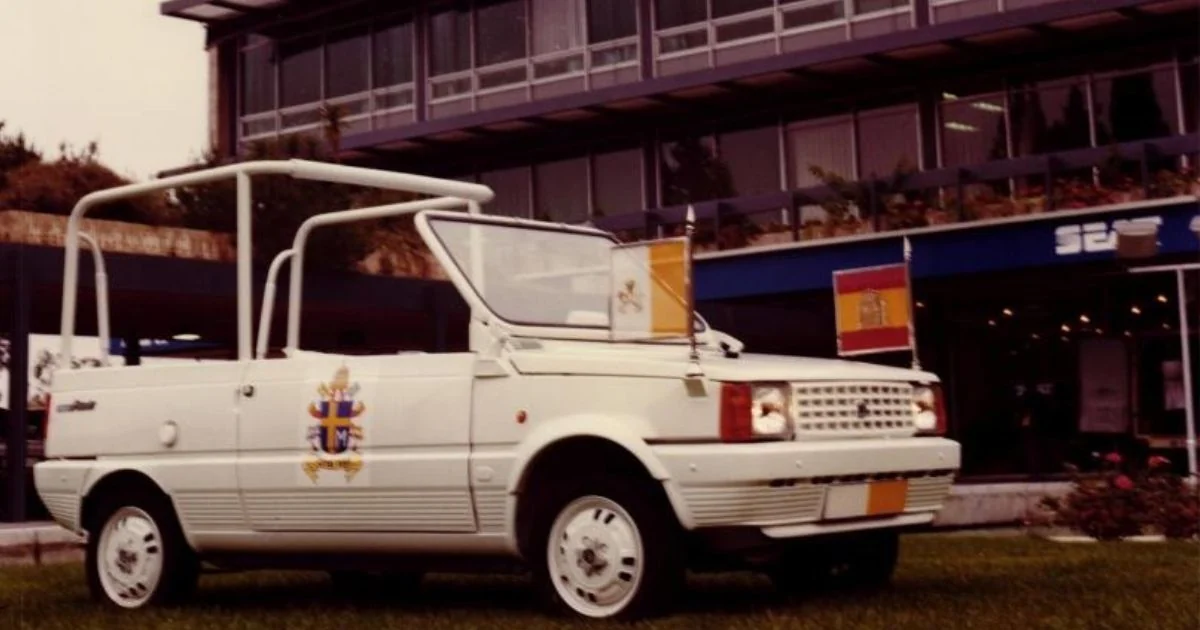
The technicians start with a perfectly conventional SEAT Panda, that tiny three-door, 3.38 m long, 1.46 m wide, and about 695 kg hatchback, wildly popular at the dawn of the Eighties. They convert it into a kind of open pickup tailored to pontifical protocol. The roof disappears, as do the side windows, to fully clear the rear section. A folding windshield is installed, able to drop if needed. The rear platform is heavily reinforced to support a standing passenger, and padded rails are added so the pope can hold on, along with a retractable step to help get in and out from ground level.
Inside, the headrests of the front seats are removed to provide an unobstructed view of John Paul II from every stand. The interior rearview mirror moves to the top of the dashboard to remain usable even with the windshield folded down. Under the hood, nothing exotic: the Panda’s 903 cm³ four-cylinder gas engine with 45 hp, paired with a four-speed manual and front-wheel drive. A modest mechanical package, which more than suffices to creep slowly across the turf amid tens of thousands of faithful. A stark contrast to the armored Range Rover with bulletproof glass used for city travel after the 1981 attack.
Two stadium tours and a second life at SEAT Históricos
Painted white, the little Panda papamobile receives papal heraldry on its body, along with the flags of Spain and the Vatican. It also borrows features from the Marbella Panda Marbella, a higher-spec version released the same year, and wheels borrowed from a SEAT Ronda Crono 1600, decorated with faux “palomillas” in the shape of crosses, a discreet nod to the Church. The result is a very simple, almost handmade vehicle, but perfectly suited to the size constraints of the stadiums, a world apart from the closed, armored papamobiles that were becoming standard at the time.
On November 3, 1982, the Panda makes its first official appearance at the Santiago Bernabéu. It rolls across the pitch with John Paul II standing on the rear platform, saluting the faithful in a full stadium. Four days later, the same scene repeats at the Camp Nou. The Panda papamobile’s active life is limited to these two appearances, exactly the missions for which it was designed. The rest of the time, the armored Range Rover remains the pope’s primary vehicle, with the Panda reserved for those very specific movements within secured arenas.
More than forty years later, the small vehicle remains, nearly in its original state. “Basically, the only thing that has changed are the tires,” Isidre López explained to Moveo. “It has been maintained and preserved without repainting, respecting all the work done at the time.” For the head of SEAT Históricos, there is no doubt: “It’s one of the jewels we have in the collection.” Today, the collection houses about 375 historic vehicles, 240 of which are kept in Nave A-122 at the old Zona Franca factory, where the Panda papamobile also rests.
When it makes its public appearance, the effect remains undeniable. “People are surprised to see that we built an authentic Papamobile on a SEAT Panda base,” López notes. The white little pickup has also crossed borders. In 2008, it was selected for the Audi-sponsored “Power and Splendor” exhibition at the Museum Mobile in Ingolstadt, Germany, alongside state cars and other international dignitaries, and it has appeared on numerous TV programs and exhibitions dedicated to papal vehicles. A singular arc for a city car base born from a sizing error, and now one of the most watched pieces in SEAT Históricos whenever it comes to light.