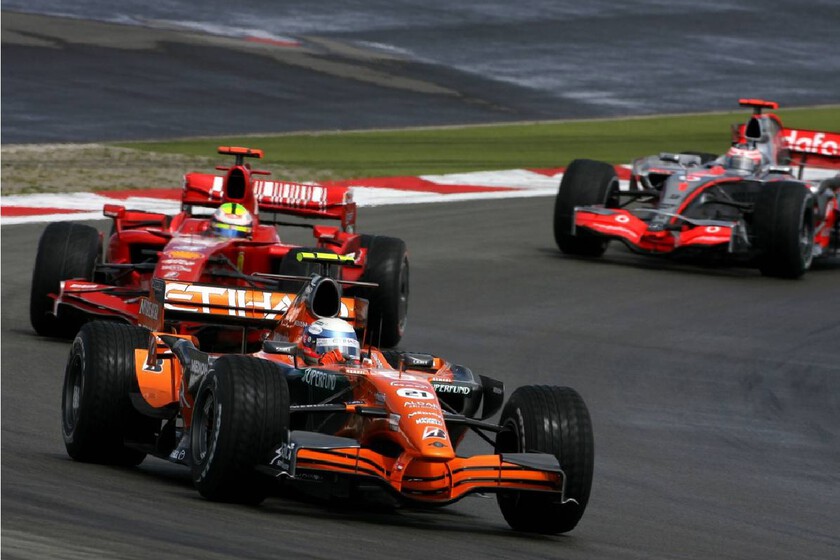
The history of Formula 1 is filled with flamboyant stories, but very few rise to the level of this one. The protagonist is named Markus Winkelhock, and having competed in only a single race, he remains an unforgettable name for early-2000s F1 fans. What is his grand achievement? Becoming the leader in his first and only Grand Prix.
Winkelhock was a semi-amateur driver with hardly any notable results, but he had to climb into the worst car in Formula 1 overnight because Spyker found itself without a driver. His times in the free practice sessions were so poor that many urged him not to be allowed to race, but a twist of fate led him to set an unbeatable record in the race.
Markus Winkelhock, the driver who led almost half of the laps he completed in Formula 1
Like many of the great stories, Winkelhock’s tale begins with a flare-up. The one who inflamed Spyker team chief Colin Kolles when his driver, Christijan Albers, left a pit stop too early during the French Grand Prix and yanked the fuel hose loose. It was Albers’s latest blunder, and Kolles fired him on the spot. That, plus Spyker running out of sponsor money.
The problem was that on the horizon loomed the European Grand Prix at the legendary Nürburgring, and Spyker had no driver. Kolles searched far and wide for a suitable replacement, but found nothing better than Markus Winkelhock. And who was Markus Winkelhock? Well, no one knew him very well.
He was the son of Manfred Winkelhock, a former Formula 1 driver from the 80s with a modest record, and the most he had done was race in the DTM, where he never managed to score a single point. But having spent a few months serving as Spyker’s test driver, they decided to call on him while they hunted for something better. So it was decided: Winkelhock would race at Nürburgring.

Friday’s free practice sessions were brutal. Winkelhock sat last, more than a second behind the second-to-last, who happened to be his teammate Adrian Sutil. Concerns grew among many, but what set off alarm bells was Saturday’s: in qualifying Winkelhock finished almost three seconds behind the driver in the third-to-last place, and 1.5 seconds behind his teammate.
That was when many drivers voiced their doubts. Some, like Felipe Massa or Mark Webber, directly asked that Winkelhock not be allowed to race for being too slow, and others hinted that the German’s presence on track could be dangerous. But the FIA stood firm: Winkelhock was within the 107% rule, and thus could race.
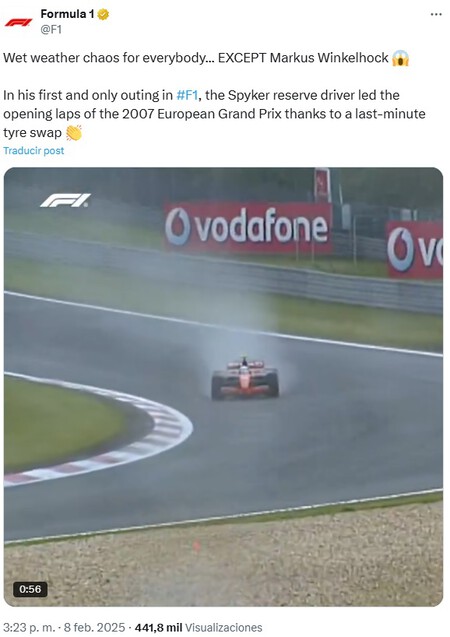
What happened on Sunday nobody could have anticipated. While everyone was on the formation lap, Winkelhock came up with an idea while starting from the back: if those dark clouds delivered what they promised, putting on wet tyres before the start could bring him significant benefits. And since he had little to lose, he did it.
And it happened. Practically as soon as the lights went out, it started to pour at Nürburgring. While all the drivers who had called for his disqualification struggled to keep their dry-weather cars on the wet track, Winkelhock overtook them at will after starting from the pit lane on rain tyres.
Thus, by the third lap Winkelhock was not only leading, but had more than a 30-second advantage. But then the FIA took an unprecedented, and since regrettably recurring, decision: it was raining so hard that a Safety Car had to be deployed. A tow truck went onto the track to haul Lewis Hamilton out of the mud, and Winkelhock’s lead evaporated. Red flag and restart.
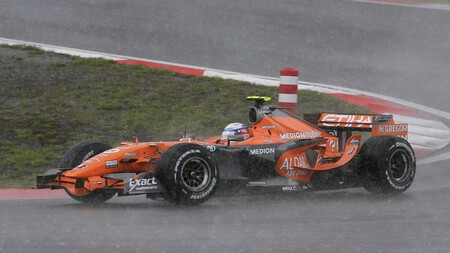
In the restart, Winkelhock quickly moved back past everyone and returned to the back of the field. Fernando Alonso ultimately won that race. But there was one final twist: the Spyker retired on lap 13, leaving Winkelhock with a record that could not be surpassed: Winkelhock is the driver with the highest percentage of laps led in Formula 1 history, more than 46%, and the only driver to have led in 100% of his races.
Following that race Spyker picked up a somewhat better driver in Japanese Sakon Yamamoto, who went on to complete the season. Winkelhock returned to the DTM, where he managed to score points, later competed in touring cars and even capped his career by winning three times the Nürburgring 24 Hours. He also claimed victories at Spa, Dubai, Indianapolis, and became champion of the Intercontinental GT Challenge.
After 17 years as an official Audi driver, the four‑ringed manufacturer decided not to renew his contract, and in 2026 he races for Lionspeed GP in the GT World Challenge Europe Endurance Cup aboard a Porsche 911 GT3 R, but he will always be remembered for that first and last Formula 1 race.
Images | Formula 1