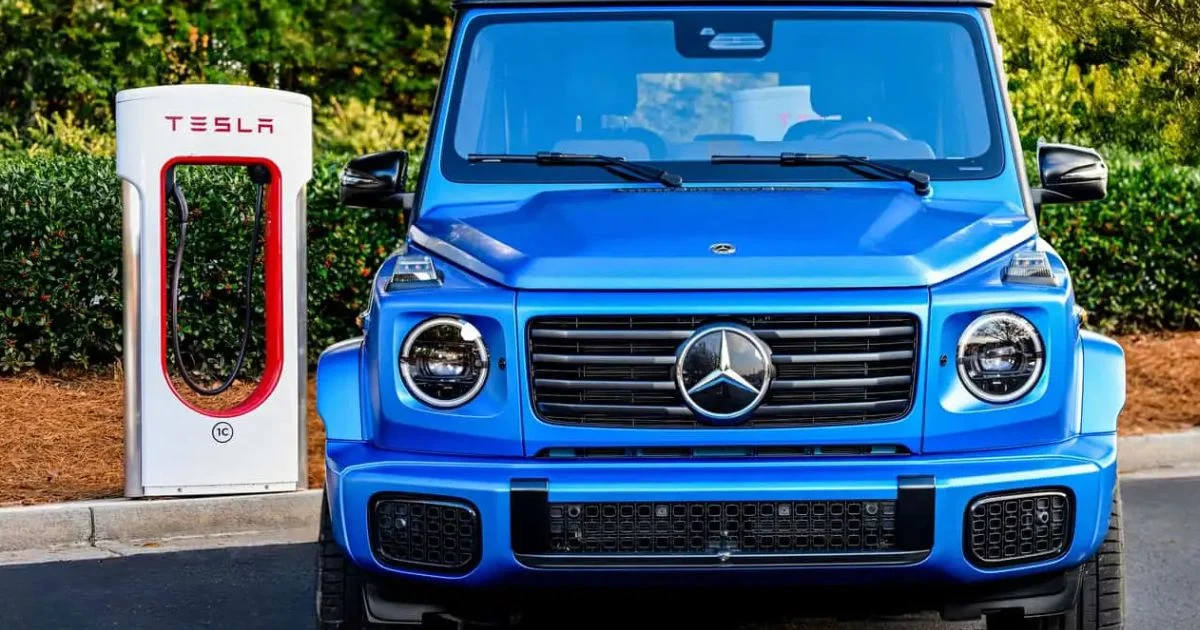
First shown in 2024 across Europe, the very first 100% electric G-Class didn’t wait for a full facelift to begin evolving. With the 2027 Mercedes G 580 Electric, now available to order from American dealers, the automaker is already refining its recipe: the same ultra-luxury boxy silhouette, but with a quietly revised spec sheet.
On the menu for this new G 580 Electric: a bit more range, lower consumption, slightly shortened fast-charging sessions, and, above all, a refreshed connectivity package with the addition of a Tesla-style NACS charging port as standard. That could reshape daily use for this plugged-in behemoth, and invites a simple question for fans of the Electric G-Class 2027: what’s really different, and what does that signal for Europe?
Range and efficiency: the 2027 G 580 Electric gains a few miles
The battery-powered G 580 has never pretended to be frugal, but the 2027 model year takes a step in the right direction. On the EPA cycle, the average energy consumption drops from 33.5 to 30 kWh/100 km. The SUV remains quite energy-hungry, but it uses a few fewer kilowatt-hours to cover the same distance as before.
This gain translates into range: the official figure shows an extra 16 km on a full charge, i.e., about 401 km, compared with roughly 384 km for the previous model year. In Europe, early communications cited a WLTP range of 473 km, while the latest datasheets mention up to 479 km. In either case, the improvement is modest on paper, but sufficient to stretch highway legs a little longer while preserving the standard 20-inch wheels that come as original equipment.
Charging, dual NACS sockets and the tech sheet: what changes really matter
It’s on the charging front that the G 580 Electric 2027 shakes up its habits the most on the North American market. The old CCS1 port disappears in favor of two outlets tucked behind the same panel: a NACS connector (Tesla’s format, now the SAE J3400 standard) dedicated to DC fast charging, and a J1772 inlet reserved for Level 2 AC charging. Drivers no longer need an adapter to plug into NACS fast-charging stations, with the manufacturer even supplying an adapter to continue using existing CCS1 fast chargers. However, to take advantage of Tesla Destination AC chargers or other public chargers equipped with NACS, you’ll need to buy a NACS-to-J1772 adapter, not included, priced at a little over $120.
In terms of charging times, the improvement is measurable: the G 580 2027 touts a 10–80% charge in 29 minutes on a fast charger, down from 32 minutes previously, while the battery remains a hefty 117 kWh unit and the maximum DC charging power listed stays at 200 kW. On AC, the American version accepts up to 9.6 kW, while some European datasheets list up to 11 kW AC charging. The rest of the spec sheet stays the same: the SUV weighs about 6,750 pounds (roughly 3,060 kg), relies on four electric motors with a two-speed transmission at each axle, develops 579 hp, and accelerates from 0 to 60 mph in about 4.7 seconds. All of this is paired with a full off-road equipment setup, including electronic low-range gearing, virtual differential locks, and the G Turn function that lets the vehicle pivot on its axis like a tank.
Price-wise, the American base price climbs to $165,200, about €152,000, versus $164,550 (roughly €151,000) for the previous year, with no pricing details announced yet for the European market.