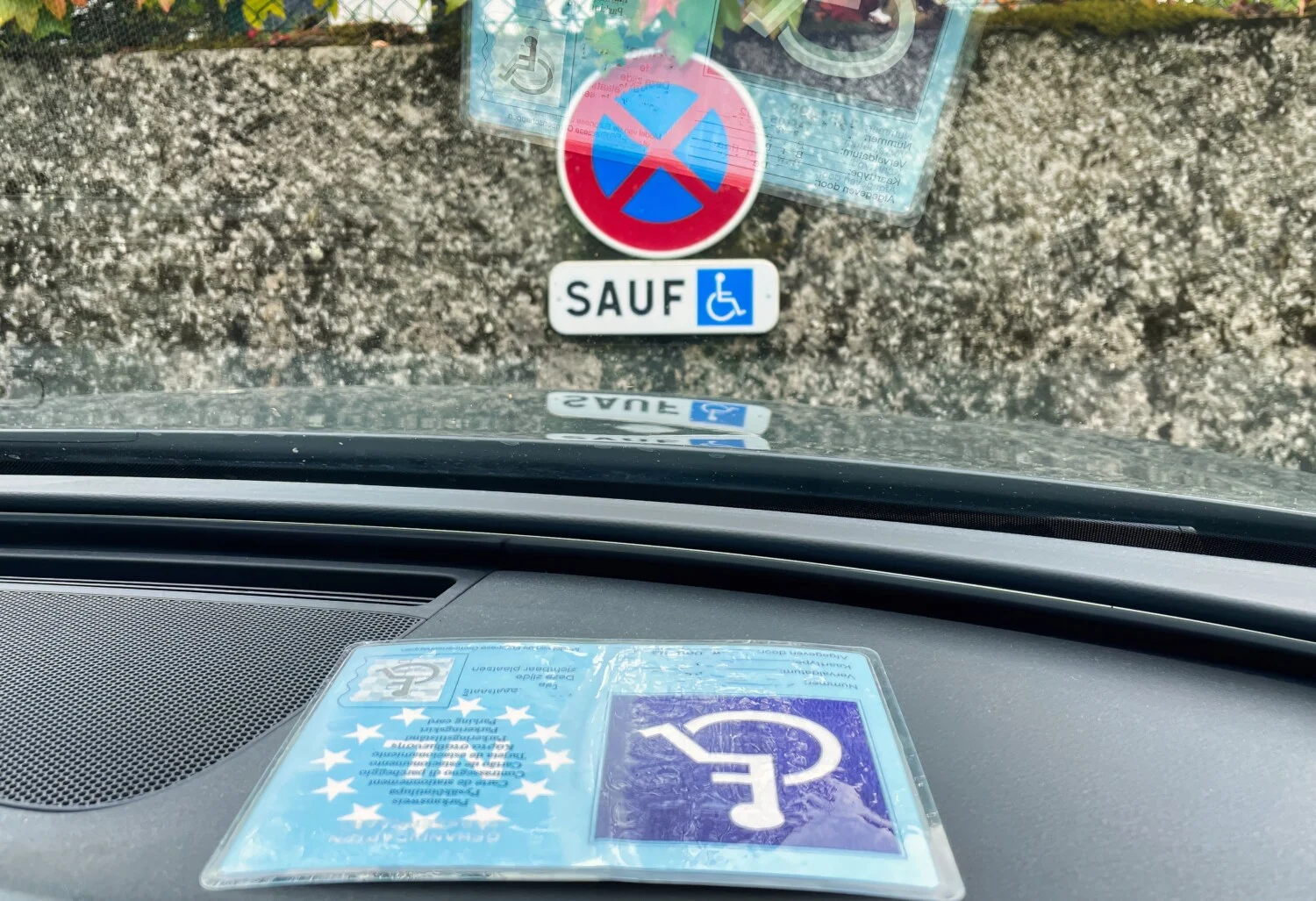
In Toulouse, a driver who has lost all four limbs discovers a parking ticket on her windshield. A misadventure reported by our colleagues at La Dépêche that begins on November 25, 2025, as she was simply heading to an appointment in the Saint-Cyprien district, with her adapted vehicle. Her car is parked in a space reserved for people with disabilities, the handicap placard clearly visible behind the windshield. “I didn’t see the little slip stuck on the windshield right away.” A banal parking scene, which will nonetheless launch a true headache for her. A a handicap parking violation that has become an administrative nightmare raises questions about how reserved parking works.
This 45-year-old mother, Warda Carles, lives in Marssac-sur-Tarn, in the Tarn department. Amputated from all four limbs in 2015 after a severe infection, she regained autonomy thanks to prostheses. With her adapted vehicle, she continues to drive and to get around alone for her appointments. “It was the day before I left for a long-planned three-month trip,” she explains. “I was a bit panicked; I didn’t know what to do.” At the Albi gendarmerie, the officers contact Toulouse’s municipal police. They tell her simply: “But you’ll have to wait to receive the ticket.” The next day, however, Warda Carles must still fly off for this three-month journey, unsuspecting of what would follow.
A handicap on-the-spot ticket that turns into an administrative nightmare
During her three months away, the procedure unfolds, with an initial fine set at €135. Upon her return in early March, she finds several notices slipped into her mailbox. Yet the registered letters containing the notice had already been returned, the deadlines having passed. In the meantime, the amount rose from €135 to €375. The charge describes “very disruptive parking in a space reserved for vehicles displaying a disabled parking permit.” Warda Carles can no longer easily contest it, and the file gradually slips away from her grasp.
In the following weeks, she notices unusual withdrawals from her checking account, then from her Livret A savings account. She learns that an administrative seizure has been started to recover the now €375 fine. Uncomfortable with online procedures, she acknowledges that she “doesn’t master the Internet.” Every service sends her to another, without truly resolving the situation. “They’ve been driving me around in circles,” she tells La Dépêche du Midi. For this heavily disabled driver, every call, every letter, and every deadline becomes an additional ordeal.
Mobility card, cheats and the rules of handicapped parking at the heart of the case
At first, Warda Carles believed she was in compliance with her “Mobility Inclusion” card issued by the Tarn department. Problem: this card did not explicitly indicate “handicap parking” or free parking in these spaces. According to the City of Toulouse, it was therefore “normal” for an officer to ticket her vehicle. The city insists that she did not follow “the steps advised by the notice of violation and the subsequent explanations from officers”. Confronted with these remarks, the complainant recalls: “My card isn’t forged!” and refuses to be lumped in with fraudsters. At the city hall, she says she heard: “If you knew how many people cheat, we don’t have time to check everything.”
Beyond her own case, Warda Carles worries about the consequences for other drivers with disabilities. “They don’t try to put themselves in our shoes. I’m standing; I can walk with prostheses. But for others? This isn’t how you make life easier for people with disabilities.” Her story also highlights the limits of a very strict policing of reserved spaces envisioned to curb abuse. For disabled motorists, between cards with different mentions, administrative records, and dematerialized procedures, every trip can quickly become a bureaucratic ordeal.