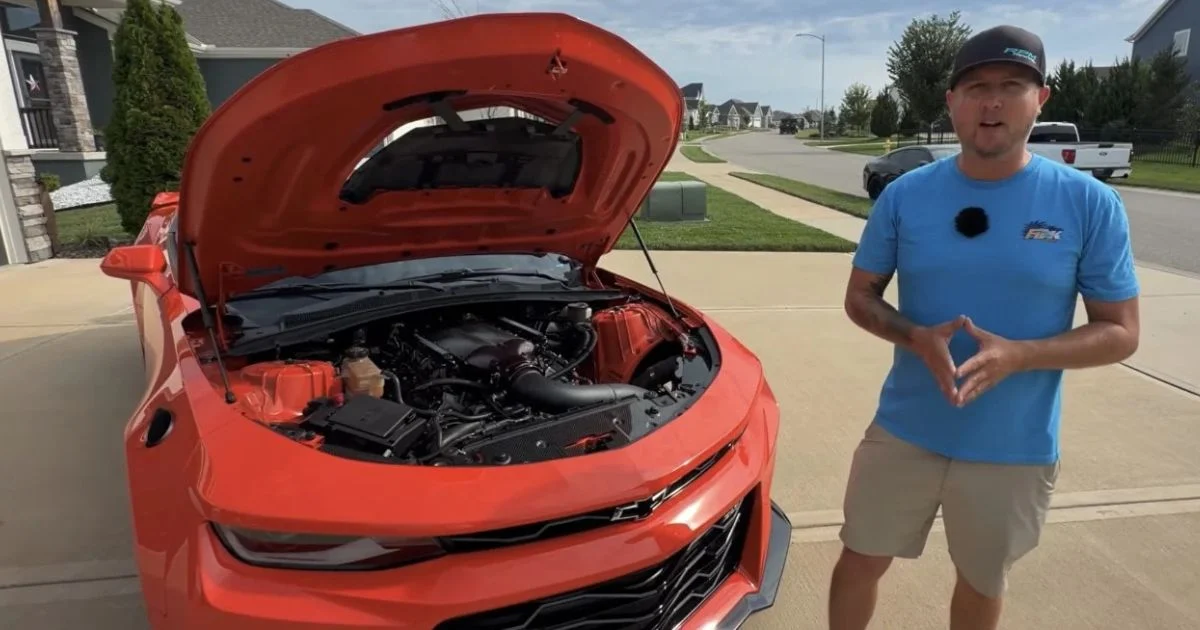
A V8 delivering 1,800 horsepower, a solid rear axle, gigantic turbochargers… and a Camaro that actually drives every day. In Missouri, Justin Keith commutes to work behind the wheel of a radically rebuilt Chevrolet that makes roughly 1,800 hp at the rear wheels. Not a weekend toy, not a drag-strip-only build, but his daily driver on local roads.
Owner of the shop tuner Killer Performance, Justin Keith started with a brand-new sixth-generation Camaro ZL1 and transformed it into a monster named Nemo, painted in Orange Crush. This 1,800-hp Camaro ZL1 racks up quarter-mile runs and also handles the roughly 35 to 40-minute ride from home to the shop. A versatility that quickly raises questions about fuel consumption, but also about what this car really asks of its owner on a day‑to‑day basis.
From a stock Camaro ZL1 to Nemo, the 1,800-hp monster
Originally Nemo was a Chevrolet Camaro ZL1 of the sixth generation powered by a 6.2-liter LT4 supercharged V8 making 650 hp. Justin Keith removed the blower to fit a forged 390 cu in LT engine built by Late Model Engines, paired with two Garrett G45 80‑mm turbos. The result pushes nearly 1,800 hp to the rear wheels—measured at the wheels, not at the crank. The originally 10‑speed automatic has been swapped for a 3‑speed TH400 transmission, a setup better suited to heavy-duty quarter‑mile competition. “Not everyone is ready to go that far with something. But it has a purpose, and that purpose is to go fast in a straight line,” Justin Keith explains in a video shared by SupercarBlondie.
To keep Nemo on a straight line in the 1/4 mile, the independent rear suspension gave way to a dedicated drag‑strip solid axle. That choice, paired with the engine prep, has let the car notch more than 200 runs over a standing‑start 400 m, with a best time already around 7.5 seconds at well over 180 mph, making Nemo the fastest sixth‑generation Camaro in this discipline. Justin Keith’s stated goal is to push the power toward 2,500 hp to target a 6‑second quarter. And yet, despite this drag‑race pedigree, Nemo also serves as a daily vehicle—used to haul him from home to the Killer Performance shop on those longer, 35–40 minute trips.
Camaro ZL1 1,800 hp: nearly 30 L/100 km of fuel on a daily basis
With that level of prep, the fuel economy follows the same logic. On the road, Nemo runs at roughly 8 mpg on E90 racing ethanol, or about 29.4 L/100 km of racing ethanol. The tank is about 57 liters (roughly 15 gallons), which gives a theoretical range of around 190 kilometers (about 120 miles) when the car is driven aggressively. For a owner, two immediate challenges arise: a sky‑high fuel budget and power that far exceeds what can be effectively used on public roads.
By comparison, a stock Camaro isn’t exactly a model of efficiency either. A V8 can approach about 14.7 L/100 km (roughly 16 mpg), while a four‑cylinder version can reach up to around 25 mpg (about 9.4 L/100 km). Nemo therefore consumes easily two to three times more than a standard Camaro, giving a clear idea of the budget required—even if gas prices remain relatively low in Missouri.
Beyond the numbers, driving a daily‑driven 1,800‑hp car presents other compromises: the air conditioning has been removed to make room for the oversized forced‑induction plumbing; the V8 is spinning around 3,000 rpm at about 65 mph with a 3‑speed transmission and a solid rear axle; and the overall package remains loud and fatiguing on long highway runs. For everyday driving, Justin Keith can only exploit a fraction of the available horsepower—roughly 20 to 30 percent—while the rest is principally suited to the drag strip. Yet for the tuner, Nemo’s meaning goes far beyond those constraints: “I’ve poured a lot of heart into this car. I’ve put in a lot of work, blood, sweat, tears… and I simply can’t imagine ever getting rid of it,” he says in the same video, while continuing to shoulder a life of timed runs and high‑octane fills.