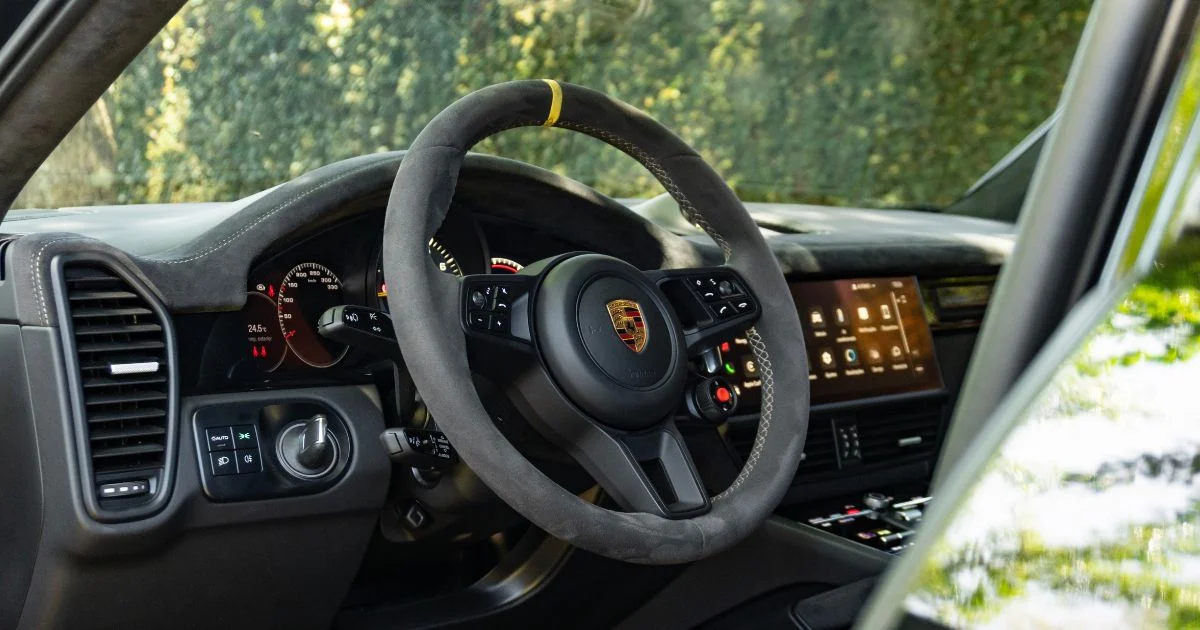
A Porsche with an automatic transmission, yet three pedals on the floor. On paper, the arrangement looks like a glitch in the matrix to any tech enthusiast. Manual gearboxes are fading year by year, dual-clutch transmissions are taking over, and the three-pedal setup once seemed doomed. Yet a new patent document reveals that the German maker is weighing another path—one that sits between tradition and electronics.
This patent, published by the European Patent Office under the reference DE102025109563A1, describes a dual‑clutch automatic transmission. It can offer three distinct operating personalities. There is a classic automatic mode. A sequential mode with paddles. And a fully “manual” mode, with a gated shifter and a floor‑mounted clutch pedal, all controlled electronically. The idea is to offer a Porsche automatic with a clutch pedal, without altering the base architecture of the transmission. It opens the door to, someday, 911s or 718s with three pedals… but without the traditional mechanical linkages.
A dual-clutch auto, three modes, including a simulated manual
Behind this patent lies an architecture familiar to Porsche. It centers on a dual‑clutch transmission of the PDK type, electronically controlled. The automaker does not alter the mechanical core of the transmission; it adds a shift‑by‑wire control layer. The clutch pedal and the lever are no longer connected by linkages. Sensors send commands to the clutches and the gear trains. The software then handles selecting the proper gear and timing the opening or closing of the clutches. Another filing with the German patent office mentions a two‑zone selector. One part handles the D, N and R positions, while the other repeats an H‑gate for the numbered gears.
In this framework, the same transmission can operate according to three distinct logics.
- A classic automatic mode, where the driver simply selects D, R or N and mashes the accelerator.
- A sequential mode, with up‑shifts or down‑shifts via steering‑wheel paddles or by moving the lever.
- A simulated manual mode, with a gated lever and a third pedal that commands a virtual clutch.
In this last mode, the normally monotonic shifter becomes a multi‑stable lever that replicates the gate of a mechanical gearbox. The effort and the detents felt can be simulated by motors and springs. It’s enough to evoke the feel of a real three‑pedal setup. The patent notes that this system could be used on a gasoline or hybrid car. For now, there is no specific model or production timeline mentioned, and no further details are provided.
Why this 3‑pedal automatic interests Porsche
Behind the scenes, this patent tackles a familiar equation for sports‑car makers. Modern engines deliver high torque. Designing a true manual transmission capable of handling those torque figures remains costly and complex to homologate for limited production runs. The dual‑clutch box remains faster and more efficient, but it offers less direct driver involvement.
This idea of a three‑pedal automatic isn’t isolated on the automotive landscape. Players like Koenigsegg, with its CC850 and its Light Speed transmission, are already exploring closely related concepts. The system can operate with nine automatic gears or six “manual” gears within the same architecture. Ferrari is pursuing the 12Cilindri Manuale, equipped with an eight‑speed dual‑clutch and a V12 producing 830 hp. Mainstream manufacturers are also tinkering with simulated manual gearboxes for electric vehicles, with software‑driven pedals and gates.
For Porsche, the challenge would be to use a single mechanical and electronic package to offer multiple driving experiences. This base could enable a smooth switch from a comfortable automatic to the tactile feel of a manual with a clutch pedal. It remains to be seen on which models and on what timeline this technology will, or will not, reach production.