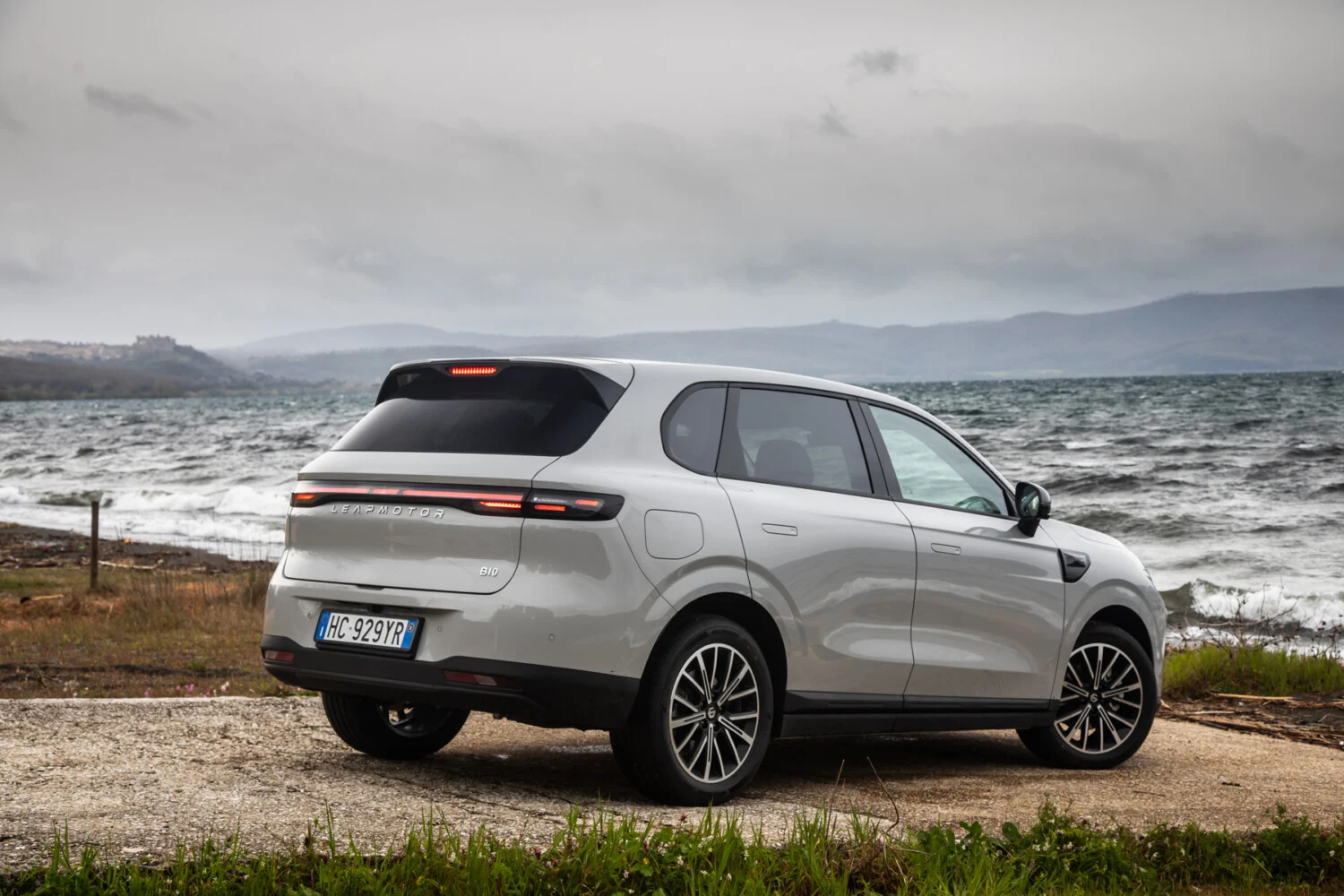
A Chinese SUV that suddenly feels European without changing its logo or its look. This is the bet of Leapmotor, which has launched the pre-production of its B10, a 100% electric compact SUV, at Stellantis‘s Zaragoza plant in Spain. By performing enough on-site manufacturing steps, the model is reclassified as “Made in Europe” and escapes the European Union’s total tariff of 30.7% applied to electric cars and range-extended electric vehicles (EREVs) from China.
At Stellantis’ Zaragoza Plant, the Leapmotor B10 Gets a European Passport
The Leapmotor B10 destined for Europe now comes out of the same Zaragoza plant as the Lancia Ypsilon, Opel/Vauxhall Corsa, and Peugeot 208. It is there that Leapmotor began pre-production of its compact SUV, betting on a level of local transformation sufficient to meet European origin rules. Concretely, the stamping, welding, and painting of the body, conducted on site, allow the B10 to be regarded as a vehicle “made in Europe” for customs purposes, and not merely as a model imported from China with only final assembly.
Until now, Leapmotor models arriving from Asia faced a total 30.7% duty at EU entry, which combines the base automotive import tax with specific measures targeting electric cars and range-extended electric vehicles (EREVs) built in China. With Spanish production, this surcharge disappears. The Leapmotor strategy stands apart from other Chinese builders. Chery in Spain, or GAC and Xpeng in Austria, do assemble vehicles in Europe from kits shipped from China… but so far they have not reached the level of European content deemed sufficient to escape these duties.
Behind this industrial arrangement lies a very tangible goal for Leapmotor: preserve the selling price of a model that is starting to gain traction in Europe while limiting the impact of the tariff barriers. “We have stamping, welding, and painting activities in Zaragoza that generate enough local content to make the B10 a product manufactured in Europe,” explains Danilo Annese, head of European sales operations for Leapmotor International, quoted by Automotive News.
The Key Role of the Alliance with Stellantis
A question that directly concerns drivers remains. Will this 30.7% tariff savings translate into a lower sticker price for the Spain-assembled Leapmotor B10? For now, the brand is taking a cautious approach. “Shipping costs from China have risen by more than 50% since the Middle East conflict (in February), which impacts our initial pricing assumptions,” adds Danilo Annese.
In Italy, where Leapmotor has sold nearly 40% of its European volume through July, the B10 electric starts at €29,900, with up to €4,000 in scrappage incentives for private buyers. The B10 EREV, equipped with a small gasoline engine to extend the range to a total of 900 km compared with 361 km for the entry-level electric (56.2 kWh battery), is offered at the same base price, but with a scrappage incentive of up to €5,000.
Launched in January, the B10 is already the second-best selling Leapmotor model in Europe, with 16,664 units sold to date, behind the compact T03 (35,285 units). The EREV versions account for roughly half of B10 sales on the continent, with wide country-by-country differences. In Italy, which remains behind on full electric adoption, about 90% of B10 sales are EREVs. In France, with a weight-based tax penalizing plug-in hybrids and range-extended vehicles, nearly all volumes rely on the electric version.
Against this backdrop, the alliance formed in October 2023 with Stellantis, which invested around €1.5 billion to acquire nearly 20% of Leapmotor and to create the joint venture Leapmotor International (51% Stellantis, 49% Leapmotor), gives the Chinese brand unprecedented access to a European distribution network and to European industrial capabilities. For its part, Stellantis gains access to competitive electric technologies to fill its plants. A combination that could still shift the playing field for established automakers if the B10 “made in Zaragoza” confirms its trajectory.