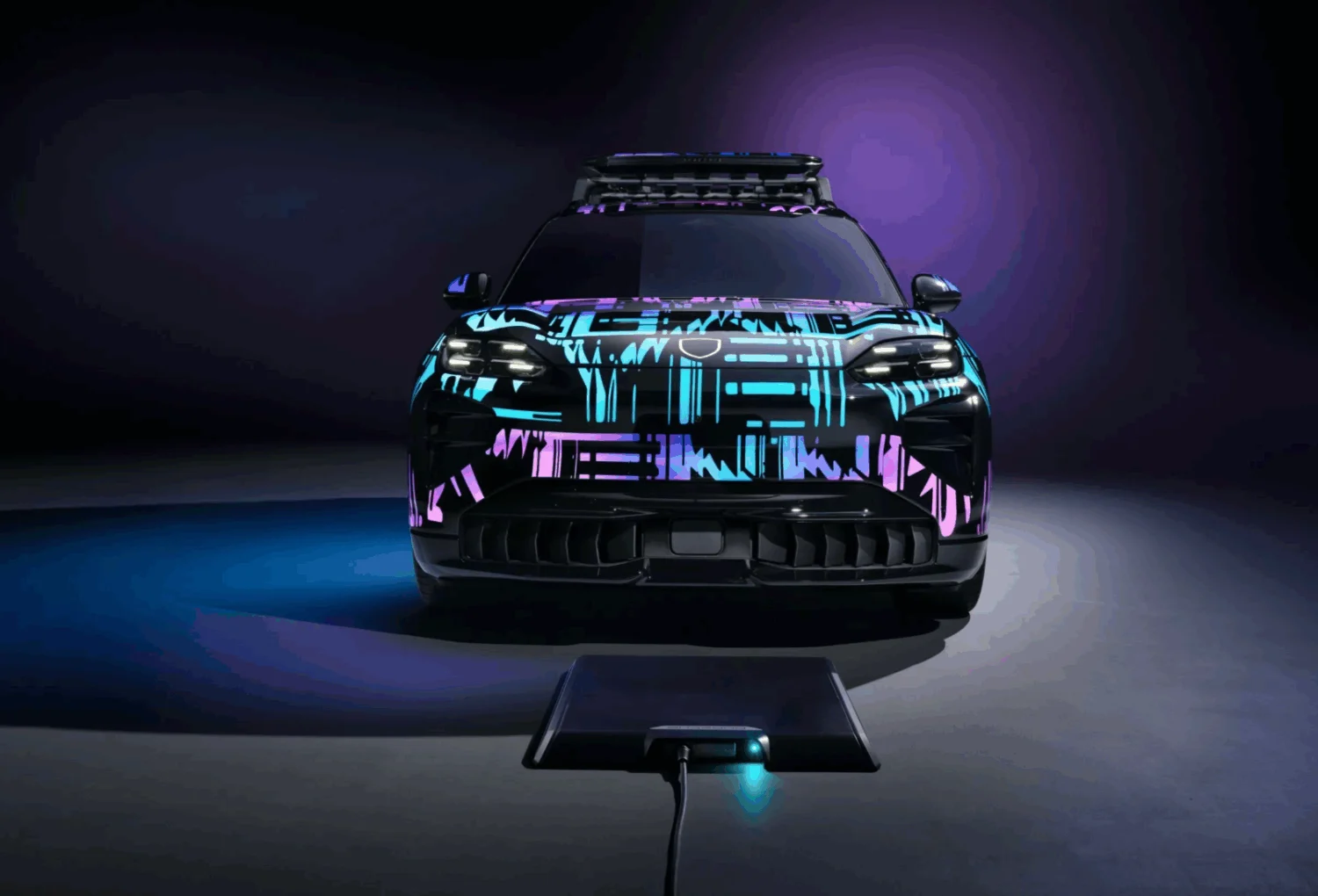
Plugging in your electric car every time could soon become optional—at least for some Porsche Cayenne Electric owners. The German SUV now offers a wireless charging option in its catalog. A technology that’s particularly convenient to use, but one that comes with a steep price tag. The full installation runs a little over €8,000 (roughly $8,900).
The Porsche Cayenne Electric Recharges Wirelessly
The principle is much like the wireless charging already widely used with compatible smartphones. To draw power, the Porsche Cayenne Electric simply has to be parked above a pad installed on the floor.
Inductive automotive charging isn’t entirely new, but its adoption remains limited. Porsche thus takes another step by offering directly this technology as a selectable option in the configurator for its electric SUV. It is, in fact, a first for a mass‑market electric vehicle.
The main advantage is obvious. No more pulling out a charging cable, plugging it into the car, and tucking it away after use. A difference that may seem minor, yet it simplifies daily routines—especially when the cable is wet or dirty.
As with many Porsche options, this extra convenience comes with a hefty price tag. The system isn’t merely a pad on the garage floor.
Three components must be ordered. Vehicle preparation for the charge is billed at €228. You then add €1,860 for the receiver device installed under the Cayenne Electric. And most notably, €6,120 for the ground‑level recharge plate.
All told, the installation costs €8,208. A sizable amount to avoid physically plugging in your car.
A Charging Power of 11 kW
At that price, you shouldn’t expect the performance of a fast charger. The wireless system on the Porsche Cayenne Electric delivers 11 kW of power. This makes it primarily suitable for home charging when the vehicle sits parked for several hours.
This setup also allows you to skip a conventional Wallbox. Porsche further claims an efficiency of up to 90%. A high figure for an inductive system.
To optimize energy transfer between the floor plate and the receiver mounted under the car, the Cayenne Electric also leverages its air suspension. It lowers the SUV to shrink the gap between the two components.
However, the driver must position the vehicle correctly. For charging to work well, the Cayenne must be parked precisely over the plate.
According to the data, the 90% efficiency claimed for this installation is higher than what can be observed with some wireless charging systems for smartphones, which can stay below 75%.
An Expensive Option, But One That Could Appeal to Some Porsche Owners
At €8,208, the Cayenne Electric’s wireless charging will likely remain a feature for owners willing to pay a premium for added comfort. It still provides an interesting answer to one of the everyday limitations of electric driving.
This option could also serve as a selling point when reselling a Cayenne Electric equipped with it. Porsche is effectively turning home charging into an almost invisible operation. You simply return home, park the SUV in the right spot, and its battery begins to recover energy. A seductive simplicity—provided you don’t mind the steep price tag.