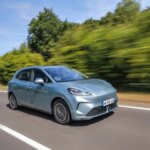
At this point, no one misses the fact that there is a war between China and Europe in the automotive industry. In record time, Chinese brands have arrived and settled in our market, and although it cannot yet be claimed that they have conquered it, their advance is unstoppable.
According to JATO Dynamics, Chinese brands are doubling their European market share year after year. In the first half of 2025 they stood at 4.8%, and in the same period of 2026 it is already 9.5%. McKinsey’s forecasts have fallen behind, suggesting that one in three cars sold in Europe could be Chinese within a decade.
Arriving is Only the Beginning, Now We Must Stay
No one dares to speak of a conquest, but it is undeniable that Chinese brands are achieving very quickly what Japanese and Korean brands took decades to accomplish.
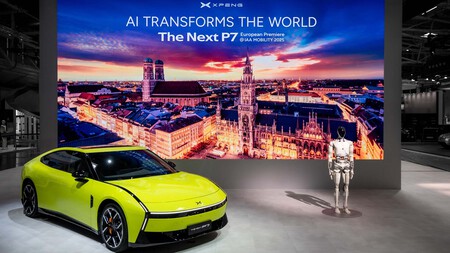
Just look at what is happening at the IAA Mobility in Munich 2025, an automobile show with a historic presence of Chinese brands, with a 40% increase in exhibitors from these companies compared with 2023: from 75 to 103. The next edition will be in 2027 and exponential growth is expected.

Meanwhile, traditional manufacturers, at least a significant portion, are going through one of the worst periods in their history, both in Europe and in other markets, including China, where Western firms no longer have the same pull as before, partly because the Chinese want Chinese cars.
Volkswagen is one of the companies that has bet most strongly on China, launching the strategy of “in China, for China”, as Reuters noted, i.e., manufacturing cars in China for the local market. The sales decline has softened but has not disappeared.
For many years, the Volkswagen Group has been one of the leaders in the Chinese automotive market, and the strategy of manufacturing in China to sell cars in that market was key to achieving it, but it no longer works.
In 2025 Volkswagen delivered 2.69 million cars in China, 8% fewer than the year before. Ralf Brandstätter (head of Volkswagen in China) acknowledged in early 2026 that “we will not return to the old superprofits because competition is too fierce. By 2030 Volkswagen is planning an offensive of 50 models.”
The Chinese manufacturers have taken note of this strategy, but to apply it in Europe. If they want to keep growing in our market, not only to achieve the same market share as Japanese and Korean brands, but to surpass forecasts and capture a substantial portion of the market, they understand that they must manufacture in Europe and, above all, for Europe.
That is, they have to build cars entirely tailored to the European customer, as the Volkswagen Group did for decades in China. It is simply a matter of playing with the same cards. “Everything we do starts from the needs of European users. That means being in Europe, for Europe, and accelerating steps toward localized production,” said Wei Haigang, president of international operations at GAC, in remarks cited by Reuters.
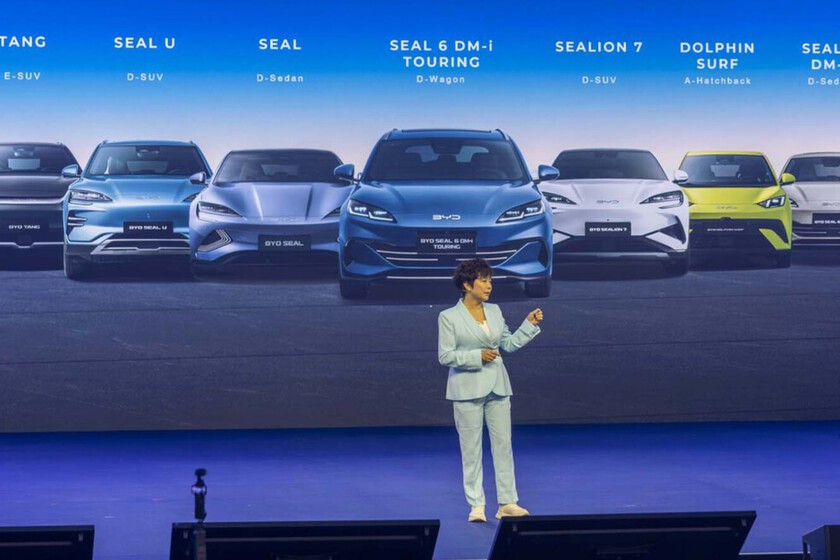
The rollout of Chinese brands at the IAA Mobility in Munich made it clear that they have arrived to stay, and although it is likely not all will do so because in China they are living their ‘hunger games’, certain companies are growing stronger in our market, such as BYD, whose European sales continued to surge in 2026, although its factory in Hungary has been delayed and full operation is not expected until late 2026 while it prepares a second plant in Turkey.
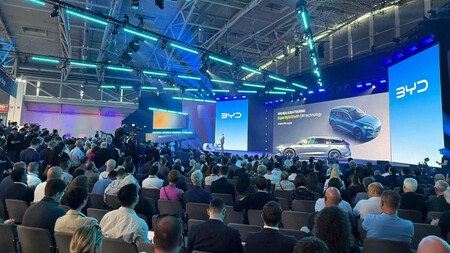
What in 2025 was only a forecast is now fact. Producing Chinese cars in Europe for Europe and tailored to European tastes rather than merely adapting their Chinese models.
The development will also take place here. Leapmotor opened in March 2026 a design and engineering center in Munich and is already manufacturing cars in Spain. XPeng also has another center in Munich, and 12 more brands will enter the European market by 2027 with a clear objective: to settle permanently in Europe.
It happened with Toyota in the latter half of the 1990s: its sales in Europe began to rise when it launched the Yaris, a product specifically developed for the European market.
Images | BYD and XPeng