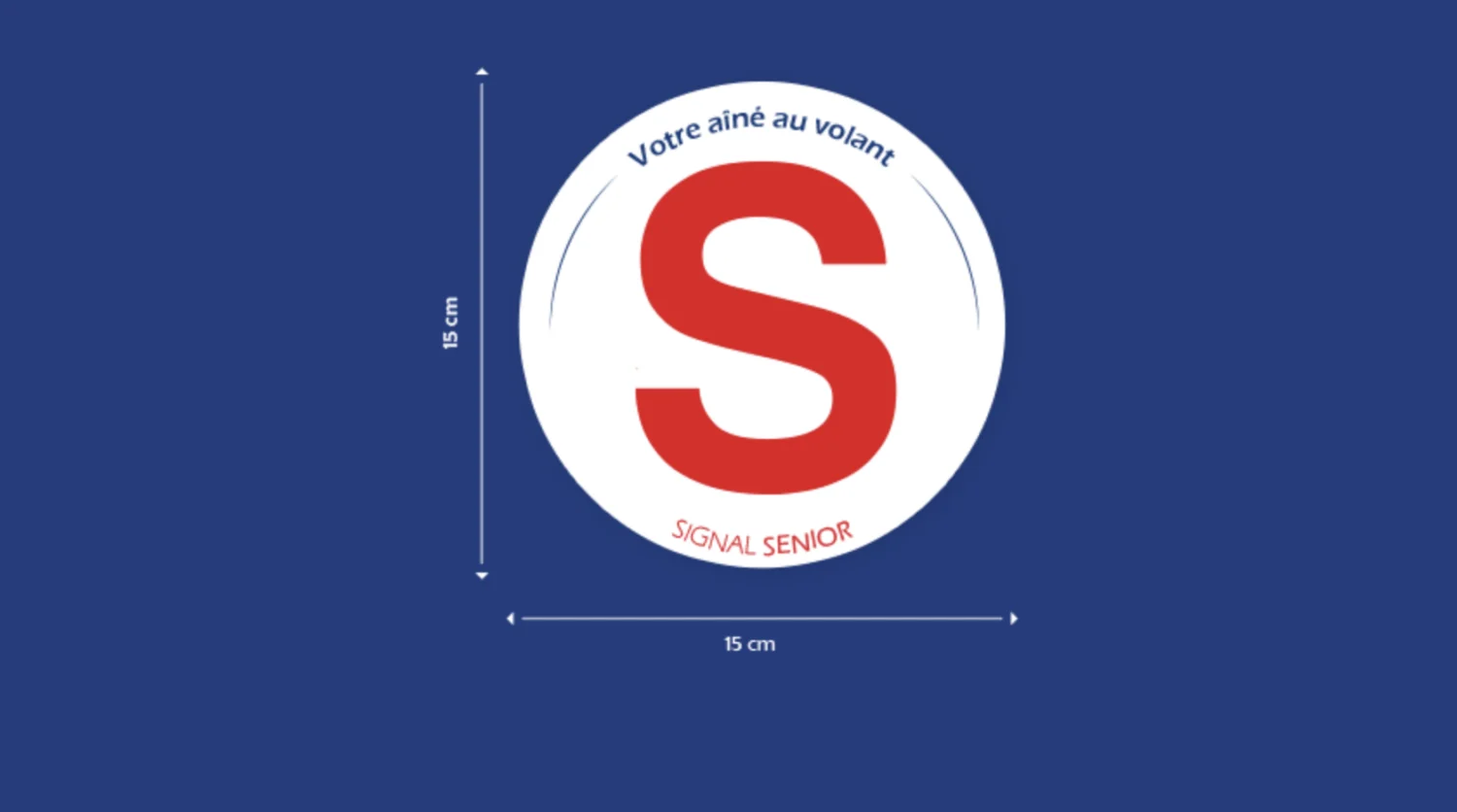
After the famous “A” sticker reserved for young drivers, another letter has appeared on the back of some cars: the “S.” Designed to signal the presence of a senior driver, this badge regularly fuels rumors on social media. Some even claim it would be mandatory from age 70. But what is it really about, and should we expect any regulatory shift?
What is the “S” sticker for seniors?
Easily recognizable by its white background and its large red “S,” this device can be affixed to the rear of a vehicle driven by an older person. Its purpose is simple: to inform other road users so they can adjust their behavior accordingly.
Unlike the “A” sticker imposed on novice drivers during their probationary period, the “S” does not impose any regulatory constraint of a similar kind.
It is precisely on this point that misinformation proliferates. For several years, publications have claimed that motorists aged 70 and older would be required to display this distinctive sign on their car.
Not mandatory for now
But that is not the case. According to information reported by Caradisiac, the road-safety authorities say there is no plan to compel the “S” sticker for drivers over 70. Its use remains entirely voluntary. A senior motorist who finds this device useful can install it, but nothing obliges them to do so.
In other words, to date, turning 70 does not mean you must automatically equip your car with an “S” badge. No upcoming obligation has been announced in the available information.
If this sticker exists, it’s mainly to draw attention to the vulnerability of older drivers. As the years go by, certain driving abilities can evolve. While the physical consequences of an accident can become much more significant.
Older drivers are not portrayed as having more accidents than other age groups. However, when an incident occurs, its consequences can be more severe due to greater physical fragility.
S sticker, a device that remains voluntary
The figures cited are particularly telling. Seniors represent 25% of people who die in road crashes while they make up 19% of the population.
In this logic, the “S” sticker mainly aims to encourage surrounding drivers to be more vigilant and patient when following or passing an older driver.
Beyond this distinctive sign, prevention also includes health monitoring. It is thus advised that seniors regularly see their physician to monitor their abilities and, when necessary, adjust their driving habits.
For the moment, the “S” sticker remains very different from the “A” disc. No law obliges seniors to display it on their vehicle, even after turning 70. It is purely a voluntary step intended to signal their presence to other road users. It remains to be seen whether its use will gain popularity in the coming years, as mobility and safety concerns for older drivers take an increasingly central place in road safety discussions.