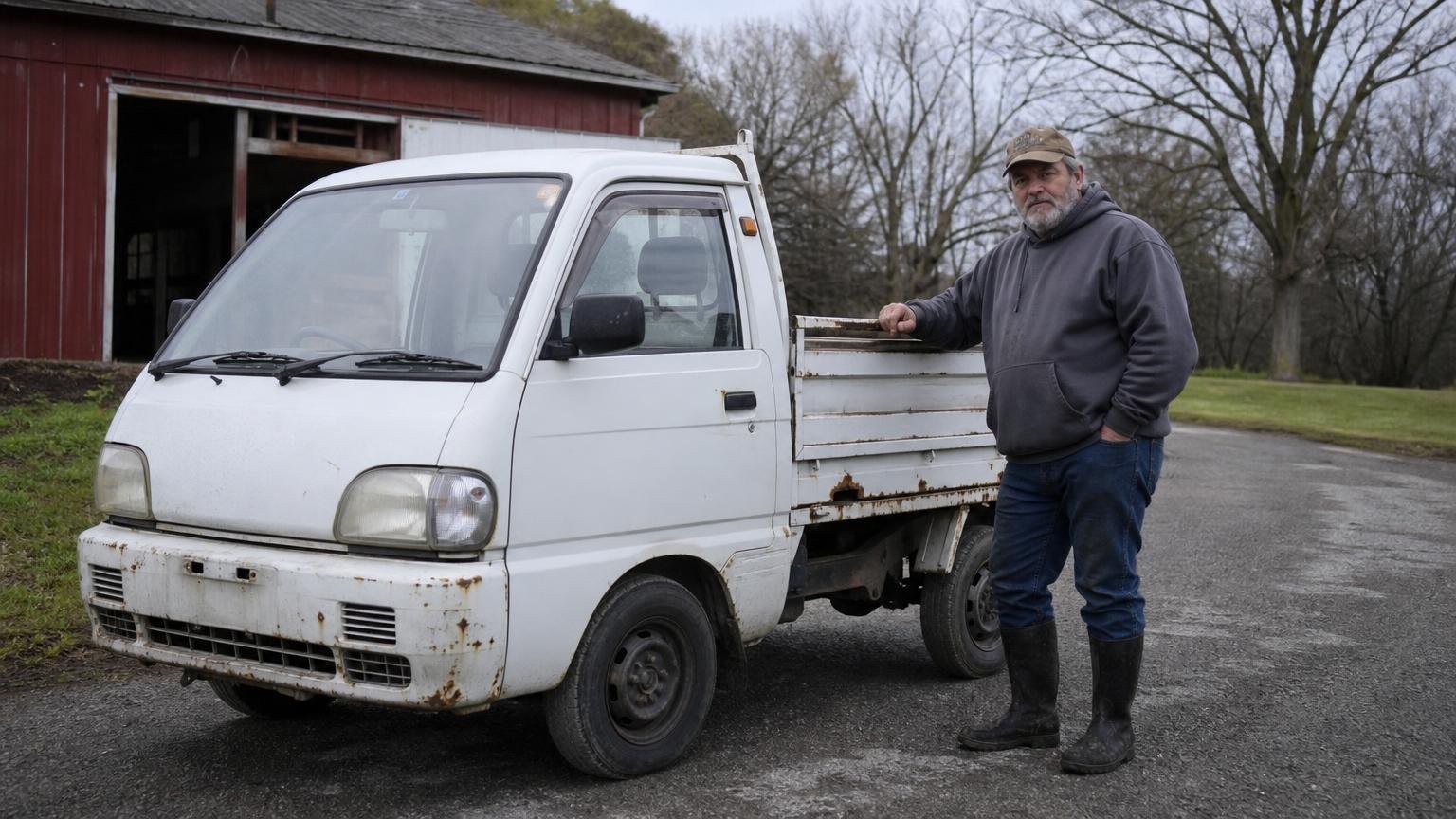
They look like toy pickups, but they haul hay like champs. For around $7,000, American farmers are snapping up Japanese mini-trucks that are officially off-limits on most public roads. The attraction is simple: cheap, reliable, 4×4 utility that sips fuel and squeezes through gates a full-size truck can’t touch.
“Put it this way,” said one cattleman in Missouri. “My UTV was $18,000. This did the same jobs for a third the price.”
What makes them irresistible
These pint-sized workhorses, often called kei trucks, pack a 660cc-ish engine, a manual or auto gearbox, and true part-time 4WD with low gearing. Most have steel beds, fold-down sides, and simple, fix-it-with-a-hammer engineering.
They’re narrow, light, and startlingly nimble. On a rutted track, a kei truck goes where a half-ton pickup won’t, then creeps into a barn without scuffing posts. Fuel economy can hit mid-30s mpg, and parts are more available than skeptics think thanks to cottage import networks.
Compared to name-brand UTVs, they offer a real cab, doors with glass, heat, wipers, and sometimes even air conditioning. “In winter, I’m warm and dry,” one North Dakota grower said. “That’s not luxury. That’s survival.”
The law says no—well, sort of
Here’s the rub: federal safety standards keep most of these trucks off highways. Under NHTSA rules, anything under 25 years old must meet modern crash requirements to be road-legal, and these imports generally don’t. EPA rules add emissions hurdles, though older examples have exemptions.
States then layer on a patchwork of rules. Some allow limited on-road use on low-speed roads. Others demand “off-road only” stickers and keep them strictly on private property. A few crack down harder, canceling titles or refusing registration outright, while enforcement varies by county.
Officially, they are often classified as off-road vehicles, farm equipment, or “mini-trucks” with specific restrictions. That’s why you’ll see them darting across pastures, not merging onto the interstate.
The end-run farmers use
Many buyers thread the needle by importing as off-road equipment, then using the trucks where the rules are most forgiving—their own land. The path, simplified, looks like this:
- Find a reputable exporter in Japan, pick a truck, and confirm year, condition, and paperwork
- Ship by roll-on/roll-off or container to a U.S. port, budget for freight, duty, and brokerage
- Clear customs using the correct forms that declare off-road or age-based exemptions
- Transport to the farm, then pursue state-specific registration if allowed, or tag as off-road only
- Insure through specialty carriers, or accept farm-use coverage with strict limits
Dealers have sprung up to smooth the process, refurbish trucks, and translate documents. “We don’t promise street plates,” one importer said. “We promise a tool that earns its keep off the pavement.”
Where they shine (and where they don’t)
On the farm, they’re almost perfect. You can load feed, tow small trailers, and creep in 4WD low through slick gumbo. The turning radius is tiny, the bed is honest, and the cabin keeps rain and dust outside.
On public roads, they’re compromised by modest brakes, basic crash protection, and top speeds that can feel sketchy at American traffic pace. Most came without airbags, modern crumple zones, or U.S.-style lighting. Insurance and liability can be a maze, too.
A state safety official put it bluntly: “They’re engineered for dense cities and farm lanes, not 70-mph freeways. That doesn’t make them bad—just out of their element.”
Still, for ranch hands, orchard crews, and maintenance teams, they’re replacing far pricier side-by-sides. When the math says three kei trucks equal one big-name UTV, budgets do the talking.
Why $7,000 is the magic number
At auction in Japan, clean 1990s and early-2000s trucks remain relatively cheap, and currency swings help U.S. buyers. After freight and fees, many land in the States around the $7K–$9K range, especially if cosmetically imperfect.
That price is low enough to absorb occasional repairs, yet high enough to justify preventive maintenance. Owners swap fluids, belts, and tires, then run them like mules. “I expected cute,” a Vermont sugar-maker laughed. “I got a beast that just won’t quit.”
The catch nobody sees coming
Paperwork surprises are common, especially when a county clerk has never seen a kei truck VIN. Some buyers discover that last year’s permissive rules turned restrictive this spring. Others learn their insurance covers only private land, not a two-mile hop on a county road.
Buyers should verify the latest statutes, document the import steps, and keep a folder of proof. A friendly conversation with the local sheriff often prevents an unfriendly roadside lesson.
What happens next
Demand isn’t fading, because the work they do is relentlessly practical. Some states are crafting clearer paths for limited on-road use; others are doubling down on bans. Meanwhile, U.S. makers are watching, rolling out tougher, more enclosed UTVs and low-speed electric work trucks.
If regulators carve out a narrow on-road category—think speed-limited, lighting-upgraded, insured, and locally confined—these rigs could move from gray-area gadget to recognized tool. If not, they’ll keep thriving where the law is simplest: inside the farm fence, mud on the tires, and a load of hay in the bed.