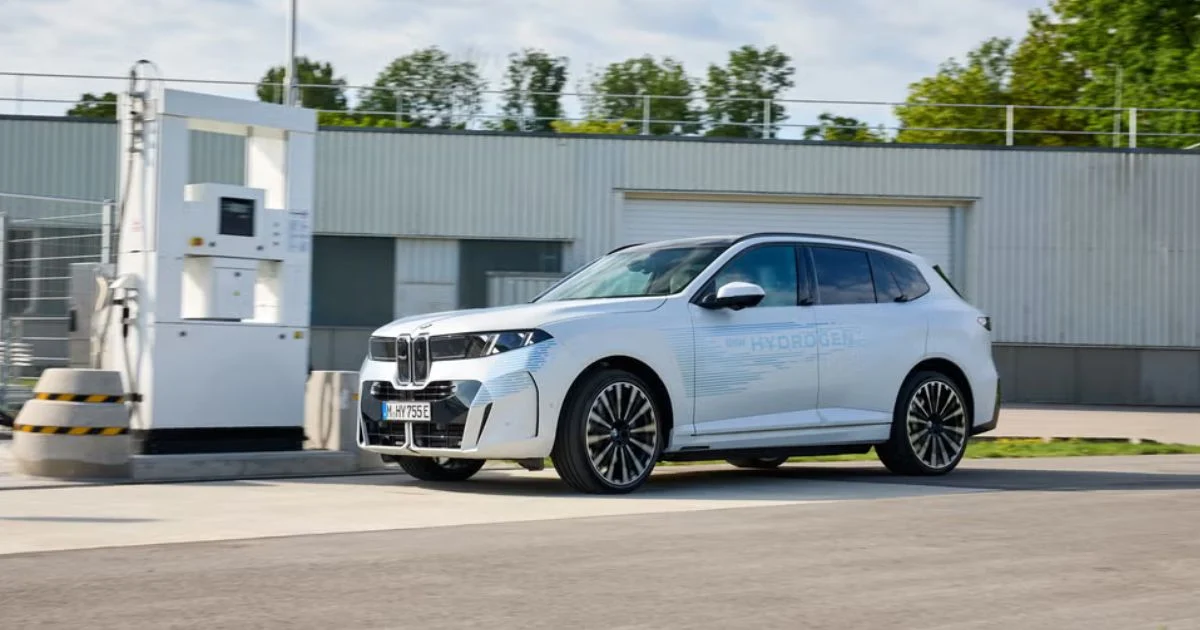
A big electric SUV that can travel roughly 465 miles between fills, with hydrogen fueling in under five minutes.
Behind these numbers, it’s no longer merely an exercise in style, but a concrete development program at BMW, launched as most automakers concentrate their resources on battery-electric powertrains.
In recent months, the Bavarian automaker has kicked off a new phase of road testing for its hydrogen SUV while starting the assembly of a third-generation fuel cell stack in Munich and preparing the Steyr, Austria, plant for production. This model, named BMW iX5 Hydrogen, is set to become the group’s first production vehicle equipped with a fuel cell, with a clear promise: deliver the driving pleasure of BMW’s large electric SUV, but with fueling characteristics typical of a conventional fuel, which immediately positions this hydrogen SUV as a very distinct option in a market currently dominated by batteries.
BMW iX5 hydrogen: a fuel-cell electric SUV that’s taking shape
The prototypes of the BMW iX5 hydrogen are currently racking up miles on real roads under a range of weather conditions and usage scenarios. The test program is designed to verify the integrated operation of the fuel cell stack, the high-voltage battery, the electric motor, the hydrogen storage tanks, and the vehicle’s control electronics. In the stack, hydrogen chemically reacts with oxygen from the air to produce the electricity that powers the motor, delivering propulsion that’s fully electric with no local emissions while driving.
For this SUV, BMW has developed a dedicated high-voltage battery designed to operate in concert with the fuel cell. The BMW Hydrogen Flat Storage tanks and the high-voltage management unit called Energy Master are intended to capture more energy during braking and improve overall efficiency. The manufacturer targets performance close to the battery-electric version of its large SUV, with a 0 to 60 mph time under five seconds and an estimated WLTP range of around 750 km. No official fuel economy or range data have been published yet, since the vehicle remains a development prototype, even though hydrogen fueling is already advertised to take under five minutes.
From Munich to Steyr: BMW is already prepping production of its hydrogen SUV
Alongside these road trials, BMW is advancing the technology itself. At the hydrogen competence center in Munich, a new run of prototypes for the third‑generation fuel cell system is coming together. This phase is about refining validation methods and preparing production processes that are more efficient and reliable, after an initial phase largely focused on feasibility of assembling components and the preliminary qualification of suppliers. The group’s strategy remains open to several technologies: the next X5 is slated to offer five powertrains, including gasoline, diesel, plug-in hybrid, 100% battery-electric, and a fuel-cell variant.
Serial production is also being prepared at the factories. In Steyr, Austria, BMW has already installed the first test benches and the specialized equipment for this powertrain, while the workforce is gradually being trained. Some system components, including the Energy Master high-voltage control unit, are produced at the Landshut site, and the collaboration between Munich and Steyr is expected to translate the lessons learned from prototype builds into the future production line. The iX5 Hydrogen development is part of the HyPowerDrive project, supported to the tune of €191 million by the German Federal Ministry of Transport and an additional €82 million from the Bavarian state, under the European IPCEI Hy2Move initiative. BMW positions this technology for applications where long range, rapid fueling, and strong operational flexibility remain top priorities, a space where this hydrogen SUV aims to stake its claim.