When you think Mitsubishi, you first picture Tommi Mäkinen’s Lancer Evolution rally cars. You also imagine the Pajero conquering the Paris-Dakar rally and, today, family‑friendly SUVs. A big, noble V8 under a long hood isn’t exactly the brand’s image. On Mitsubishi’s North American site, the lineup leans toward crossovers, a plug‑in hybrid, and a handful of four‑cylinders. In 1992, the company did develop a V8, but one intended for 20‑liter construction vehicles. That industrial block even carried an exhaust brake officially dubbed “Powertard,” as Jalopnik notes.
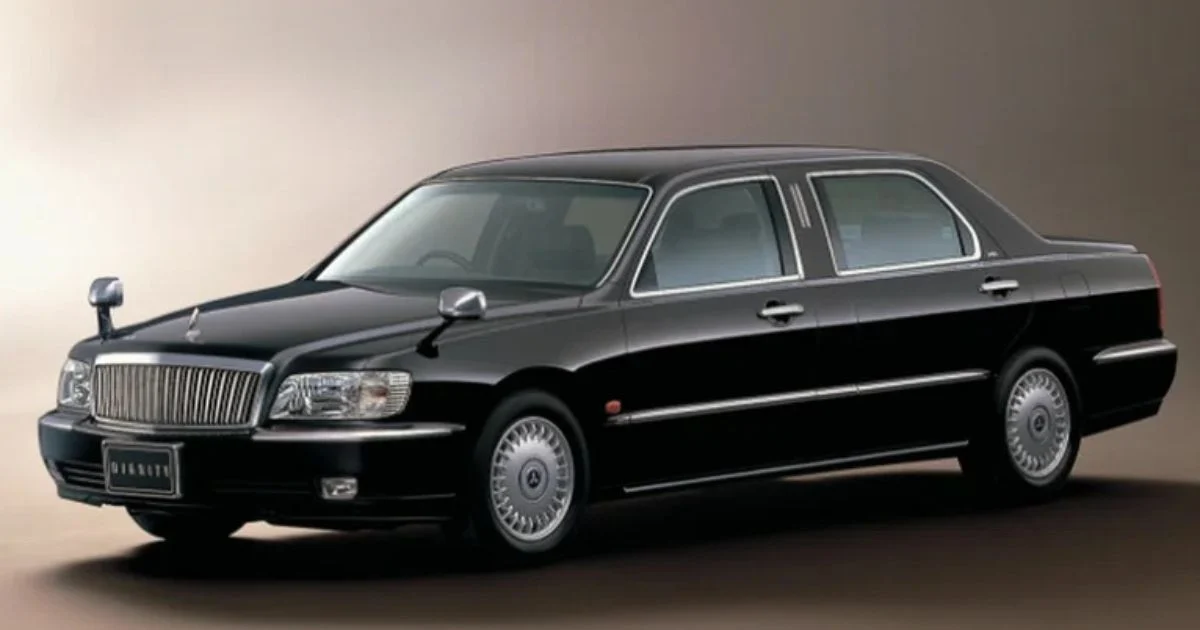
And then, surprise: Mitsubishi could still claim a very particular title. The company put into production the first modern direct‑injected gasoline V8. This rare engine is the Mitsubishi 8A8, or more precisely the 8A80 engine. It is the sole representative of this V8 family. Designed with Hyundai to power luxury sedans, this 4.5‑liter naturally aspirated V8 delivered up to 276 hp. Its torque reached 304 lb‑ft, about 412 Nm, a solid figure for the era. It was described as more powerful and at the same time more efficient thanks to its direct injection. And yet, instead of roaring in a sports coupe, it hides in a few Proudia, Dignity, and Hyundai Equus. These large sedans, sold mainly in Japan and Korea, remain almost invisible in Europe.
Mitsubishi 8A8: a GDI V8 born against the current
At the end of the 1990s, Mitsubishi leaned heavily on Gasoline Direct Injection technology. It’s their homegrown GDI, abbreviated in brand communications. The first four‑cylinders with GDI appeared around 1996‑1997 on the Galant and Carisma. The objective is simple: cut consumption while preserving performance. Very quickly, engineers wanted to elevate this technology to the top of the range. They worked on a large luxury sedan capable of facing the Toyota Century and Nissan President. The Proudia and Dignity were drawn up for this purpose and replaced the aging Debonair. They were meant to give Mitsubishi a credible technology showcase against the Japanese luxury benchmarks.
For the mechanical core, Mitsubishi partnered with Hyundai. The 8A8 project was run jointly by the two automakers. Hyundai handled the lower portion of the engine and the block. Mitsubishi, meanwhile, developed the cylinder heads and, above all, the high‑pressure direct injection system. The result, christened 8A80, is a 4,498 cc aluminum V8 with a 90° layout. It uses dual overhead camshafts and 32 valves. The engine is mounted transversely to fit into front‑wheel‑drive sedans. The compression ratio sits at about 10.7:1, relatively high for a large naturally aspirated engine. This level is made possible by the precise combustion control offered by direct injection. A recipe far ahead of its time for a brand not accustomed to highway‑miking V8s.
The 8A80: the first mass‑produced direct‑injected gasoline V8
On paper, the Mitsubishi 8A8 V8 checks all the boxes for a big modern engine. Its official power rating is 276 hp, in line with Japan’s horsepower cap. Torque peaks at 304 lb‑ft (about 412 Nm), delivering plenty of low‑end grunt. The block weighs roughly 230 kg with its full exhaust system. For a V8 of this size, that’s reasonable thanks to extensive use of aluminum. Direct injection delivers fuel straight into the cylinders through high‑pressure injectors. The engine management system can fine‑tune the air‑fuel mixture according to load. It runs leaner at light load, which helps lower fuel consumption.
This technical spec is paired with a fairly unusual architectural choice. The 8A80 is mounted transversely and drives the front wheels. The transmission is a five‑speed automatic. Most luxury V8s are mounted longitudinally and paired with rear‑wheel drive. Mitsubishi and Hyundai opted for a more compact layout that frees up space. This solution also makes sharing components with other front‑wheel‑drive models in the group easier. The challenge is as much technical as it is image; both partners wanted to prove their know‑how. In terms of innovation, this gasoline direct‑injected V8 arrived years ahead of its rivals. Other large‑volume gasoline V8s would not embrace direct injection until the mid‑2000s.
Proudia, Dignity, Hyundai Equus: the rare Mitsubishi 8A8 sedans
The problem is that the showroom chosen for this engine never found its audience. The Mitsubishi Proudia is a large front‑wheel‑drive luxury sedan launched in 1999 in the Japanese market. Its limousine version, the Dignity, stretches the wheelbase to offer more rear legroom. Both are aimed at luxury car buyers with cutting‑edge equipment and technology. Yet buyers in this segment showed little interest in the engine’s mechanical sophistication. Production ended in 2001 after only 1,227 Proudia units and 59 Dignity units were built. The Dignity was always shipped with the 8A80, with no alternative engine option. The Proudia could also be equipped with a V6 GDI, and the production figures don’t differentiate the versions. So it’s impossible to know how many of these sedans actually hid the Japanese V8 beneath their hoods.
Hyundai, for its part, deployed the same technical package on its flagship Equus. This model is also known as Centennial in some markets. The direct-injected V8 here carries the internal designation G8AA and remained a premium option. The body found far greater success than Mitsubishi’s offerings, with more than 110,000 units sold. A government recall in 2004 affected 29,932 Equus cars. Documentation mentions at least 3,156 cars equipped with this GDI V8 within that recall. It’s clear that the engine stayed a minority, even in the Korean market. Over time, fuel‑efficiency demands and the push for high‑octane gasoline posed problems. Issues with carbon buildup and fragile catalysts pushed Hyundai toward a version with indirect injection. This pioneer of direct injection in a V8 thus remained both exceptionally advanced and exceptionally marginal.