“Fucking charger!” Jim exclaims, slamming the door of his Chevrolet Equinox. He has to perform an extra maneuver to test the one next to it. And it works! I ask him: “Not always simple to drive electric?” Jim tilts the solar clips on his sunglasses and spins up: “Driving is fine, it’s actually pretty pleasant, but every time I have to charge, I come away with a headache. It’s my first electric car, but the next one will definitely be a hybrid!” And when I point out that despite the intermittently reopened Strait of Hormuz, gas is topping $4 a gallon and his choice to go all-electric could inspire other Americans, he half-acknowledges: “A lot of people do what I do—they lease to try it, and if it doesn’t suit them, they switch back to gas or move to a hybrid.”
Inflation
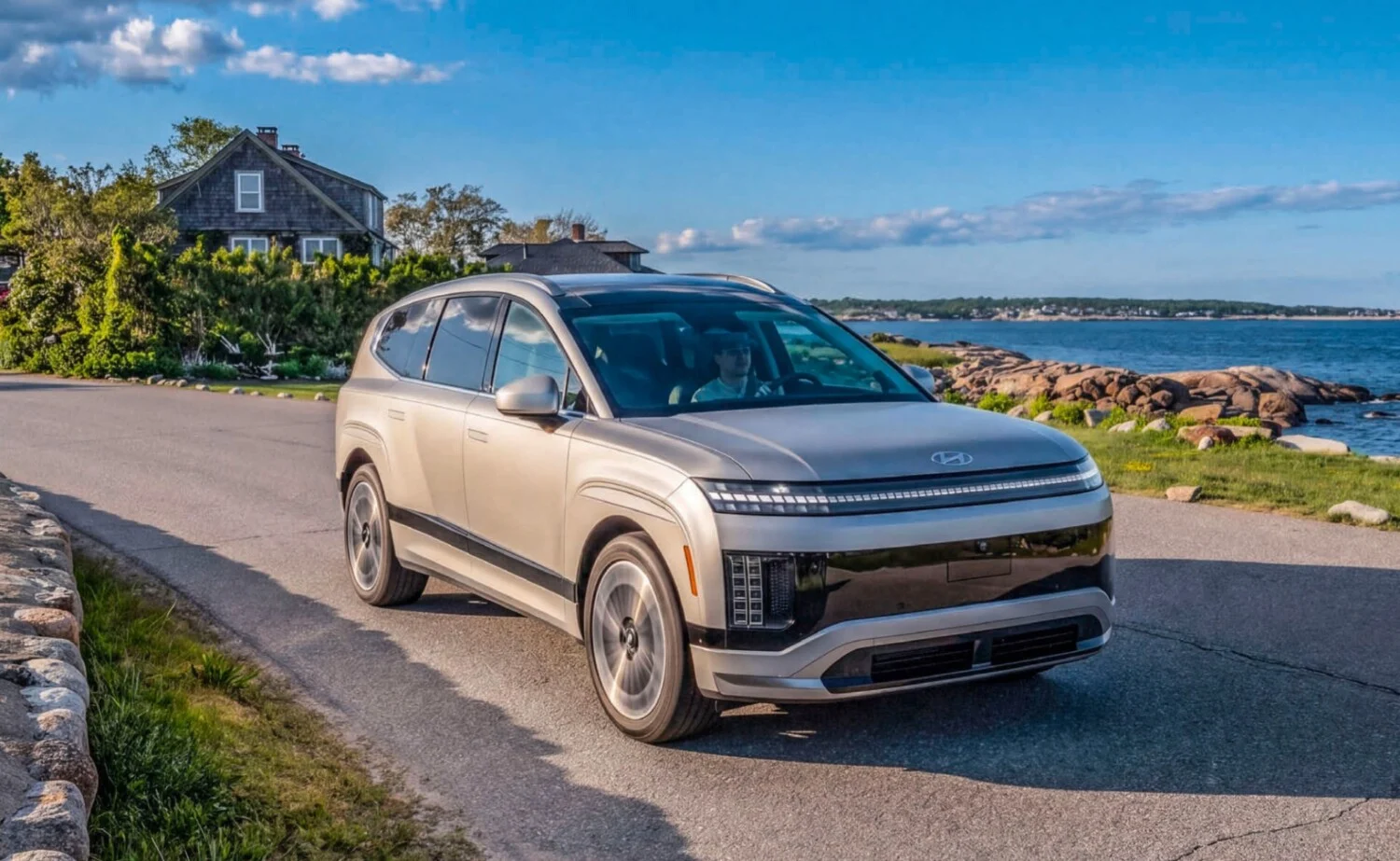
We’re in New York State, somewhere between Boston and the Big Apple, on a road trip in a Hyundai Ioniq 9. Compared with Jim, we’re pretty relaxed about range: a battery over 100 kWh and a consumption rate of 23.9 kWh per 100 km, which translates to roughly 350 kilometers (about 220 miles) on a full charge. Enough to reach the two cities directly with a small topping-off.
Departing Boston to spice things up—and, above all, to enrich the journey—we head north to the Cape Ann peninsula and the charming seaside town of Rockport. A first leg that lets us gauge the inflation effect in the United States.
The lobster roll—the same one you’ll find in Saint-Tropez or the Marais in Paris for around 17 €—is almost $30 with tax. On Highway 2, which will carry us toward the Berkshire region for the day’s stop, the trip planner marks charging stations at regular intervals. The battery still reads 30%, but we decide to stop for a recharge, just to be safe.
We’re not locals, but we spot a charger capable of delivering 180 kW—not ideal, but enough for our Ioniq 9, engineered for 800 V and up to 270 kW. In the United States, like most electric cars, the Hyundai leans on Tesla’s 400 V network, by far the most developed in the country. To charge elsewhere, the brand has provided two adapters that can be tucked under the hood. Smart move.
6 KW maximum
Because a road trip in an electric car needs a little drama, the Ford dealer’s charger refuses all our credit cards. No big deal—the town is full of other charging points. After a quick check, none of the local options exceed 6 kW, which means nearly 18 hours to be back on the road; one hour of charging lets us enjoy a coffee and gain about 2.6 miles of range. It’s going to be a long evening…
Patience isn’t my strong suit, so I advocate resuming the charge battles and switch back to Eco until the hotel at Lenox exits. The moment we plug the Ioniq 9 into one of the hotel’s chargers, we’re down to 9% battery and just over 20 miles of range. A comfortable margin!
This first day makes clear that, in this region of the United States—arguably one of the most charging-forward—networks have grown quickly, though the number of fast-charging stations remains insufficient, especially when compared to Europe.
It’s no surprise Jim complains about his Chevrolet, which still touts nearly 500 km of range (a touch over 300 miles in real life). After 10 hours and 40 minutes of charging at 6 kW on roughly 200 V, our Hyundai Ioniq 9 has recovered 105.58 kWh, for a bill under $30. Even if current policy scrapped incentives for switching to electric, that single point might push many Americans toward watts—so long as the EV isn’t the household’s only car.
A range that surpasses 560 km
With a range that exceeds 350 miles (more than 560 km), we don’t have to plan a recharge stop. Yet that’s exactly what I decide to do—pull into the station offering the highest charging power along the route. It’s here that we’ll meet Jim again, who is stunned by how little time we leave the SUV plugged in.
Beyond charging speed, I brag about the onboard comfort, the ease and the pleasure of the ride. I relate that to the price tag of the model, built in the United States and selling for just over $60,000. That’s not enough to make Jim hesitate; he peels back the smoked lenses of his sunglasses and says: “Cars have become way too expensive these days, that’s the problem!”
That sentiment echoes a Times piece that notes a 1950 Chevrolet 150 cost $1,900 (roughly the equivalent of about $22,000 today) and that there were only four cars under $25,000—Hyundai Venue, Kia Soul, Nissan Sentra, and Versa. The Times adds that 100% tariffs on Chinese-made EVs help keep supply tight. Without those tariffs, Americans would have access to more than ten models, with about a third of them being 100% electric. When asked whether high fuel prices spur the switch to electric, the French market—where strong incentives exist—appears to say yes. The American market, where vehicle prices are rising much faster than the growth of public fast charging, seems much more cautious.
Find our Hyundai Ioniq 9 road test in Auto-Journal, issue no. 1215, dated 08/20/2026.