Cool and methodical, the European Commission picked up the pen on July 6. It published an implementing regulation “instituting a definitive antidumping duty on imports of new tires (…) originating in the People’s Republic of China”. It is already in force, which means tires manufactured in China are now subject to an additional surcharge on top of the tariffs they already owe. No retroactive effect of the measure, however, was granted.
Chinese Tires, State‑Controlled Tires
The European Commission opened an investigation on May 21, 2025, following a complaint filed a month earlier by the “Coalition Against Unfair Tire Imports”. This entity, for which no trace of any legal existence could be found, clearly groups Michelin, Continental, Pirelli and many other major European manufacturers.
According to Brussels, “the complainant provided in its petition sufficiently compelling evidence of distortions in China’s raw materials market”—rubber, for example. Natural or derived from petrochemicals, this material accounts for 41% of a tire’s weight, according to Continental.
Yet the European Commission traced in five-year plans laid out by various Chinese provinces legal acts ordering officials to favor the rubber industry. Thus, “the 14th Five-Year Plan of Jilin Province for the development of the petrochemical industry provides that authorities will fully promote the development of the industry of new chemical materials, such as technical plastics, synthetic rubber …”, notes the Commission.
And the pattern is repeated in many other provinces! “Chinese authorities turn to favorable public procurement, financial support and other tools to boost the competitiveness of domestically produced tires on foreign markets,” Brussels adds.
Beyond favorable conditions to access raw materials, China also requires its national companies to appoint officials from the Communist Party of China within their organizational charts: “Thus, the state’s presence in tire-sector companies (…) allows authorities to influence price formation and costs,” the Commission further notes.
With subsidized raw materials and officials directing supposedly private enterprises, it’s hard to reach any conclusion other than this: Chinese tires today are state‑driven!
What Does This Mean for French Motorists?
The Commission imposed three different antidumping regimes, which relate both to the margins found for the manufacturers and to the attitude those companies displayed toward the European investigation. The first regime is specific to the Korean tire maker Hankook, which operates plants in China and likely benefited from certain country-specific leniencies. Hankook, having cooperated fully with the investigation, sees its tires from China (and only those) hit with a 4.3% surcharge. The second scenario concerns Chinese tire makers that agreed to answer the Commission’s questions; they face a 24.4% surcharge. The third undoubtedly covers Michelin, Continental, Pirelli and numerous other major European manufacturers. According to Brussels, “the complainant provided in its petition sufficiently compelling evidence of distortions in China’s raw materials market”—rubber again.
Natural or petrochemical, this material accounts for 41% of a tire’s weight, according to Continental. Yet the European Commission unearthed in the five-year plans of various Chinese provinces acts compelling the favoring of the rubber industry. Thus, the 14th Five‑Year Plan for the Petrochemical Industry in Jilin Province provides that authorities will fully promote the development of the industry of new chemical materials, such as technical plastics, synthetic rubber, and the like—and the manufacturers who refused to listen now face a 45.3% tariff on their rubbers!
According to calculations by the Paris Tire Union, a typical first-price tire is sold for around €61 on average in France today. With the maximum 45.3% tariff applied, it would rise to €88 per tire. A realistic price point for a flagship offer? “There is no guarantee margins won’t shrink for distributors. For auto‑service centers, a tire is a loss leader,” notes the union.
The manufacturers themselves could also shoulder part of the surcharge to avoid passing it entirely to customers. So it’s hard to forecast with precision that one brand will jump by X%: “At this stage, we do not have enough precise elements to establish a direct link between the recent EU measures and changes in consumer‑facing prices,” explains the Nantes-based Jymeo, which runs an online tire price comparison.
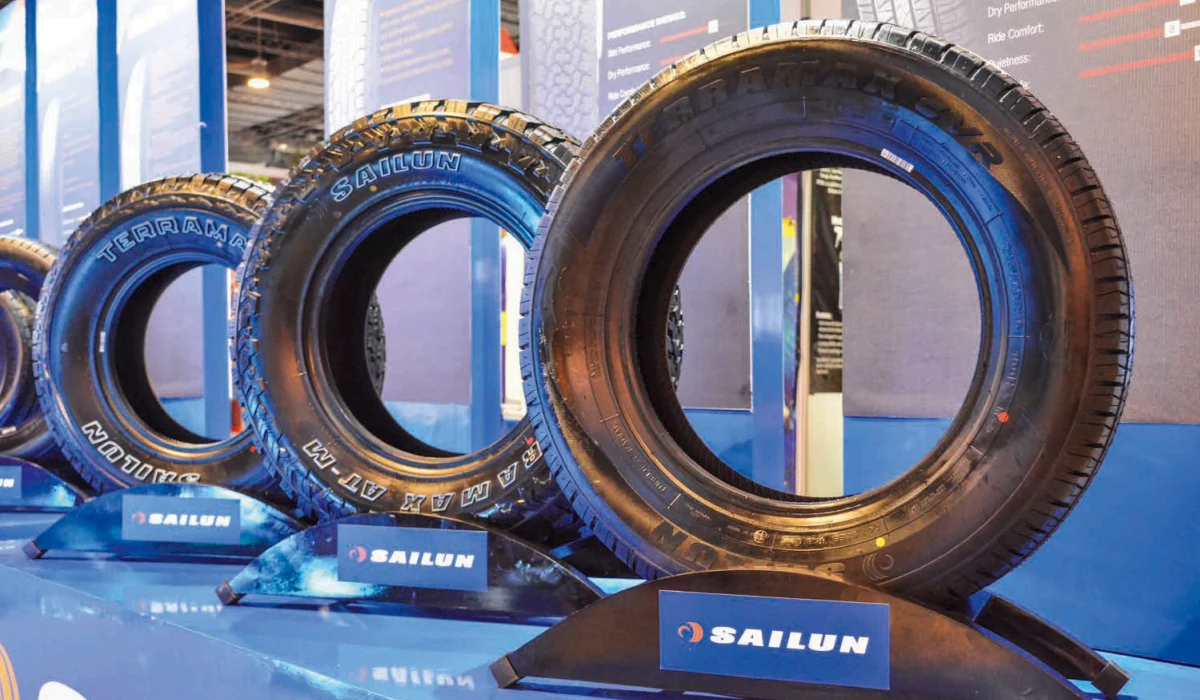
A few observations, however. Norauto markets Road Rider brand tires, its entry-level line. By all signs, Road Rider tires are actually Rovelo products sold under another name. Knowing Rovelo is itself a Sailun brand, the link is clear.
As Sailun cooperated with the EU investigation, it would seem automatic that its tires would rise by 24.4% in Europe. The reality at Norauto tells a different story. On July 7, 2026, a Road Rider 185/55 R 15 82 V RHP 780 P tire was €40.90 apiece in France. By July 23, it was listed at €43.90, a 7.33% increase in two weeks. Is this due to the European import tariff? Mobivia, to which Norauto belongs, did not respond to our inquiries.
Substitution Solutions Already in the Works
The European Commission did not sanction tire makers themselves but tires produced in China. The nuance is important: “Chinese manufacturers may be tempted to circumvent this law by shifting production to other Southeast Asian countries, or even to North Africa,” the Tire Union observes. It seems to be an accurate read.
On July 6, 2026 — the day the Commission laid out the antidumping charges — Guangzhou South China Rubber Tire (Wanli) announced the creation of a joint venture with a Malaysian investor: $320 million will be spent to build a factory in Malaysia capable of producing 5 million tires per year!
Sailun, which likely makes tires for Mobivia, already operates plants in Cambodia and Vietnam. Shandong Yongsheng Rubber, another Chinese tire giant, has decided to set up shop in northern Morocco. On January 26, 2026, it was announced that a new factory would rise in the North African kingdom in the coming months.
With more than 1,700 employees and an expected output of 6 million tires per year, it would become Africa’s largest tire factory … unless Egypt, also keen to host Chinese tiremakers in recent times, beats it to the punch at Europe’s doorstep.
The Auto‑Journal’s View
Premium tires like Michelin have continued to lose market share in France in recent years. The issue isn’t fading interest; it’s price. Will raising the price of low-cost tires translate into more sales for rival brands? Not necessarily, and for the moment Chinese tires remain the cheapest on the shelves, which means they’ve retained, or nearly retained, their appeal.
Find our investigation into Chinese tires in Auto-Journal issue no. 1215, dated August 20, 2026.