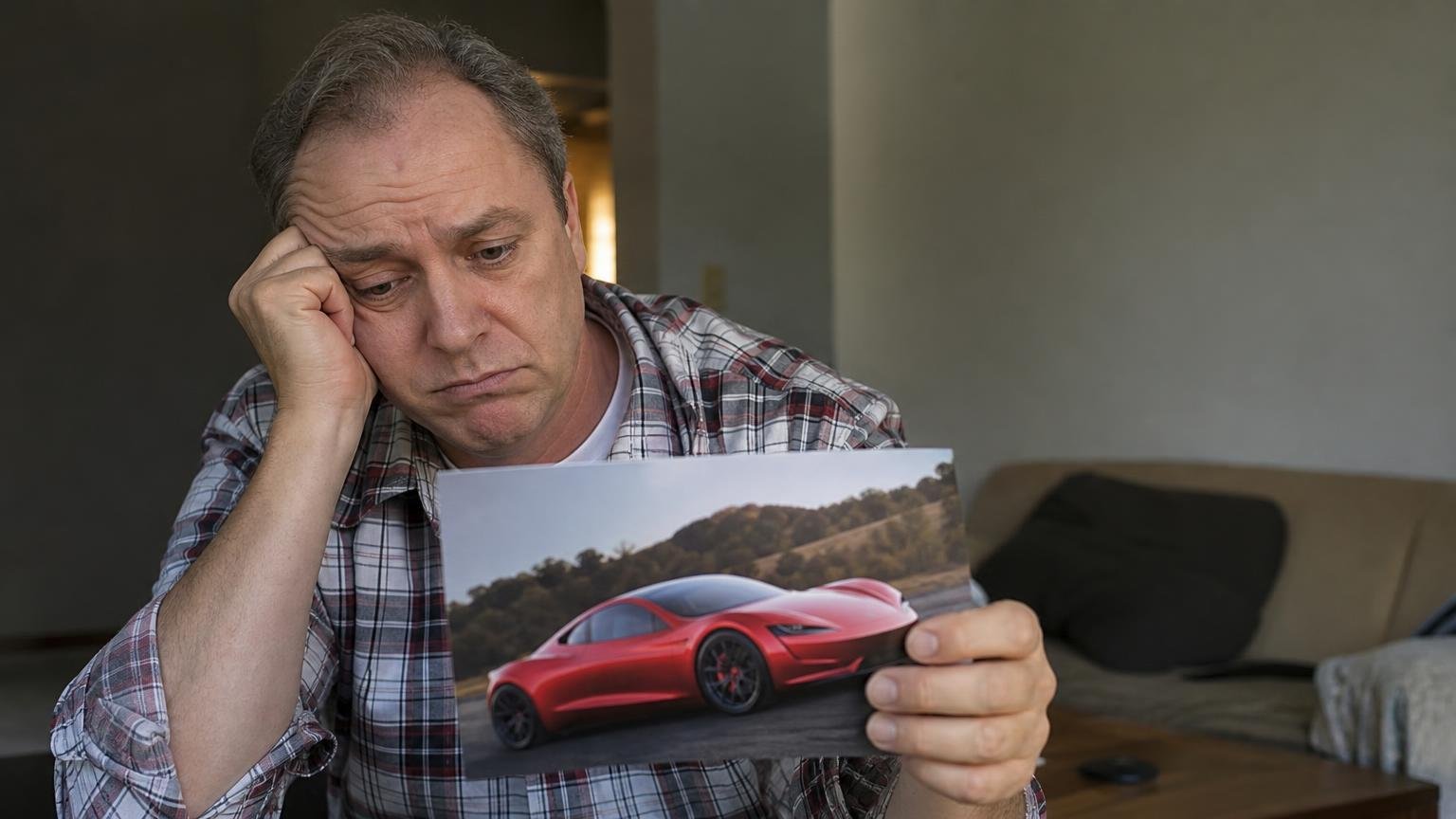
He was certain the future had a delivery date. A reservation, a confirmation email, and a promise from Silicon Valley that speed and silence could live in the same machine. He imagined the first night drive, the empty highway, the soft click of a stalk and a surge of electric torque. It all felt close enough to touch.
“I wasn’t buying a car,” he says now, “I was buying a timeline.” The line kept moving, and the future stayed just out ahead.
A launch that felt inevitable
In late 2017, the numbers were mythic and the unveiling cinematic. A prototype bounded onto the stage, and the internet did the rest. He placed his reservation within days, like thousands of others who treated a checkout page like destiny. The underlying pitch was simple: engineering on an unprecedented curve, and a company that made delay sound like progress.
“It felt like buying a ticket to the future,” he recalls. Friends cheered, threads blossomed, and spreadsheets began predicting delivery windows. The waiting became a hobby, then a habit.
Timelines that kept moving
Deadlines slipped in polite increments at first, then in long, quiet arcs. A year became two, two became several, and each update was both hopeful and hedged. Big things were happening—new factories, new models, new constraints—each framed as a step toward something bigger.
The world didn’t help. Supply chains snarled, batteries grew scarce, and priorities shifted toward vehicles that could ship by the hundreds of thousands. A halo product is a shining promise, but high-volume cars are a business plan. “I get it,” he says. “But after a while, every quarter felt like a rerun.”
The cost of waiting
The deposit sat innocently on a statement, a small anchor tied to a very large dream. He told himself it was fine to wait, because the car would be historic, because he’d outlast the delays, because patience would eventually turn into horsepower.
But time charges interest in strange ways:
- Missed chances for other cars, other trips, other stories, all postponed by a future that refused to arrive.
The emotional math grew messy. Pride turned into quiet embarrassment, then into a wry stubbornness that kept him from cancelling. “I didn’t want to admit I’d fallen in love with a prototype,” he says. “It wasn’t rational, it was ritual.”
What Tesla says now
Official signals remain teasing and intermittent. Engineering updates hint at breakthroughs, not dates. Hype is still a central technology, and bold claims are part of the company’s grammar. The car, when it arrives, will likely be absurd in its numbers—because that is the point of a flagship.
From the outside, it’s clear the business has evolved. Gigafactories hum, mainstream EVs define the ledger, and the runway for ultra-low-volume supercars is narrower than the stage that launched them. “The delay isn’t the shock,” says an auto analyst. “It’s that the dream stayed this shiny.”
The community that formed in the hold
Reservation holders found one another online, because rituals need witnesses. They compared notes, traded screenshots, and turned rumor into a collaborative sport. Some cancelled and returned with renewed optimism. Others doubled down and treated each delay as a badge.
A strange empathy developed—both for the engineers chasing physics and for the fans chasing a very specific feeling. “You can mock the wait,” one owner-in-limbo posted, “but not the want.”
Plan B, then Plan C
While he waited, the world moved on. Rivals arrived with stunning specs. Chargers spread like new nervous systems. He tested other EVs, admired their manners, and almost convinced himself to switch. Almost.
He bought a practical electric daily instead, telling himself it was a bridge and not a replacement. It carried dogs and groceries, stacked miles without drama, and showed him that the most remarkable thing about EVs is how quickly they become normal.
What the preorder era reveals
He is a citizen of the preorder age, when technology is sold as a timeline as much as a tool. Deposits become votes, and early buyers act like investors in a story they don’t quite control. The upside is shared excitement; the downside is extended ambiguity.
“Expectation is a kind of fuel,” he says. “It keeps you going long after the tank should be empty.” Fans become caretakers of a myth, keeping it polished while the real thing gathers dust somewhere out of view.
Still waiting, still wanting
Nine years is a long time to keep a promise on layaway. He checks his inbox less often, but he hasn’t pulled the plug. The calendar has taught him humility, and the market has taught him options, yet the magnetism remains peculiar and strong.
“I still want it,” he admits, almost sheepish, almost defiant. The future may not have a fixed arrival, but sometimes the waiting becomes the story—a tale about faith, friction, and the curious endurance of a dream that keeps resetting its own clock.