
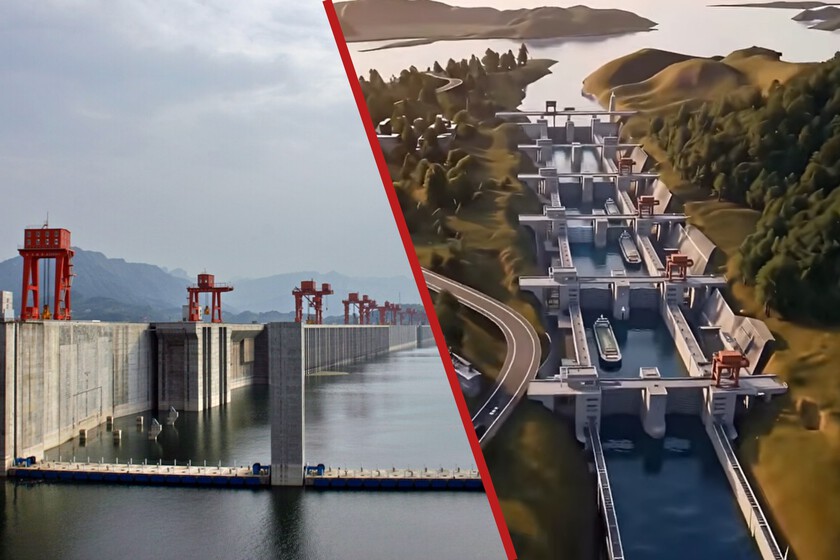
China has the world’s largest dam, so colossal that it has even shifted the axis of the Earth. And to allow ships to pass through it there is a lift at that height—a kind of gigantic tub—that can support vessels of up to 3,000 tonnes, accompanied by a complex lock system. Yet, astonishingly, it has already proven too small.
The structure in question is the Three Gorges Dam, on the Yangtze River: a waterway artery crucial to the People’s Republic. Its navigation passage was designed for an annual cargo load of 100 million tonnes. But that limit has long been surpassed, and in 2025 it set a record with 173 million tonnes. In short: there is a monumental bottleneck to cross it. Work has already begun on a solution: a nearly 7-kilometre water ladder.
10,000-tonne ships climbing the mountain
They call it the New Three Gorges Transportation Channel, a fairly unglamorous name for the colossal engineering feat it represents. This new project is a new waterway with double locks across five levels. Instead of a single elevator, it operates like a staircase: ships pass through each level, connected by locks, to traverse the northern area beside the dam. When vessels enter each chamber, the water level is raised or lowered, thereby overcoming the dam’s 113 m vertical rise.
The figures are staggering. In total, this five-level water staircase will extend about 6,680 metres: almost 6.7 km. Each individual chamber measures roughly 280 m in length and 40 m in width, translating into a capacity for ships of 10,000 tonnes. Each gate separating the chambers weighs 1,440 tonnes. China already boasts that it is the largest internal lock system in the world.
As explained by engineer Niu Xinqiang, chief scientist of the Yangtze River Design Group, this new lock-based channel essentially modernizes the upper river’s two-lane navigation into a multilane canal. In short: it will allow a greater flow of ships to traverse the Three Gorges and, in turn, permit even larger vessels. When completed, and coupled with the ship lift and the existing lock system, it is expected to enable the passage of 336 million tonnes of cargo per year.
A colossal project and an environmental challenge
The construction of this new canal to cross the Three Gorges Dam represents a major challenge, arguably more complex than the two systems already in place. The massive locks will have to be carved into the mountainside, through very hard rock strata. The figures provided by the engineers convey the scale: approximately 160 million cubic metres of earth and rock will be excavated, and almost 10 million cubic metres of concrete will be used.
There is also the environmental impact to consider: the goal is to disturb fauna and flora in both the river and the land region it will cut through as little as possible. The builders insist that it will be controllable. To this end, they have implemented protective measures based on a simple principle: “build, protect and restore while building”. For example, they will install facilities to allow fish to pass.
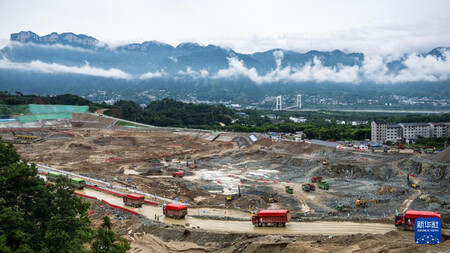
Inspecting the ground has already forced plan adjustments, such as discarding underwater blasting in favor of mechanical excavation to protect the Chinese sturgeon spawning zones. This has pushed the budget up by about 2,000 million yuan. At Gezhouba Dam, downstream and also slated for a new passage, over 3,200 trees will have to be replanted, many of which are more than half a century old.
The project is proceeding within the context of an active infrastructure network, requiring extraordinary precision in the installation of equipment. Xinqiang notes that the New Three Gorges Transportation Channel will mean adding and modifying navigation facilities in a gigantic water storage hub that already exists. They face restrictions in design and construction, making this a massive challenge for the entire design-build-operate chain.
Also at stake is the environmental footprint: the aim is to disturb fauna and flora as little as possible in both the river and the land through which it passes. The designers assure that it will be controllable. To that end, measures have been put in place based on a fundamental principle: “build, protect, and restore as you build”. For instance, they will implement fish-pass facilities.
The ground investigations have already compelled changes, such as abandoning underwater blasting and turning to mechanical excavation to protect the spawning zones of the Chinese sturgeon. This raised the budget by about 2,000 million yuan. In the Gezhouba Dam further downstream, which will also be altered with a new passage, more than 3,200 trees will need to be replanted, many of which have more than fifty years of age.
Nearly 10 billion for a new inland waterway
On June 8 the construction of this titanic project officially began. At the Chongqing Guoyuan port, massive gantry cranes are already working at full tilt, and autonomous trucks shuttle back and forth loading materials. The total projected investment stands at 77,208 million yuan, almost 10 billion euros at current exchange rates, a budget that could vary as the work progresses.
For the New Three Gorges Transportation Channel, the execution timetable is estimated at about 112 months, over nine years. This places the completion of the works and its opening to river traffic around 2035, provided there are no delays. It stands as the first major infrastructure project China has launched in its Fifteenth Five-Year Plan (2026-2030).
“The new canal will fully harness the advantages of Yangtze River waterway transport, strengthening multimodal transport capabilities by road, rail, and waterway, and it is expected to yield an average saving of more than 6,000 million yuan per year in transport costs,” argues Xinqiang. Partly because it will allow 10,000-tonne ships to reach China’s western regions, and because it will shorten transit times.
From factory floor to port, faster. The Yangtze River Economic Belt is of immense importance to China: it spans 11 provinces and major urban centers, including Shanghai. Its GDP accounts for almost half of the national GDP. This region, laid out along the river, has developed a powerful industrial base: from metallurgy to electronics or advanced technologies, through car manufacturing and pharmaceuticals and chemicals.
In this zone, several of China’s leading firms—such as BYD, SAIC, Chery, and Changan—have established their roots. This new river corridor will streamline the movement of cars from factories to seaports, where they can be loaded onto the enormous Ro-Ro ships heading to markets like Europe.
Images | China Three Gorges Corporation, Xinhua News