In Brief
The head of Porsche, Michael Leiters, has confirmed the production of the electric versions of the 718 Boxster and Cayman, justifying this choice on economic grounds. However, Porsche has decided to keep thermal variants as well, notably to satisfy customers who are loyal to six-cylinder engines. The company asserts that the autonomy of its industrial decisions takes priority over synergies with other brands in the Volkswagen Group, such as Audi. Moreover, there are no plans to halt Taycan production at this time, but the lineup will be streamlined. Porsche’s evolving strategy aims to pair profitability with retaining its passionate customers.
It took the arrival of a new leader to put the doubt to rest. Michael Leiters, at the helm of Porsche since January 1, has just settled the fate of the battery-powered 718 Boxster and Cayman. They will indeed see the light of day.
A Profitability-Driven Decision at Porsche
The Porsche executive explained it in an interview with the Frankfurter Allgemeine, the German daily that questioned him about the major trade-offs underway in Zuffenhausen. For several months, rumors of an outright abandonment of the program circulated insistently in trade press, fueled by the automaker’s financial difficulties. But also by public indifference toward a compact sports car without a flat-six.
The matter is now closed, at least in principle. Even though the project’s contours have evolved substantially since its launch just a few years ago, to the point of becoming almost unrecognizable.
The argument put forward by the Porsche boss boils down to a single sentence. And it has nothing sentimental about it. “With the electric 718, we’ve reached the conclusion that we are going to build this model.” “Because it’s the best economic solution and it will be a fantastic car,” he tells the German daily.
The line succinctly captures the method of the new Porsche leader, who subjects every program to profitability scrutiny before any other consideration.
A former McLaren executive, Leiters succeeded Oliver Blume, who now devotes himself exclusively to chairing the Volkswagen Group. His agenda is basically a clean-up. Under the previous leadership, investments in electrification widened Porsche’s operating margin hole by €1.8 billion in operating income. That’s roughly $2.1 billion.
Audi Theory Debunked by Management
Another explanation circulated across Germany. According to the Frankfurter Allgemeine, the retention of the electric 718 would be less about its own economics and more about Audi’s need to borrow several components from that platform to build its future sports car… billed as the electric heir to the TT.
Leiters flatly contests this reading. “I first evaluate every project exclusively from Porsche’s point of view. Does this make economic sense or not? Only then do potential synergies within the group come into play,” he tells the German newspaper.
The message to Wolfsburg is unambiguous. Porsche asserts full autonomy over its industrial decisions, even if that means ruffling its best-established internal partners.
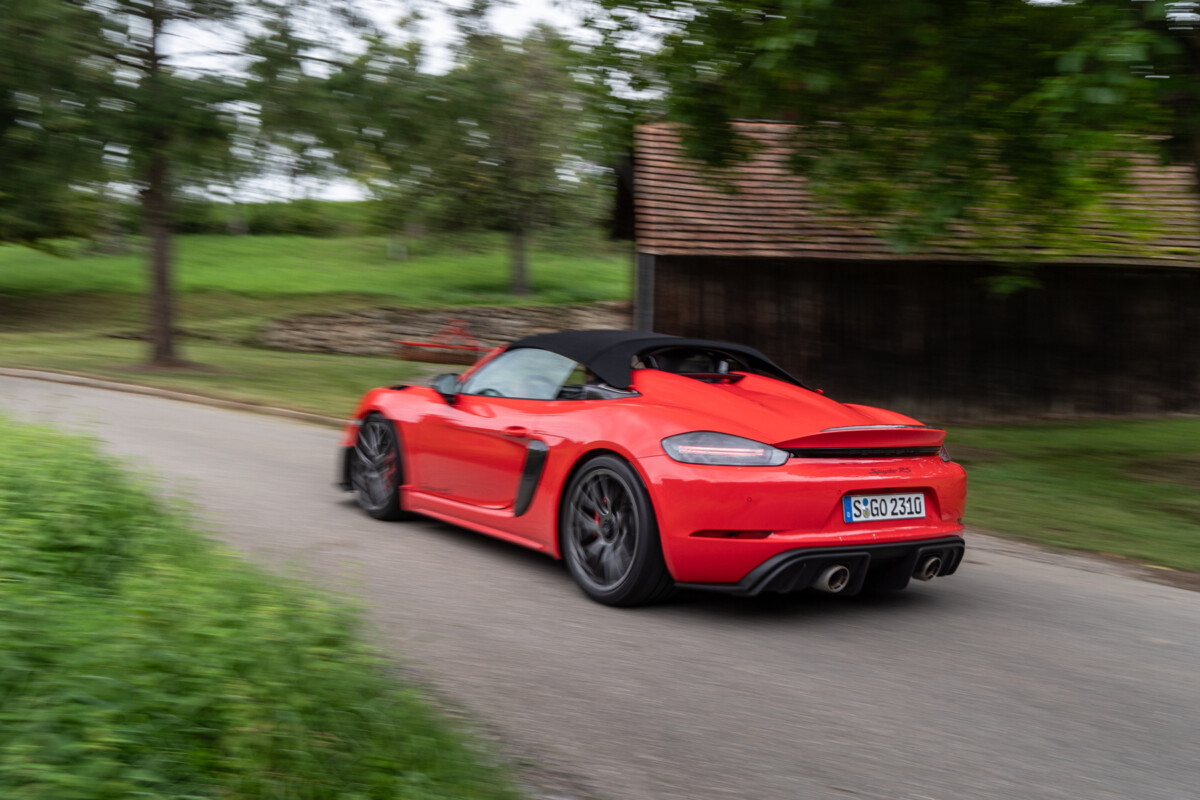
Rescued, the electric 718 won’t occupy the spot it was originally promised. The original brief called for a fully electrified lineup with no thermal escape hatch contemplated. That dogma fell by the wayside along the way. Porsche first announced that the most radical variants would retain a combustion engine. Logically, the six-cylinder naturally aspirated engines already in service on the Cayman GT4, GT4 RS and 718 Spyder RS.
The manufacturer then pushed the approach even further, reworking the model’s architecture to accommodate gasoline blocks on versions far more affordable. The two technologies will thus coexist in the catalog. And the thermal powertrains start with a solid lead with Porsche’s clientele… at least if pricing remains controlled.
Porsche Keeps Moving Forward with Electric Models
That interview also yielded two other notable takeaways. The first concerns a potential sports car positioned above the 911 in the company’s hierarchy. An idea Leiters mentions among development avenues for the North American market. Without confirming any program or providing a schedule.
The notion isn’t new and traces back to the Porsche Mission X concept. The second concerns the Taycan, whose disappearance had been floated in the context of streamlining the lineup.
“We’ve already started. With the Taycan, we will reduce the number of variants even further and thus cut complexity. We do not intend to stop the Taycan in the short term,” the executive insists. He also cites the sums already invested in this sedan. It remains to be seen whether the public will follow the move. And given Porsche’s purist clientele, it’s hard to say the task will be easy. Stay tuned.
Comparative Table
| Electrification investments | Operational debt incurred | Converted to dollars |
|---|---|---|
| €1.8 billion | €1.8 billion | $2.1 billion |
Key Takeaways
- Porsche confirms the production of the 718 Boxster and Cayman electric models under Michael Leiters.
- The decision to keep these models is driven by profitability, not sentiment.
- Thermal versions will continue to sit alongside electric models in the 718 lineup.
- Porsche asserts independent decision-making autonomy from the needs of other brands in the Volkswagen Group.
- The Taycan lineup will be simplified, with no short-term end of production planned.
- A possible sports model above the 911 has been discussed, but there is no concrete project or official timetable.
FAQ
Will Porsche really produce the electric Boxster and Cayman?
Yes, Michael Leiters confirmed that the 718 Boxster and Cayman electric versions will be produced.
Will the thermal versions of Boxster and Cayman disappear?
No, Porsche will retain certain thermal versions, notably the six-cylinder sport models.
Why did Porsche decide to launch the 718 electric?
The decision was driven primarily by the project’s economic profitability, according to the executive.
Is there a link between the 718 electric project and Audi?
Leiters rejects that explanation, stating that each project is validated first for Porsche.
Will Porsche Taycan stop production?
No, Porsche plans only to reduce the Taycan lineup’s complexity and does not foresee an end to production in the short term.