
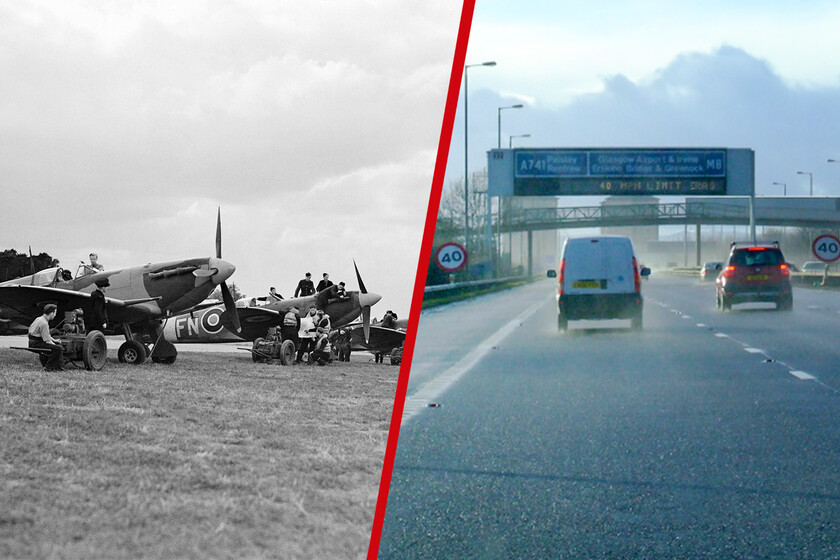
Under the asphalt, campuses and even gas stations across half of Europe lie remnants of World War II airfields. The continent’s reconstruction turned the military legacy into the bedrock of highways, universities and civilian airfields that remain operational today.
At the end of World War II, Europe was covered with military airfields. Thousands of concrete runways, built in months for bombers and fighters, dotted a continent that needed to be rebuilt from scratch.
From a Military Airfield to a Highway or a University Campus
Many of these facilities lost their function almost immediately. Postwar aviation demanded longer runways and better-located airports, so the wartime legacy was left as barren, flat ground, already leveled and almost always connected to the existing road network, precisely what any postwar urban plan needed.
When the highway boom arrived, that land proved irresistible. In the United Kingdom, The M62 was laid directly over the base’s main runway at Burtonwood in 1973.

At the highway’s inauguration, the hangars and access from the runway, now the M62, were still visible.
This base grew to become Europe’s largest air force base, with more than 18,000 personnel stationed there and a pivotal role in the Berlin Airlift. Today the highway runs over what used to be the east–west runway, and parts of the old runway layout can still be discerned beside the asphalt.
A similar fate befell the M8 as it passes through Glasgow, with the stretch between Hillington and Arkleston occupying the former Runway 08/26 of Renfrew Airport, closed in 1966. The highway’s routing almost perfectly mirrors the original runway’s orientation, a detail only truly appreciable from the air.
Other airfields did not end up under asphalt, but under classrooms. The Barberán y Collar airfield in Alcalá de Henares served as a Soviet base during the Civil War and is now an external campus of the University of Alcalá.
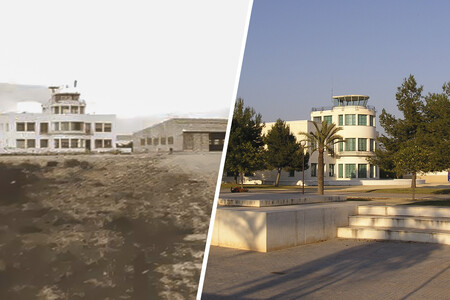
In Alicante, something similar happened. The Rabasa airfield, a stopover for the French airmail service in the 1920s, of which Antoine de Saint-Exupéry was a part, and a Republican base during the war, is now the campus of the University of Alicante.
The original control tower, erected in 1940, remains as an administrative facility, and the old hangar has been transformed into the Palmetum of the campus, a collection of palm trees beneath the old metal framework.
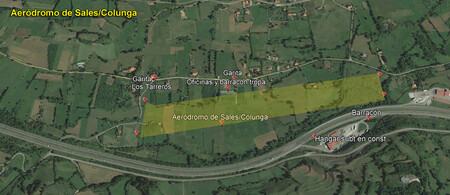
Aeródromo de Colunga junto a la A-64, Asturias.
Spain also has an example beneath the asphalt. In Llanes, Republican miners dug an underground hangar next to the Sales Colunga airfield that was never finished. Today those tunnels lie beneath the southern petrol station of the A-64, which erased, without knowing it, its last visible remnants.
Sometimes none of this is visible from the asphalt, except for a control tower repurposed as an office and a discreet commemorative plaque. But every time a car changes lanes on the M62 near Warrington, it crosses the exact spot where B-47s took off seventy years ago. Or when a student walks past the university’s administrative building, ninety years ago pilots and mechanics were passing by, ready to die for what they believed to be right.
Images | RAF, Historical Traveler, Dr RdL, Etnacila