
In Brief
The impression that some new-car taillights look off or barely lit stems from a shift in how lighting is designed, notably with indirect-reflection systems like those on the Tesla Model Y. Even though they appear understated, these lights meet homologation standards, but they can confuse other road users—especially in challenging conditions. This trend fuels a debate between bold styling and road-safety requirements. Many drivers, and even some police officers, mistake this compliant lighting for a malfunction. The question lingers: where should creativity end and legibility begin on the road?
While cruising at night behind a brand-new car, you may have had a moment of doubt. Little red light at the back, or none at all, giving the impression that the vehicle is nearly invisible, and a touch of unease: could the taillights be broken? Yet, when you brake, everything lights up as it should—no evident defect.
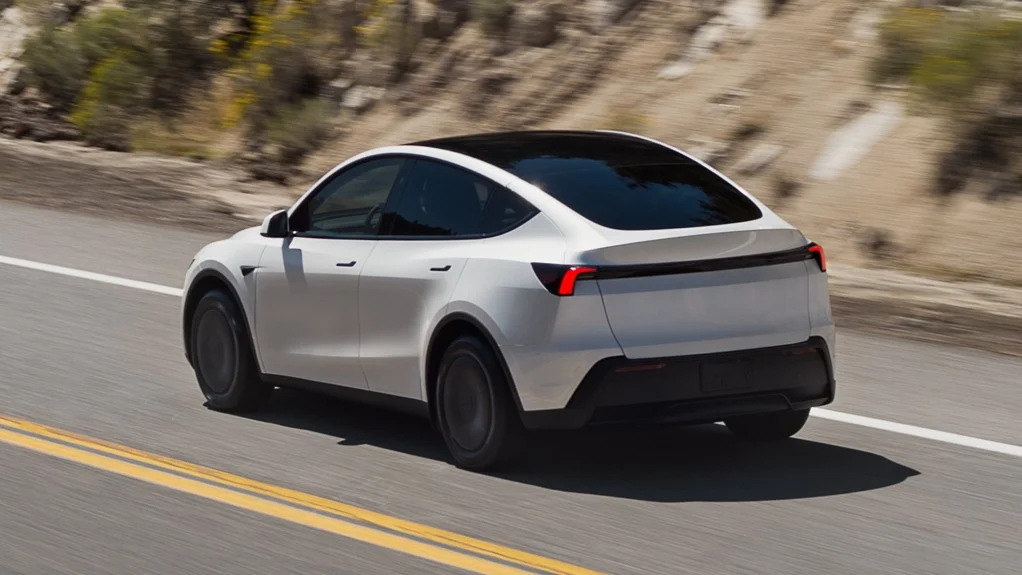
This odd contrast isn’t the result of a single fault but rather a new way of shaping auto lighting. For about a decade, horizontal LED bars have become a signature feature, from Kia to Porsche. And the latest evolution pushes the concept further: the new generation of Tesla Model Y introduces indirect-reflection taillights, a system called IRL, which works flawlessly but upends the visual habits of drivers and even some officers.
When New Car Taillights Appear Dim
A scene in Indiana illustrates the discomfort well. A driver of a Tesla Model Y was pulled over by a police officer convinced that the taillights weren’t functioning. For the officer, the faint red glow seen from a distance looked like a malfunction. For the owner, everything was in order—the system met the standards and lit up as intended.
What that officer saw mirrors what many motorists already notice. Up front, the car looks well lit with LED daytime running lights. At the rear, however, the light signature is discreet, sometimes nearly invisible depending on the angle or the weather. Road-safety bodies even refer to these vehicles as “phantom vehicles,” cars that are hard to spot from behind while their drivers believe they are clearly visible.
The Tesla Model Y’s Indirect-Reflection Taillights in Detail
On the latest version of the electric SUV, Tesla refers to them as indirect-reflection taillights, or IRL for “Indirect Running Light.” The concept is perplexing. Instead of shining directly out the back, a row of LEDs tucked beneath the upper trim projects light onto the paint of the tailgate. The red surface you see isn’t the light source but a reflected glow. The brake lights, meanwhile, stay traditional and illuminate only when braking.
This choice sits within the broader battle for lighting signatures, where brands compete to stand out at any cost. Tesla claims a design that is different, meant to leave a lasting impression. Franz von Holzhausen, the company’s head of design, calls the innovation “refreshing.” On the engineering side, Lars Moravy, vice president of engineering, maintains that the system strictly complies with homologation standards based on light intensity, regardless of the surface type emitting it. On paper, everything aligns with the rules governing lighting—whether the American FMVSS 108 or the UNECE/CE regulations in Europe (R7 and R48)—which focus on minimum power, usable luminous area, and visibility angles.
Tail Light Design, Standards, and Visibility: Where Is the Line?
The question then recurs with emphasis: how far can design push the lighting while preserving readability of signals? The texts emphasize precise laboratory measurements, while real-world nighttime driving, rain, and vehicles with varying shapes challenge perception. Theoretically, a taillight can be compliant yet give another driver the impression that it’s only half-lit, or that a police officer on the roadside might misread it.
The debate extends beyond taillights alone. Some contemporary models feature a very tall beltline and limited rear glass, shrinking the central rearward view. This complicates maneuvering, even as manufacturers tout rear-view cameras and 360-degree systems that help with parking and exiting spaces. Yet many drivers notice that no screen can fully replace direct human perception when judging distance to the car behind or instantly discerning whether those taillights are clearly legible to other road users.
Key Takeaways
- Indirect-reflection taillights are being adopted by several new vehicles, including the Tesla Model Y.
- Although approved, this type of lighting can seem dim or less visible depending on conditions and viewing angle.
- The stark contrast between position lights and brake lights can heighten the sense of anomaly among some drivers and law enforcement officers.
- Manufacturers push the envelope of lighting design to stand out while still complying with regulations.
- The safety debate centers on real-world readability on the road, beyond what official standards require.
- Technology does not fully erase the need for good human perception to keep road safety high.
FAQ
Why do some new car taillights look almost off?
This effect results from new lighting designs, notably indirect-reflection taillights that render light less visible depending on angle or weather.
Are indirect-reflection taillights homologated?
Yes, they comply with major international standards governing light output and visibility, even if the perceived brightness differs from traditional lighting.
Which models are already using this technology?
Brands like Tesla, particularly on the Model Y, but also Kia and Porsche have adopted innovative lighting signatures that sometimes involve indirect reflection.
Does this system pose a road-safety risk?
Even if homologated, some users or police officers worry about reduced visibility in certain conditions, renewing the debate over safety.
Can an indirect-reflection taillight be mistaken for a faulty light?
Yes. Drivers and police have occasionally mistaken this type of taillight for a malfunction due to its discreet appearance, even when it’s functioning normally.