
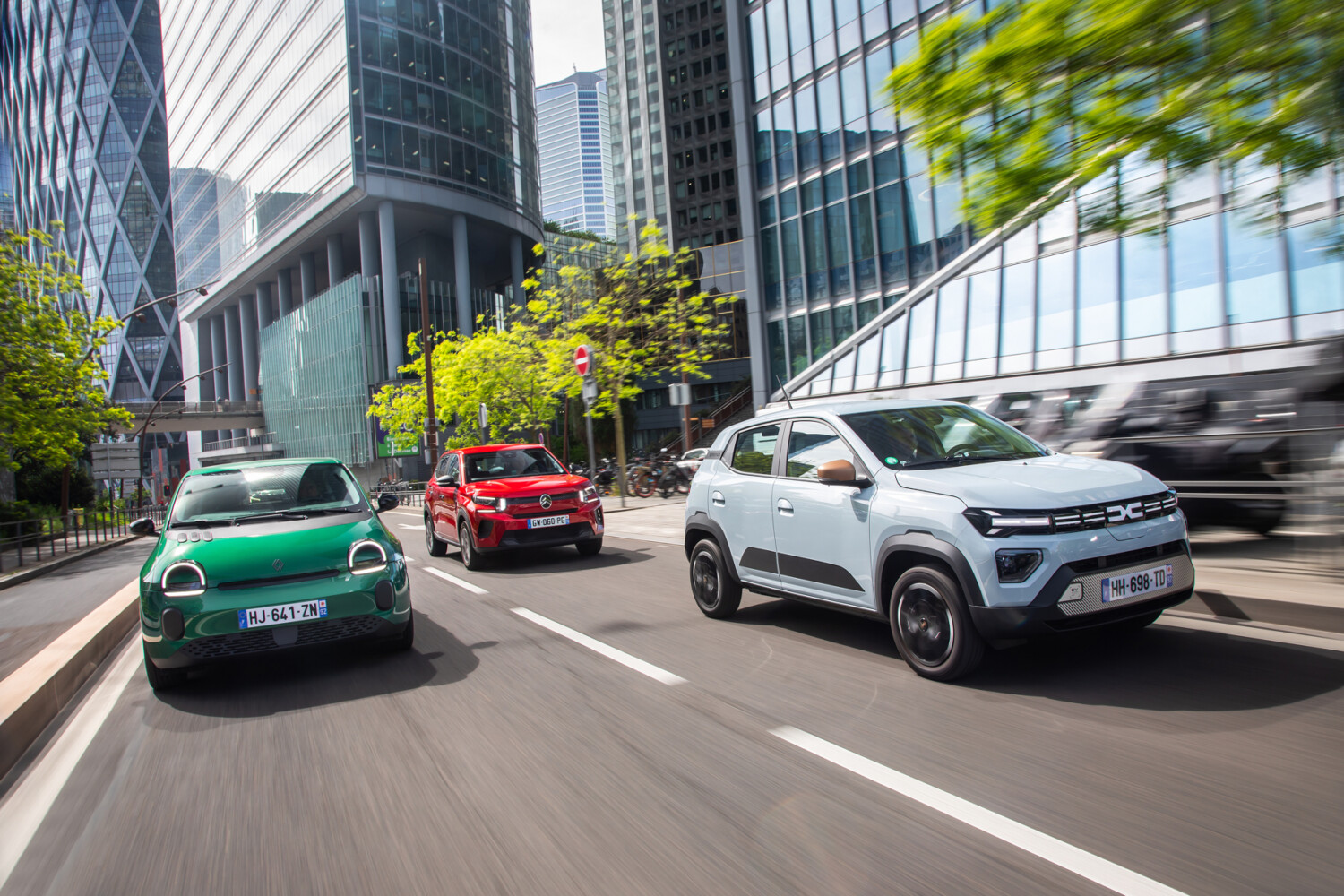
In Brief
The showdown between the Renault Twingo E-Tech, the Citroën ë-C3, and the Dacia Spring spotlights three takes on an affordable electric city car designed for urban living in 2026. The Twingo stands out with its appealing price, comfort, and overall driving enjoyment, delivering well-balanced performance. The Citroën ë-C3 wins over with its spacious interior and five seats, but it suffers from a shorter range and a more limited equipment list. The Dacia Spring compensates for a less refined finish with a generous boot, solid equipment, and livelier driving dynamics.
Are we witnessing a return to common sense? After a period when cities saw attempts to offer more versatile city cars at often sky-high prices, manufacturers are reverting to simpler, more affordable models designed primarily for urban use. A niche that the Dacia Spring occupied on its own after the disappearance of the previous-generation Twingo and the Seat Mii, Skoda Citigo, and Volkswagen Up!. In 2025, the Romanian-made Spring topped the A-segment electric car sales in Europe, and Renault now enters the fray with its snappy, more modern-looking Twingo E-Tech. The Citroën ë-C3, larger but now fitted with a more modest battery, also shakes up the small “low-price” EV circle with a battery at best around 30 kWh and pricing under €20,000. The eligibility of these two French cars for the enhanced green incentive weighs heavily, while the Spring, produced in China, settles for a modest bonus. It isn’t defeated yet, however—Dacia has added better road-holding, a new battery, and a more powerful electric motor (102 hp; the base 70 hp version remains in the lineup). The Extreme trim (the most “upmarket”) is their default top pick. At similar prices (excluding subsidies), the ë-C3 (113 hp) and Twingo (80 hp) present themselves in entry trims You for Citroën and Evolution for Renault.
Renault Twingo e-Tech vs Citroën ë-C3 vs Dacia Spring: On the Road?
With the new replacement under development by Dacia, based on the Twingo, the Spring has benefited since March from a brand-new lithium-iron-phosphate (LFP) battery pack positioned under the floor (the old one sat beneath the rear bench). Result: a lower center of gravity. The new power steering adds heft and steadiness, reducing the pendulum motions that plagued the first version. The Spring gains both precision and driving pleasure, and the front axle also benefits from a stabilizer bar. It’s not luxury, but it helps. The engineers’ work is unfortunately hampered by the dreaded Linglong Eco Master tires, whose grip remains precarious in wet conditions—a real disaster in the rain. Don’t expect the brakes to compensate for a misstep at speeds above 50 mph, either; a cautious ride is required. After all, this is no longer the “calf” of old!
With 102 hp, the Spring has wings. It accelerates from 0 to 60 mph in under 6.5 seconds and reaches a standing-start 1,000 meters in under 35 seconds. Its rivals remain speechless by comparison… A liveliness that reinforces its image as the nimble “little mouse,” exceptionally adaptable in city limits.
Also forgotten are the hair-raising moments to squeeze into fast lanes. Driving above 78 mph, however, remains beyond its reach. The Renault Twingo and Citroën ë-C3 struggle to reach such speeds, and top out around 80 mph. Wind noise and a lack of refinement remind us that these cars aren’t built for long highway hauls. It’s on rough city streets—the paving, manhole covers, and speed bumps—that their comfort should be judged. The Citroën, though missing the hydraulic bump stops of the base suspension, handles small irregularities better than the Spring, which can feel stiff and bouncy despite generous suspension travel. The standout surprise is the Twingo, incredibly plush over imperfect surfaces.
None of these cars seems impervious to rough roads, but the Twingo is least bothered, even when it rides on optional 18-inch alloy wheels (16 inches on steel wheels). The chassis control is excellent, steering is quick and precise, the small turning radius makes parking easy, and the brake feel is natural, making it a very pleasant city car to live with. The driver also appreciates the smooth, progressive regenerative braking in the B mode (a feature shared with the Spring). And in this regard, the old regime’s star still offers the best driving position—specifically, the seat height adjustment—and a tilt-adjustable steering wheel. Visibility isn’t flawless for any of the three: the rear headrests aren’t integrated, which can block the rear view. In the Spring and ë-C3, white plastics on the dashboard reflect in the windshield—material quality isn’t their strong suit, either.
Renault Twingo e-Tech vs Citroën ë-C3 vs Dacia Spring: Interior Life?
The Twingo’s original, slightly more colorful presentation doesn’t stop it from featuring hard plastics, though they’re of better quality (a matte texture) than its rivals’ more “junkyard” interiors, which create those glare issues mentioned above. The Spring, despite its rugged, no-nonsense vibe, levels up in the Extreme trim with two-tone upholstery that mimics leather on the bolsters and the top of the seats. It also benefits from a 10.1-inch touchscreen (25.7 cm). Beyond the different brand-specific graphics, the UI is largely Renault-sourced. Menus, interfaces, and both Apple CarPlay and Android Auto are present, and the Spring gains a rearview camera as standard and even a potential GPS for €400.
Two features the Twingo Evolution misses are rear electric windows (unlike the base Evolution). It settles for rear quarter-windows with a crank, reminiscent of an old three-door Renault Supercinq. It does rise above with two more generous rear seats, provided you’re not taller than about 5’11” (1.80 m) because there’s limited headroom. The rear seats slide 6.7 inches (17 cm) and can fold to reconfigure the interior and trunk volume (between 250 and 350 dm3, counting space under the floor). The Spring also offers a strong boot (325 dm3) but lacks a fold-flat rear seat. The option exists to add a small front storage bin (about 30 dm3) under the hood, priced at €180.
From the B-segment, the ë-C3 takes a clear lead in cabin space. There’s plenty of headroom and legroom in the rear, plus a true five-seat layout—the Citroën earns valuable points here. The trunk is 310 dm3, more practical than the Twingo when passengers slide the rear bench rearward to stretch their legs. The ë-C3 scores with more numerous storage spaces and a bit more overall space than the other two. That’s about where the compliments end for the ë-C3, though. In the base You trim, interior finish is extremely spartan: rear windows are manual, the rear seat isn’t split, and there’s no radio at all. And no screen—just a place to mount a smartphone. Install the Citroën-recommended app and plug in the USB port, and you can access information or your favorite music once reception is adequate. The knobs to the right of the steering wheel only adjust volume for the two stock speakers. Fortunately, climate control remains, unlike the others.
Renault Twingo e-Tech vs Citroën ë-C3 vs Dacia Spring: In-Bag Price?
Thanks to the enhanced eco incentive of €3,620, the Twingo E-Tech lands at €15,870 after subsidies. The ë-C3 You, once the discount is applied (about €3,600), starts at €16,390. That’s not bad, but it comes with a limited standard equipment list and a rather disappointing 175 km range from a 29 kWh net battery. By comparison, the Spring offers more range (about 200 km between charges) with a smaller 24.3 kWh net pack. It’s a better value overall for daily errands, but the economy ends up with a more limited equipment list and variable build quality. The Spring’s total price sits around €19,320 after subsidies, with a €380 CEE incentive (the only incentive granted to Chinese-made EVs). The Twingo remains the best overall compromise: strong price, 200 km of range, and a 27.5 kWh net battery that’s just slightly more expensive to recharge than the Romanian car. The shared drawback across all three remains: no standard DC fast charging (DC) on any, and an optional DC charger is priced around €500. The Twingo’s option—up to 50 kW charging (with V2L)—is a step ahead of the Spring’s 40 kW V2L and the Citroën’s 30 kW; the Twingo is the only one allowing rapid charging as an option while also offering V2L. Renault also includes AC fast charging up to 11 kW (instead of the base 6.6 kW) as an option; the Spring doesn’t need it, while the ë-C3 charges at 7.4 kW from the factory and would require an extra €400 to reach the fast-charge capability. The Twingo still has the last word here.
Renault Twingo e-Tech 80 hp / 29 kWh Evolution: The Ups
- Comfort and road manners
- Interior space for a city car
- Price versus performance
Renault Twingo e-Tech 80 hp / 29 kWh Evolution: The Downsides
- “Marginal” range for daily use in some conditions
- Trunk a bit modest in size
- Sound insulation could be better
Citroën ë-C3 Urban Range 113 hp / 30.3 kWh You: The Pros
- Solid damping and comfort on rough roads
- The only one with five seats
- Attractive price point
Citroën ë-C3 Urban Range 113 hp / 30.3 kWh You: The Cons
- Range feels a touch short for a larger city car
- Equipment and finish are minimal in You trim
- Turning circle could be tighter
Dacia Spring 102 hp / 25.1 kWh Extreme: The Pros
- Pep in its step
- Reasonable equipment level
- Generous cargo space
Dacia Spring 102 hp / 25.1 kWh Extreme: The Cons
- Finish and materials feel a bit plasticky
- Limited interior space for taller occupants
- Traction can be finicky in slick conditions
Renault Twingo e-Tech vs Citroën ë-C3 vs Dacia Spring: Verdicts?
On the Road:
- 1st: Renault Twingo e-Tech
- 2nd: Citroën ë-C3
- 3rd: Dacia Spring
Interior Life:
- 1st: Renault Twingo e-Tech
- 2nd: Citroën ë-C3
- 3rd: Dacia Spring
Budget:
- 1st: Renault Twingo e-Tech
- 2nd: Citroën ë-C3
- 3rd: Dacia Spring
The Auto-Journal’s Pick: Renault Twingo e-Tech
The Twingo dominates the discussion thanks to its driving pleasure, practicality, and overall coherence. The ë-C3 with its 30.3 kWh battery, though trimmed in equipment and range, remains a compelling choice for anyone who needs a “bigger” car. The Spring, while outmatched on the road and on price, still shines with its generous equipment for the money.
Read our comparison test between the Renault Twingo e-Tech, Citroën ë-C3, and Dacia Spring in l’Auto-Journal issue no. 1209, dated May 13, 2026.
Comparative Table
| Model | Power (hp) | Battery (net kWh) | Range (mi) | Price with incentives (USD) | Seats | Trunk (L) | DC Charger (optional, kW) |
|---|---|---|---|---|---|---|---|
| Renault Twingo E-Tech Evolution | 80 | 27.5 | 200 | About $17,460 | 4 | 250–350 | 50 |
| Citroën ë-C3 You | 113 | 29 (or 30.3) | 175 | About $18,000 | 5 | 310 | 30 |
| Dacia Spring Extreme | 102 | 24.3 (or 25.1) | 200 | About $21,300 | 4 | 325 | 40 |
Key Takeaways
- The Renault Twingo E-Tech leads this comparison thanks to its driving feel, practicality, and very attractive price.
- The Citroën ë-C3 offers excellent interior space with five seats but suffers from a modest range and limited standard equipment.
- The Dacia Spring impresses with its cargo capacity, kit, and dynamic behavior, though its finish is judged as average.
- All three models stay under €20,000 after subsidies, but only the French cars benefit from the enhanced green incentive.
- The DC fast charger remains an optional extra for all three city EVs.
- None of these cars offers broad versatility beyond city use; they’re best suited for urban driving.
FAQ
Which city electric car is the cheapest after subsidies?
The Renault Twingo E-Tech tops the list at about €15,870 after the eco incentive, making it the most affordable in this comparison.
Which car offers the best real-world range?
Both the Dacia Spring and the Renault Twingo E-Tech exceed their published ranges, delivering over 200 kilometers in typical use.
Can the Citroën ë-C3 seat five passengers?
Yes. It is the only one of the three that can accommodate five occupants, a strong point for interior usability.
Is the DC fast charger standard on these models?
No. The DC fast charger is not standard; it is an optional feature on all three vehicles and enables quicker charging at fast-charging stations.
Which car has the biggest trunk?
The Dacia Spring offers the largest cargo space at 325 dm3, surpassing its rivals.