
Concrete is everywhere: buildings, roads, tunnels, bridges, ports, dams, housing or high-speed rail lines depend on a material that has enabled the construction of modern civilization. But its fundamental ingredient, cement, has become one of the great industrial and climate challenges today, since its production accounts for 8% of global CO₂ emissions due to its most problematic component, clinker.
In addition to that climate pressure, another less visible issue adds to the equation: durability. Many of the large infrastructures built during the enormous development of the 1960s, 1970s and 1980s have reached a stage where they require constant inspections, repairs and costly maintenance. While engineers seek new materials to extend their lifespans, part of the answer lies in constructions dating back more than two thousand years.
The “defects” of Roman concrete were actually an extraordinary technology
In bays such as Pozzuoli, near Naples (Italy), Roman port structures still survive that have withstood the action of seawater for nearly 2,000 years. Their resilience drew the attention of archaeologists and scientists, who began to study why those materials aged in such a way that differs from many modern concretes.
In 2023, a major breakthrough arrived with research led by Professor Admir Masic, from the Massachusetts Institute of Technology (MIT). His team published in Science Advances a study that identified the role of lime clasts, small white fragments inside the Roman concrete that for a long time had been interpreted as a consequence of a poorly refined mixture.
But far from that being the case, those fragments were a chemical reservoir created through a technique called hot mixing: the Romans incorporated quicklime together with volcanic ashes and other dry components before adding water.
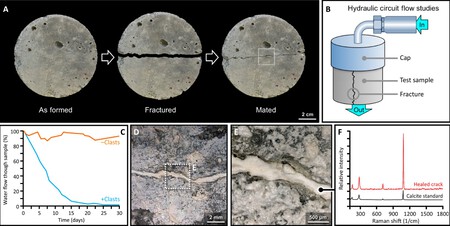
That reaction generated high temperatures and left small zones rich in highly reactive calcium within the material. Thus, when a microcrack allows the entry of water, that calcium can dissolve and generate new minerals capable of filling the crack.

In the experiments conducted by the MIT researchers, samples produced with this technique fully sealed their cracks in approximately two weeks, while others made by conventional processes remained cracked.
The significance of the discovery was so great that Masic himself continued exploring how the ancient Roman builders worked. By the end of 2025, a new study published in Nature Communications analyzed a genuine Roman work preserved in Pompeii after the 79 eruption of Vesuvius.
There appeared piles of materials prepared for construction, including direct evidence of the use of quicklime in dry mixes, confirming the use of the hot mixing technique. “I expected to see Roman workers walking among the piles of material with their tools,” Masic recalled to MIT as he described the thrill of studying that kind of time capsule of ancient engineering.
Fuente: MIT
AI and 3D printing to reinvent a recipe from the Roman Empire
The modern industry does not aim to substitute modern reinforced concrete with an exact copy of the Roman recipe, since current structures require mechanical properties that are impossible to compare with those of Antiquity, especially due to the use of reinforcing steel and contemporary designs.
But the idea is to extract the knowledge hidden in that technology and adapt it to new materials. As Masic explains: “We don’t want to copy Roman concrete completely today. We simply want to translate some phrases from this book of knowledge into our modern construction practices.” In this way, the most recent advances use tools that the Romans could never have imagined.
Artificial intelligence models and artificial neural networks allow analyzing thousands of combinations of lime, minerals, fibers and additives to predict how the strength and durability of concrete will evolve over time. Meanwhile, other parallel researches work with bacteria such as Bacillus subtilis, capable of promoting the formation of calcium carbonate crystals that help seal microcracks.
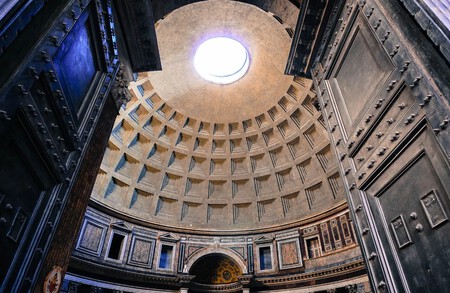
Interior of the Roman Pantheon dome
Another promising line studies permanent 3D-printed formworks: structures that function as a kind of exoskeleton that supports and protects slower-curing concretes while they reach their final properties, opening the door to designs inspired by the extraordinary longevity of historic structures such as the Roman Pantheon.
That is why, after centuries of technological advances, materials engineering has discovered that a part of the future of our roads, ports and bridges perhaps lay waiting beneath our feet. The Romans did not leave a manual of artificial intelligence, but they did leave a lesson that 21st-century researchers continue trying to decipher: how to build something that endures the passage of time.
Images | Unsplash, MIIT, Nature Science