
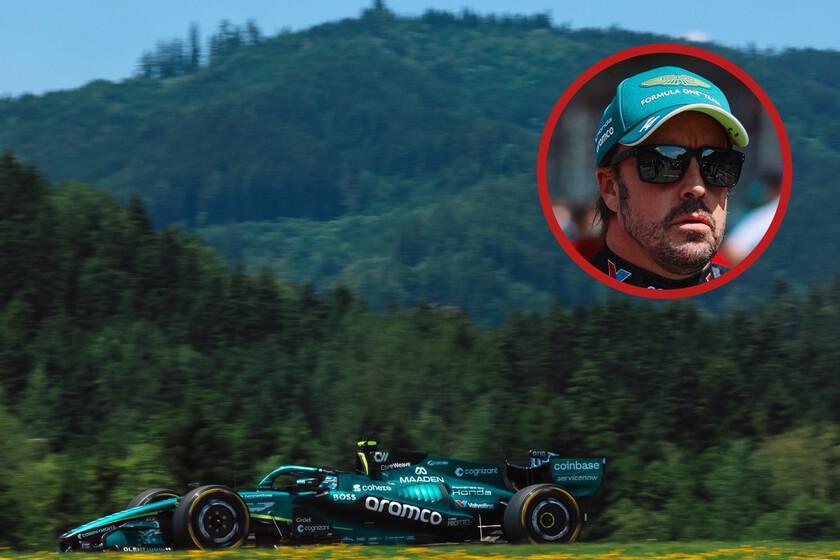
Aston Martin has already confirmed that its new upgrade package will arrive in Hungary, in three races. Fernando Alonso will be able to have the new Adrian Newey chassis and the new Honda engine, but along the way a problem arises: the two races in between could go from a formality to a farce.
Newey has chosen not to develop anything on the AMR26 until he can introduce all the upgrades at once, but the rest of the teams are indeed improving their pace. In Austria, a 4.3-kilometer circuit, Alonso was 5.79% off the best time in qualifying. In Silverstone and Spa, not beating the 107% will be a real risk.
The 107% is a very real danger for Fernando Alonso at Silverstone and Spa
For decades, albeit with a small gap in between, The 107% rule governs Formula 1. A rule that means that if you are not within roughly 7% of the performance of the fastest, you are not prepared to race because you are too dangerous, and therefore the FIA bans you from going out on track. Since HRT in 2012, this rule has not had to be applied. Until now?
Fernando Alonso, who was the fastest Aston Martin in Austria, posted a time of 1:09.942, while George Russell’s pole with Mercedes was 1:06.113. That is, Alonso was 5.79% slower than Russell at the short Red Bull Ring, a circuit of barely 4.326 kilometers in length.
This weekend Formula 1 races at Silverstone, a much longer circuit, 5.891 kilometers in length, and on top of that it is estimated that the importance of the power unit, and more specifically the battery, will be greater than in Austria. The perfect setup for Aston Martin not to surpass the 107%.

Additionally, since many teams have their factory near Silverstone, it is expected that almost all will introduce updates, something Aston Martin has already said it will not do. Nor will it do so in Belgium in two weeks, at the immense Spa-Francorchamps, the longest circuit in Formula 1, with 7.004 kilometers of length and straights that will be a torture for the Aston Martin.
It is true that in recent years when a car has not surpassed the 107% the FIA has always looked the other way and allowed it to race, but it is also true that these cases have always occurred under strange circumstances. In Aston Martin’s case, it would be pure car performance, and the FIA would have to make an extraordinary decision.
We will see if before starting to rebound to the surface in Hungary, Aston Martin does not hit the bottom of the ocean in Silverstone and Spa.
Images | Aston Martin