It has been less than four years since Chinese manufacturers such as BYD, MG or Leapmotor, and soon Xiaomi, have been advancing in Europe with affordable prices and generous equipment. However, data from the used-car market reveal a less favorable reality.
Buying a Chinese electric vehicle in Europe has proven to be a gamble with fine print. The entry price is attractive, the equipment is generous, and the finishes have improved notably in recent years. The problem arrives when it’s time to sell it.
Why do Chinese cars lose value in Europe?
In Germany, depreciation of Chinese vehicles accelerates. According to data from Deutsche Automobil Treuhand (DAT), the appraisal benchmark in Germany, Chinese-brand electric and plug-in hybrid cars retained at the start of 2024 61% of their original value. By April 2026, that figure had fallen to 47%. A drop of almost 14 percentage points in just over a year. The rest of the electrified market has also corrected, but by roughly 7 points. Chinese cars depreciate, in other words, at roughly twice the average rate.
The phenomenon isn’t exclusive to Germany, although it is measured there with more precision. Indicata data show that a three-year-old electric vehicle in the United Kingdom is worth, on average, 38% of its original price, compared with 46% retained by equivalent models in Germany, France, or Spain.

Part of the problem has origin in the commercial strategy of the Chinese brands themselves in Europe. Chinese manufacturers rely too heavily on short-term sales channels, such as rental fleets, subscription services, and even dealer registrations, which generates a flood of nearly-new vehicles entering the used market. That oversupply of second-hand stock contributes to price declines.
The most striking aspect of the case is that the accelerated depreciation is not necessarily due to a bad reputation or unreliable cars. BYD’s Blade batteries, for example, typically retain more than 90% of their capacity after three years of use. The problem is not the battery or the car itself, but the buyer’s perception.
Martin Weiss, from the DAT, notes that some rental companies now require cash compensation before accepting Chinese vehicles. “The gap in residual values is fundamentally a confidence issue,” said Christian Schüssler of Arval Germany to Automotive News. “Without stable brand confidence, there is no stable demand for used vehicles.”
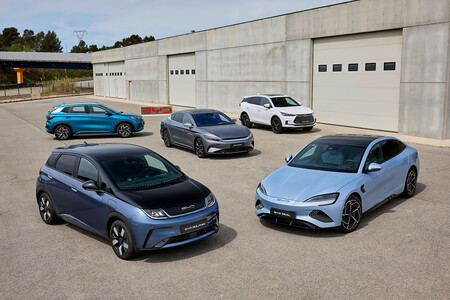
BYD’s lineup on arrival in 2023. Today, all models have been updated (more power, greater range, more equipment) or have been discontinued.
And add to this the speed of product cycles. When a Chinese manufacturer refreshes or discounts an active model, owners of older versions see their resale value drop almost immediately. It’s the same phenomenon that affected Tesla after its price cuts in 2022 and 2023, but amplified by the lack of a track record for Chinese brands in Europe. Let BYD serve as an example.
The Shenzhen-based brand officially arrived on the passenger car market in Spain in March 2023. Today, three years on, it has almost entirely refreshed its range. It no longer sells any of the models with which it began. And those that remain have improved markedly, such as the Atto 3, SEAL, or Dolphin, which now debuts a PHEV version with more than 1,000 km of range, the Dolphin G.
The market verdict, for now, is clear: Chinese cars sell well when new but sink as they age. Reversing this dynamic requires something that cannot be imported on a ship from Shanghai: history, a service network, and time.
Find your ideal electric car
If you have thought about buying an electric car, this will interest you. We have created the Personalized Electric Car Recommender, where in addition to seeing models that fit your needs you will also have answers to the questions that are most likely to worry you, such as price, range, or nearby charging points.

Looking for your next electric car but overwhelmed by so many options? It’s normal.
More than 45,000 readers have already tried it. And you?
Advice offered by the brand