
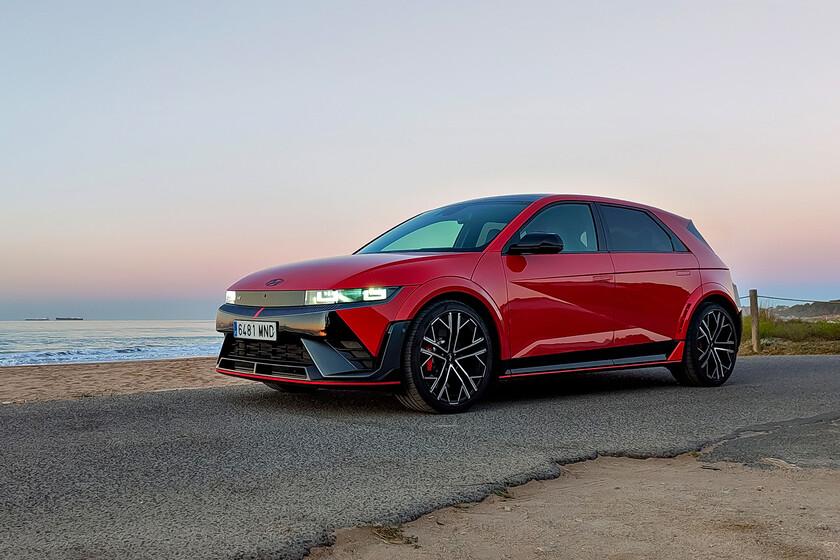
There are cars that are tested with the head and others that are tested with the guts. The Hyundai Ioniq 5 N belongs to the latter category, and that, coming from an electric vehicle, is a clear statement of intent from Hyundai.
At heart, it’s precisely what you would expect from Hyundai’s N division. Yes, it’s a 650 HP electric car, but it features a fake engine sound, a simulated gear change, and a torque vectoring distribution tuned not to be fast, but to be fun. And fun cars have to make sense.
Hyundai Ioniq 5: Beyond Logic!
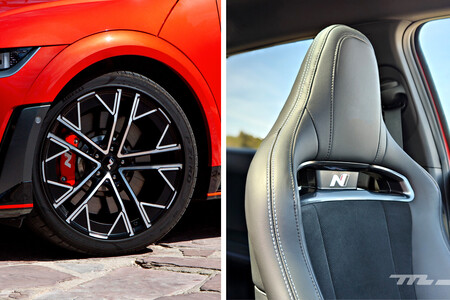
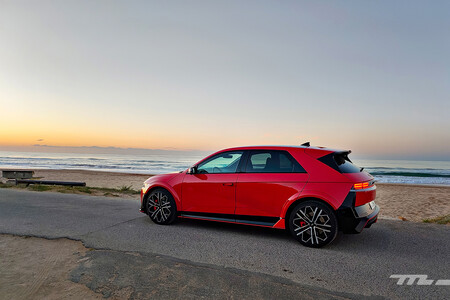
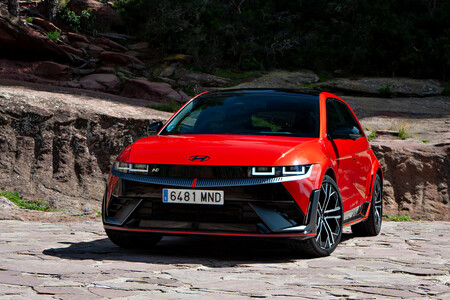
The starting premise was not exactly optimistic. Under a body with SUV ambitions lie 3 meters of wheelbase, 4.71 meters in length, and 1.94 meters in width. They are almost industrial-container proportions that neither the 21-inch forged wheels nor the bold colors (the Soultronic orange as standard or optional pastel matte blue) can fully conceal. The physics, certainly, isn’t what attracts you to this Hyundai N.
What it does sell, instead, is what happens when you press the accelerator. Two permanent-magnet synchronous motors deliver between 226 and 238 HP on the front axle and between 383 and 412 HP on the rear when the N Grin Boost is activated, that extra push of about 40 HP for ten seconds. In total, up to 650 HP.

The combined torque reaches 770 Nm, enough for a 0-100 km/h time of 3.4 seconds. The battery, 84 kWh and 800 V architecture support up to 350 kW charging, enabling a jump from 10% to 80% in eighteen minutes.
However, the most relevant technical figure isn’t any of the above, but the dozens of structural reinforcements — 42 additional weld points, more than two meters of extra structural adhesive, strengthened motor and battery mounts — that Hyundai has added to ensure this crossover can endure repeated track sessions without stressing the cells.
Thermal management keeps the battery between 30 and 40 °C in Drag Racing mode and between 20 and 30 °C in Track mode, a setup that explains why the car doesn’t lose power in long track stints, something uncommon for an EV and even more so for one weighing 2,275 kg.
Is it that good?
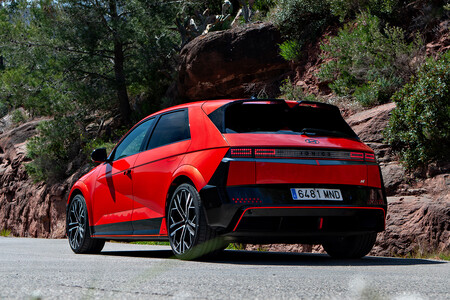
It’s on the road, preferably winding roads, where this car has left me speechless. The Ioniq 5 N impresses with a balance that nobody expects from a car of this mass: contained understeer, a precise front axle despite the lack of rear-wheel steering, and a rear that lightens under hard corners thanks to the combined work of the specific Pirelli P Zero tires and the rear electronic limited-slip differential e-LSD. Braking, despite an initial soft bite, holds up well under heavy use.
But the real star is the N e-Shift, the gear-shift simulator that Hyundai developed to mimic, with surprising fidelity, the sensations of a petrol-powered car.
The sound, which imitates a turbo four, is fairly convincing and its intensity can be adjusted from the cockpit. Exterior speakers, though too discreet, also signal that this car isn’t just any Hyundai.
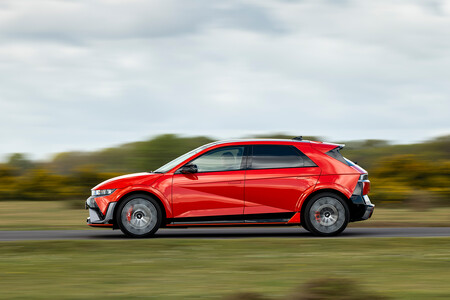
And then the improbable happens: the few vibrations and the rev climbs, though artificial, give the sensation of piloting a gasoline car. There is a virtual fuel cut at 7,700 rpm that interrupts acceleration, LEDs indicate when to shift gear. The shifts are more or less abrupt depending on how hard you push the accelerator.
You can even accelerate in neutral and reach the cut. In short: this Hyundai has everything of a big-displacement GTi. The system is so well executed that Porsche has decided to copy it in its electric cars, starting with the recently updated Taycan.
The catalog of acronyms doesn’t end there. The NTD distributes torque between axles in eleven levels, the NAS+ adjusts the intensity of the synthetic sound, and the NRS reads road signs to suggest Sport mode as curves approach along the road section we’re on. Too many features, as the manufacturer itself concedes, for every driver to tailor “their” Ioniq to perfection.
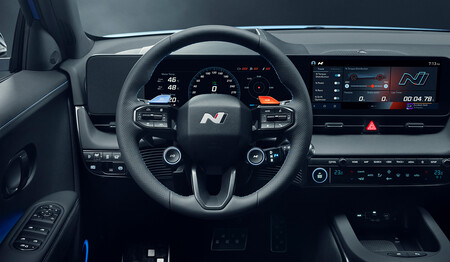
The flip side of so much customization is a menu interface that isn’t intuitive and some incompatibilities between programs: you can’t use variable torque distribution and the gear-shift simulator at the same time, for example, and the N Pedal in its most aggressive level borders on rough.
All in all, the balance is clearly favorable. The Ioniq 5 N isn’t aiming to thrill by itself—the basic mechanics of an EV will never replicate internal combustion—but it achieves that by applying engineering to pleasure: a fake gear-change that feels real, a thermal management system that can take on the circuit, and dynamic behavior that makes you forget you’re piloting a 2.2-ton creature. It is probably the first EV capable of convincing those who still prefer the gasoline engine.
And how is it as a daily car?
Well, like any electric. It’s by no means bothersome in city or highway driving and demands little from the driver. Turning off the sounds makes it as quiet as any other Ioniq 5, and even the suspension, unlike a MINI John Cooper Works Electric, isn’t uncomfortable.
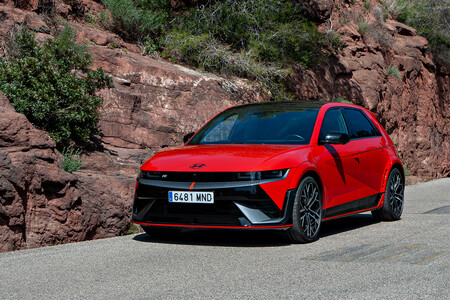
As with the rest of the Ioniq 5 range, the cabin is very spacious and roomy, especially in the rear seats. In the front seats there are sporty touches, with bucket seats being the most evident.
They are comfortable and it’s easy to find a good driving position. But the interior does not skimp on storage space or comfort, and no driver-assistance or connectivity features are sacrificed (Android Auto and Apple CarPlay compatibility).
As an electric car, however, its only truly improvable point is consumption. Like a high-displacement gasoline sports car, energy usage is high. Almost 27 kWh per 100 km in sporty driving (range 314 km) and an average of 23 kWh/100 km on the highway at legal speeds for a WLTP range of 365 km with a single charge, which practically means about 300 km from 10% to 80% battery. Fun has its price.
And not only in range, also in the literal sense. The car starts at 78,000 euros, but there are few options beyond body colors, as the standard equipment is ultra-complete.
Hyundai Ioniq 5 N: Our Evaluation
7.9
7.0
9.0
7.0
8
8
8
8
9.0
8
7
Pros
- Dynamic behavior
- Highly rewarding to drive
- Performance
- Practicality
Cons
- Electric range
- Consumption
The Hyundai Ioniq 5 N is the best electric car I’ve had the chance to test. It remains too heavy (the physics and chemistry of batteries are what they are), the interface is still a bit convoluted, and in my view it doesn’t convey enough emotion, but Hyundai achieves what no other manufacturer—not even Tesla, BMW, or Porsche—had managed: turning a technology many equate with an appliance into a compelling sales argument. With an extraordinarily accomplished dynamic feel—it’s even better than a Tesla Model 3 Performance—and the simulated gearbox, the 5 N becomes a true machine of fun.
|
|
|
|
Engine |
Two permanent-magnet synchronous electric motors, one per axle. |
|
Battery |
Lithium-ion, 84 kWh capacity |
|
Maximum power |
609 CV (650 CV with the N-Grin Boost) |
|
Maximum torque |
770 Nm |
|
Drivetrain |
All-wheel drive |
|
Dimensions (L x W x H) |
4,715 x 1,940 x 1,585 mm |
|
Wheelbase |
3,000 mm |
|
Boot |
480 liters |
|
Weight |
2,275 kg |
|
80 to 120 km/h |
1.9 s |
|
0 to 100 km/h |
3.5 s |
|
Top speed |
260 km/h |
|
WLTP economy |
21.2 kWh/100 km |
|
Empr. consumo in test |
22.5 kWh/100 km |
|
WLTP range (electric) |
448 km |
|
Real-world range (test) |
375 km |
Find Your Ideal Electric Car
If you’ve considered buying an electric car, this will interest you. We have created the Personalized Electric Car Recommender, where in addition to seeing models that fit your needs you’ll also get answers to the questions that concern you most, such as price, range, or nearby charging points.
|
The car used for this test was provided by Hyundai. For more information, see our corporate relationships guide. |

Looking for your next electric car and feeling overwhelmed by so many options? It’s normal.
More than 45,000 readers have already tried it. And you?
Advice offered by the brand