
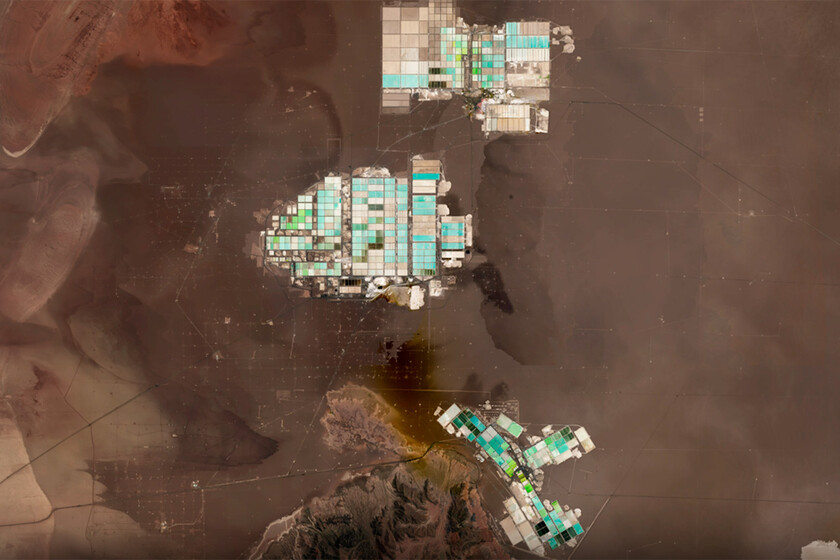
From space, a satellite view, it looks like an abstract painting: a mosaic of geometric shapes in tones of electric blue, neon green, or bright yellow that contrast with the desert’s dull color palette of the Atacama.
It is the evaporation ponds of the Salar de Atacama, Chile’s largest salt flat, which supplies a large share of the world’s lithium—the coveted “white gold” essential for batteries for electric cars. The hypnotic spectacle of how their colors change over the year is shown by NASA with these images. But it also helps to understand one of the biggest contradictions of decarbonizing transport: the process used is wrecking ecosystems.
What the color palette seen from space hides
Since the 1980s, lithium has been extracted at the Salar de Atacama, located in the Antofagasta region, to the north of Chile, within the traditional territory of the Atacameño indigenous people. NASA, in collaboration with the Earth Resources Observation and Science Center (EROS), has documented this process with satellite images of the HLS sequence (Harmonized Landsat and Sentinel-2), captured in natural color that show the salar between March 2025 and February 2026. The color changes reveal the evaporation of the lithium ponds during that period.
The Atacama Desert is the driest non-polar desert on Earth and one of the harshest places on the planet: each year, rainfall is measured in mere millimeters. It therefore harbors the ideal conditions for lithium extraction.

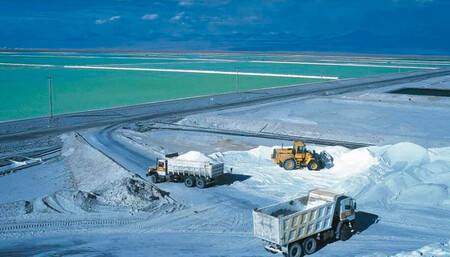
The extraction of lithium from brine begins with drilling into the salt flat to access underground brine deposits rich in lithium. This brine is pumped to the surface into these open ponds, where the water evaporates thanks to the hyper-arid desert environment and the intense solar radiation. The evaporation lasts for months, but the water is naturally lost, concentrating lithium progressively.
And at a snail’s pace, it means that millions of liters of brine are pumped daily to feed the pools. And during the process more than 90% of the initial volume evaporates. Once the lithium concentration is sufficient, it moves to chemical treatment plants to remove impurities and transform it into the compound used in battery production.
A process that is draining ecosystems
The problem is that relying on this method of extracting brine by pumping and drying in ponds is becoming the subject of intense environmental controversy due to its impact on sensitive ecosystems.
A recent report prepared by several human rights organizations and research observatories in Chile, Argentina, and Bolivia (the so-called lithium triangle in the high-Andean salt flats of these three countries) concludes the dire consequences of lithium mining in this region. In particular, it has caused an irreversible and irrecoverable loss of water.
“The information we gathered in our study shows that the impact of lithium mining on water is enormous,” says José Aylwin, coordinator of the Globalization and Human Rights Program of OC and lead author of the analysis. “It is estimated that producing one ton of lithium carbonate, with the technology currently used at the Salar de Atacama, requires, on average, the evaporation of half a million liters of brine water.”
Additionally, another study reveals that this extraction method is sinking the salar at a rate of 1 to 2 centimeters per year. Or that groundwater levels have dropped more than 10 meters in the last 15 years. The impact on habitats key to species such as the vicuña or the Andean flamingo is added.
The environmental price of the electric car
The solution, experts detail, lies in turning to technologies that reduce water use. For example the Direct Lithium Extraction (DLE by its English acronym), which allows obtaining the mineral with chemicals rather than through the slow evaporation in water-intensive ponds. Although this technology has begun to be introduced in some operations within this lithium triangle, it is still in the minority. The dominant model remains pumping and evaporation.
Concerns from other communities whose lands have not been exploited, is that if more sustainable methods are not adopted, they will end up suffering the same as the areas where these operations are located, with vegetation loss, lagoons and groundwater depletion.
Thus, while there is a push to reduce fossil fuel emissions—the main culprits of global warming—the demand for critical minerals is leaving an irreversible physical footprint in other parts of the world. We are witnessing a harsh paradox: cutting emissions in major cities is coming at the expense of destroying fragile ecosystems and groundwater near the surface.
Find your ideal electric car

If you have considered buying an electric car, this will interest you. We have created the Personalized Electric Car Recommender, in which, besides seeing the models that fit your needs, you’ll also get answers to the questions that most worry you, such as price, range, or nearby charging points.

Looking for your next electric car and feeling overwhelmed by so many options? That’s normal.
More than 45,000 readers have already tried it. What about you?
Advice offered by the brand