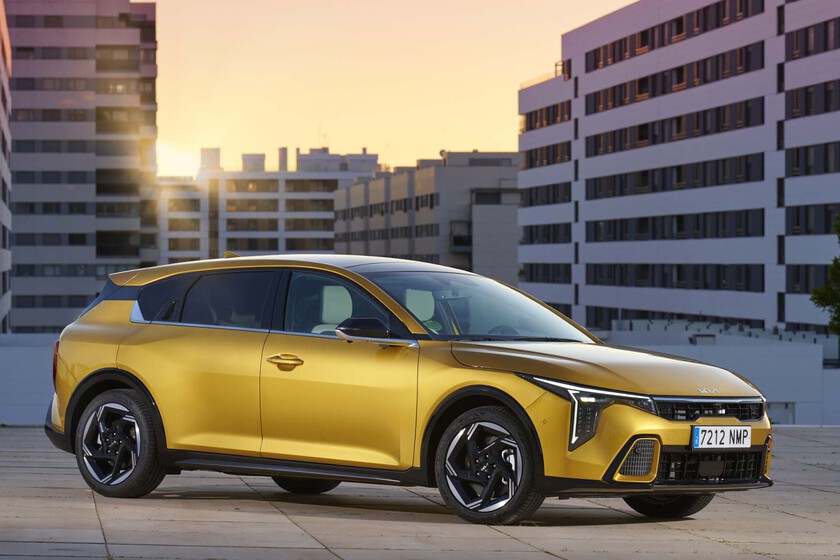
Kia says goodbye to the Ceed and brings to Europe the Kia K4, a compact car built in Mexico and making its debut in Spain with two engines: a 115 HP MHEV petrol and a 1.6 turbo petrol with 150 HP or 180 HP.
It is already on sale in three trim levels, with plenty of interior space and the logic that many current cars have lost.
A compact with the ambitions of a full-size car
There’s something that happens a lot lately: people with cars that are 15 or 20 years old decide to buy a new one, and when they look at the market they feel overwhelmed and don’t know where to start.
Why? Very simple, because cars sold today are nothing like those from three or four decades ago and they look like spaceships to them: multiple electrification options, giant touchscreen displays, interiors that practically have no physical buttons and a suite of driver-assistance features that feel too intrusive and make driving feel artificial. Not to mention that most cars sold today are SUVs, and many of the non-SUVs have SUV-like traits and are considered crossovers.

All of this makes things much more complicated, and someone looking to replace their Volkswagen Golf 2.0 TDI from 2005, their Ford Focus 2.0 TDCi from 2005, or their Opel Astra 1.4 16V from 2007 with something similar doesn’t have an easy task, simply because there are fewer similar models left. That said, it’s not all lost yet because there are still some options, and Kia has just launched a car we can refer to as “a traditional compact” that can do absolutely everything.
The Kia K4. In Kia’s lineup it occupies the gap left by the Ceed (only the XCeed will continue to be sold, and it will be renewed soon) and we can consider it an alternative to the Sportage for anyone who does not want an SUV, nor electrification (or electrification in the right measure, depending on the engine chosen).
And yes, although it is a compact, it is very large because it measures 4.44 meters in length, surpassing rivals such as the SEAT León (4.37 m), the Volkswagen Golf (4.28 m) or the Opel Astra (4.37 m), though it is still far from the Honda Civic and its 4.56 m length.
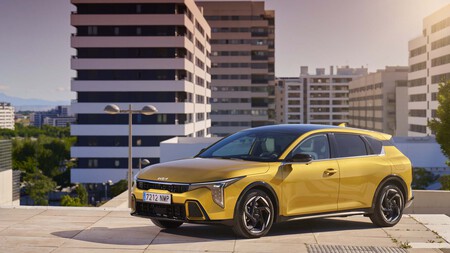
If we talk about the design, on the outside as well as inside, it follows the design language set by Kia’s recent launches, including its electric cars. That means the interior is fully digital, in fact, it features three displays: a 12.3-inch digital instrument cluster, another 12.3-inch central touchscreen, and a third 5.3-inch screen between them for the climate controls.
However, unlike more and more cars that rely entirely on screens and touch controls, the K4 sticks with normal buttons: for the climate control, on the steering wheel, to access key multimedia functions, or to adjust the mirrors.
View this post on Instagram
In part, thanks to this, it is easy to understand and use because there is nothing to complicate the driver’s life. Also, everything is within reach, visibility is good in all directions, and the driving position is comfortable.
Everything makes sense and is functional, and those two things aren’t so common nowadays. It’s also notable the absence of piano-black plastics; it took effort, but it seems brands have understood that it isn’t the best idea.
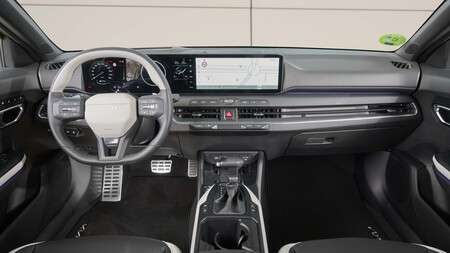
And it shows well in terms of quality. It’s on par with the Niro, but it doesn’t reach the level of the Sportage, both in materials used and in their fit and finish, yet it is very close to its SUV sibling and fully meets expectations: it gives the impression of being built to last and to withstand the test of time.
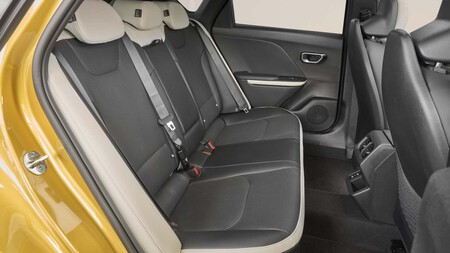
It has plenty of space. That’s one of the advantages of being so large on the outside. Behind, two tall adults can ride comfortably because there is lots of headroom, shoulder room, and especially legroom. The center seat, as is typical in this segment, is narrow, but it does the job in a pinch and works fine for a child.
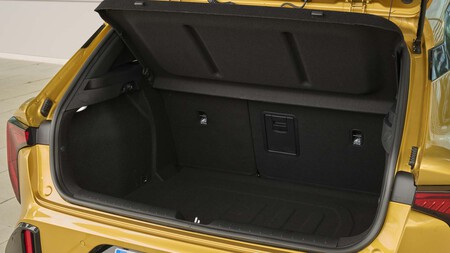
The trunk, with 438 liters of capacity, is directly one of the best in the segment. And it’s not just large: the loading mouth is wide and the design is very regular, so it’s quite usable, even perfectly suited for a family trip with luggage.
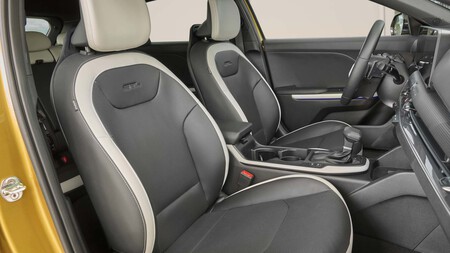
If more space is needed, the rear seat backrests can fold down in a 40/60 split and in the center (at the height of the rear armrest) there is a hatch to load long items, such as skis.
That said, if you opt for the mild-hybrid version, the trunk reduces to 328 liters: with this powertrain you gain the DGT ECO badge, but you lose 110 liters of capacity to make room for the hybrid system’s battery, which sits right under the floor and, by the way, leaves a lot of empty space around it, so it isn’t very well integrated; at least, those gaps can be used to store smaller items.
Kia K4: this is how it drives
The logic and practicality are also evident behind the wheel. At the first test drive I got to sample a K4 in the base Drive trim, the 115 HP 1.0 TGDi MHEV engine and a six-speed manual, and a K4 GT-Line with the 1.6 TGDI 180 HP engine and automatic transmission.
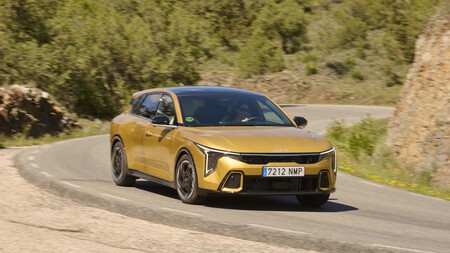
The two share the ease of use because there’s no need to worry about issues that are increasingly common in modern cars, such as managing a hybrid system or energy recovery through regenerative braking. I’d say it’s as simple as inserting the key, starting up, and driving, like in traditional cars, but the start is keyless, so that’s one thing you save.
The 115 HP 1.0 TGDi MHEV might seem insufficient for such a large compact, but it’s actually enough. You won’t be the fastest merging onto the highway, and when you overtake you’ll need to be sure, because with this engine the K4 isn’t a rocket, but it moves with enough ease, both in the city and on the highway: thanks to the turbo, this three-cylinder meets expectations, provided you use the gear changes appropriately.
Be aware, with this engine and gearbox, the car needs 12.2 seconds to accelerate from 0 to 100 km/h, so you must be clear that you can’t demand miracles. You won’t have any solvency problems in any situation, but it isn’t the quickest compact, especially when fully loaded.
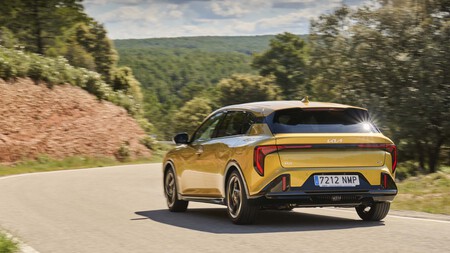
It’s a pleasant engine (it vibrates and sounds surprisingly little for a three-cylinder), it benefits from the ECO badge and is the most affordable option in the range. Moreover, it uses little fuel: on a route that mixed city streets, secondary roads, and some highway, the average was 5.8 l/100 km. Since the petrol tank holds 47 liters, the range is good and you don’t have to stop every two by two to find a gas station when you go on a trip.
With that in mind and given that it feels like a larger car on the highway because it sits very settled, is well damped and very comfortable, we’re looking at one of those compact cars you can travel long distances in, although for this purpose the 1.6 TGDi petrol (obviously) goes better.
In the K4, this four-cylinder engine is available with 150 HP and with 180 HP, always with the automatic DCT. It’s even smoother and more pleasant than the 1.0 TGDi, and the 180 HP variant offers more than decent performance, accelerating from 0 to 100 km/h in 8.4 seconds and reaching 210 km/h.
It isn’t sporty by nature (and the car’s setup is very comfort-focused), but it’s a motor that pushes well and the seven-speed automatic also works smoothly and pleasantly.
The downside is that fuel consumption is higher than with the 1.0, and it’s easy for the average to exceed 7 l/100 km. It also doesn’t have the ECO badge and wears the C badge, but, realistically, not everyone needs the ECO sticker or zero-emission status: many drivers don’t live in big cities, and the C badge is enough in most of Spain.
Price of the Kia K4
Nor does the price help this version. With Kia discounts, the Kia K4 is available from 26,250 euros with the 1.0 TGDi MHEV 115 HP engine, manual transmission, and the Drive trim. The good news is that this trim is well equipped as standard: 16-inch alloy wheels, electrically foldable mirrors, Apple CarPlay and Android Auto wired-free, light sensor, keyless entry and start, front and rear parking sensors, electric parking brake, and a rear camera, among other things.
With this Drive trim, the same engine and the DCT, it is available from 27,250 euros and with the 1.6 TGDi 150 HP engine and the automatic DCT starts at 29,250 euros.
Above that is the Tech trim. In this case, the 1.0 TGDi MHEV with manual starts from 27,550 euros and 28,550 euros with the automatic, while the 1.6 TGDi 150 HP with automatic has a base price of 30,550 euros.
The top of the range is the GT-Line. Here there are two options: the 1.0 TGDi MHEV 115 HP only with automatic, starting from 31,350 euros, and the 1.6 TGDi 180 HP with the DCT, which starts at 34,350 euros. Later a wagon-bodied variant of the K4 will join the lineup.
Images | Kia